
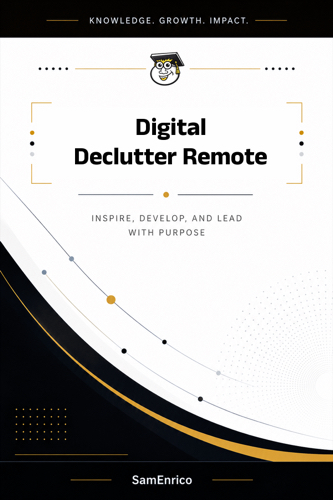
Digital Declutter Remote eBook
Organize files, tabs, and notifications for faster
Organize files, tabs, and notifications for faster task switching.
Formats
Free sample
Chapter 1: The Fifty-Nine Minute Thief--The spreadsheet was named final_v3_REALLYfinal_USETHISONE.xlsx.You have been looking for it for ninety seconds. Your manager’s face hovers in a Zoom window, patiently waiting. Two Slack messages buzz in the background—one from a colleague asking for a “quick sync,” another from a bot reminding you of a meeting that started three minutes ago. Your cursor dances across the screen, opening and closing folders: Downloads, Desktop, Documents, then back to Downloads again. The file is not there.
You try searching “budget.” Forty-seven results appear, none of them correct. You try “Q3.” Twenty more. Your heart rate climbs. Your manager asks, “Do you have that number for me?” and you hear your own voice say, “One second, just pulling it up,” even though you have absolutely no idea where the file is.This moment—this specific, grinding, humiliating moment—is not your fault. But it is your problem.Welcome to the hidden economy of digital clutter.
Every remote worker pays into it daily, but almost no one tracks the withdrawal. The average knowledge worker loses fifty-nine minutes per day to precisely this kind of friction: hunting for misplaced files, switching between applications, recovering from interruptions, and untangling the mess of tabs, notifications, and half-organized folders that passes for a modern digital workspace. Fifty-nine minutes. That is nearly ten hours per week. That is four hundred and ninety hours per year.
At a conservative consulting rate of fifty dollars per hour, that is twenty-four thousand five hundred dollars of lost value per knowledge worker annually.And that is the conservative estimate.The Mathematics of Interruption Let us start with a number that will haunt you: five minutes.This is the average time required to return to full cognitive depth after an interruption of any kind. The research comes from Gloria Mark at the University of California, Irvine, who has spent two decades studying attention in the workplace. Her team placed timers on knowledge workers and measured exactly how long it took them to return to a focused state after being interrupted—by an email, a Slack message, a phone call, or a self-interruption (checking the news, opening a new tab, looking for a file). The answer, consistently, was approximately twenty-three minutes to resume the same task at the same depth of focus.Twenty-three minutes.That is not a typo. A ninety-second interruption costs you nearly half an hour of productive time.
The mechanism is neurological: attention is not a light switch that flips on and off. It is more like a pot of water coming to a boil. When you are focused, your brain enters a state of “flow” characterized by high theta and alpha wave activity, reduced activity in the default mode network (the brain’s “daydreaming” system), and increased connectivity between task-relevant regions. This state takes time to achieve—typically ten to fifteen minutes of uninterrupted work. And when you are interrupted, the pot does not simply cool slightly.
It returns to room temperature. You have to start boiling again from scratch.Now multiply that twenty-three minutes by the number of daily interruptions. The typical knowledge worker is interrupted every three to five minutes, according to Mark’s research. That means you are spending most of your day in a state of cognitive recovery, not in a state of productive work. You are not “busy.” You are fractured.I use the round number five minutes in this chapter not to contradict Mark’s research but to make the math accessible.
Five minutes of recovery per interruption is a conservative, easy-to-remember estimate. The actual number, depending on task complexity and individual differences, ranges from three to twenty-three minutes. But even at five minutes per interruption, the arithmetic is devastating.Consider a typical remote workday. You start at 9:00 AM. By 9:03 AM, you have checked email.
By 9:07 AM, a Slack notification pulls you away. By 9:12 AM, you open a new tab to “quickly” check the news. By 9:17 AM, you cannot find a file and spend ninety seconds searching. By 9:22 AM, you have recovered from the file search—or so you think. In reality, you are still shallow.
This pattern repeats until 5:00 PM. By the end of the day, you have spent more time recovering from interruptions than doing focused work. And you feel exhausted, not because you worked hard, but because your brain spent all its energy context switching instead of producing.The Remote Double Whammy The fifty-nine minute figure and the five minute recovery cost are bad enough in a traditional office. But remote work introduces a unique multiplier effect: the Remote Double Whammy.Here is what that means. In a physical office, your work computer and your personal computer are typically separate devices.
Your work data lives on one machine, behind a firewall, in a set of folders you only access during business hours. Your personal data lives on another machine, or on your phone, or in your home. There is a physical boundary between work and life. That boundary is not perfect, but it exists. You have to literally walk away from your desk to cross it.Remote work erases that boundary.
Your work laptop sits on the same desk—sometimes the same physical surface—as your personal devices. Your work files live in the same Downloads folder as your child’s birthday party video. Your work Slack sits one click away from your personal Instagram. Your work calendar shares a screen with your personal reminders. There is no firewall.
There is no commute. There is no physical ritual of leaving the office.This collapse of boundaries creates two specific problems that compound each other.First, context bleeding. Because your work and personal data are intermingled, your brain never fully disengages from either domain. You might be writing a work report when a personal notification pops up—“Your Amazon package has shipped.” You might be planning a family vacation when a work Slack pings—“Urgent: client needs revision by 2 PM.” Each switch between work and personal domains is not just a standard context switch. It is a domain switch, a concept we will explore in depth in Chapter 11.
Domain switches cost significantly more cognitive energy than switching between two work-related tasks because your brain must reorient its entire value system, goals, and emotional context. Switching from Excel to Instagram is not the same as switching from Excel to Power Point. One is a shift in tools. The other is a shift in identity.Second, permanent availability. In an office, leaving the building signals to your brain—and to your colleagues—that the workday is over.
Remote work offers no such signal. Your laptop is right there, always. Your email is always two clicks away. Your Slack is always buzzing. The result is a phenomenon called “telepressure”: the compulsive urge to check work messages outside of work hours.
Telepressure is not just annoying. It is physiologically costly. Studies show that people with high telepressure have elevated cortisol levels, worse sleep quality, and higher rates of burnout, even when they are not actually working more hours. The mere anticipation of a work notification is enough to keep your stress response activated.The Remote Double…
This is the end of the free sample. Get the eBook to keep going. Buy now
About this book
Details
- Author
- Smoot Genevive
- Publisher
- SamEnrico
- Language
- English
- Genre
- Non-Fiction, Self-Help, Digital, Declutter
- Released
- 2026-06-09
- Pages (approx.)
- 137
- Available as
- eBook, Audiobook

Read better in the ZLOADR app
Your eBooks on your phone or tablet. Sign in with your SamEnrico account and start reading.
More by Smoot Genevive
 Saint Francis Joyful AsceticSmoot Genevive$11.99
 Dental Daubert ChallengesSmoot Genevive$11.99
 Teresa's Last IllnessSmoot Genevive$11.99
 The Sudden Severe Headache GuideSmoot Genevive$11.99
 The Forgotten Knights of the Hardwood: Japan's First Basketball CrusadeSmoot Genevive$11.99
 How to Start a Fire Tender Business (Beginners Guide)Smoot Genevive$11.99
 Local to Global PivotSmoot Genevive$12.99
 DataCamp Career Tracks ReviewSmoot Genevive$12.99
 AI-Driven Platform Development BusinessSmoot Genevive$11.99
 Learn to Play the TsuzumiSmoot Genevive$11.99