
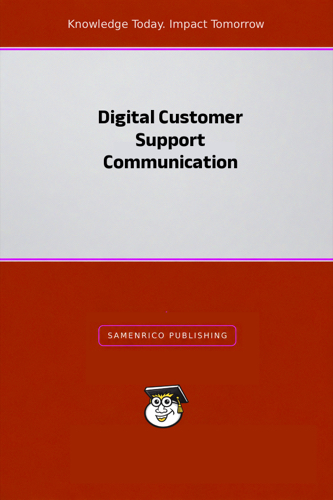
Non-FictionSelf-HelpCustomer Support
Digital Customer Support Communication eBook
Handles tickets, chats, and emails effectively.
Handles tickets, chats, and emails effectively.
Formats
Free sample
Chapter 1: The Effort Mandate--–- In a crowded food court in suburban Chicago, two customers experienced the exact same product failure on the same afternoon. Both bought a pair of wireless earbuds that stopped charging after three weeks. Both called the same support line. Both spoke to agents with the same training manual. One hung up furious, vowing never to buy from that brand again.
The other became a loyal advocate who recommended the product to seven friends within a month. The difference between these two outcomes had nothing to do with the product defect. It had nothing to do with refund amounts or shipping speeds. It had everything to do with a single, often-misunderstood variable that most support organizations still fail to measure, let alone optimize: customer effort.This book is about digital customer support communication—specifically, how to handle tickets, chats, and emails in a way that transforms frustrated strangers into loyal advocates. But before we dissect the mechanics of macros, the etiquette of live chat, or the architecture of ticket routing, we must first understand the fundamental shift that makes this book necessary.
The old rules of customer service—"smile and dial," "be polite," "satisfy the customer"—are dying. In their place, a new mandate has emerged, one that is both simpler and more difficult than anything that came before. The mandate is this: Make it easy.This chapter establishes the foundational thesis upon which every subsequent chapter is built. Drawing from decades of research including the landmark The Effortless Experience by Matthew Dixon, Nick Toman, and Rick De Lisi, we will explore why reducing customer effort is the single most reliable predictor of loyalty in the digital age. We will contrast the old world of call centers with the new reality of asynchronous, multi-channel digital support.
We will break down the economics of tickets, chats, and emails. And we will confront an uncomfortable truth that most support leaders avoid: the metrics you are probably using to measure success are actively destroying customer loyalty. By the end of this chapter, you will understand why a "fast but wrong" answer creates more churn than a "slow but complete" one—and why the digital customer demands a fundamentally different approach than their voice-only predecessors.The Psychology of the Digital Customer To understand how to serve digital customers, you must first understand who they are and how they think. The digital customer is not merely a call center customer who happens to be typing instead of talking. That assumption—that channels are interchangeable—has led to more failed support transformations than any other single error.
The digital customer operates under a different psychological framework, shaped by three distinct forces: impatience, information asymmetry, and the absence of vocal tone.Impatience Is Not a Character Flaw; It Is a Feature of the Medium When a customer calls a traditional call center, they have already made a significant psychological investment. They have dialed a number, navigated an IVR menu, listened to hold music, and surrendered control of their time. By the time they reach an agent, they have committed to the interaction. They will wait because they have already waited.The digital customer makes no such commitment. They send an email while waiting for coffee.
They open a chat window during a meeting they were already ignoring. They tweet at a brand while watching television. Their attention is fragmented, their patience thin, and their switching costs near zero. If your email auto-reply takes six hours, they have already contacted a competitor. If your chat agent takes forty-five seconds to respond, they have already closed the window.
Research cited in The Effortless Experience suggests that the average digital customer expects a response within four hours for email and thirty seconds for chat. But expectation is only half the story. The more important dynamic is that digital customers do not perceive waiting as "the cost of doing business." They perceive it as a failure of the brand to respect their time.The Informed Customer Is the Most Dangerous Customer Twenty years ago, customers called support because they needed information. The agent held the knowledge. Today, that power dynamic has inverted.
The digital customer has almost certainly already searched your knowledge base, read your help center articles, watched a You Tube tutorial, and scrolled through Reddit threads about your product. They are not calling because they lack information. They are calling because the information they found was contradictory, incomplete, or required an action only you can take.This creates a unique psychological dynamic. The digital customer arrives pre-frustrated, having already invested effort in self-service. They are not grateful to reach you; they are annoyed that you forced them to reach you.
Your first interaction with them is not a fresh start—it is the culmination of a failed self-service journey. As we will explore in Chapter 3, this is why the best ticket is the one never written. But for the purposes of this chapter, the key insight is this: the digital customer's effort clock starts ticking long before they contact you. By the time they submit a ticket, they have already expended effort. Your job is not to provide information.
Your job is to stop the bleeding.The Silence of the Screen Perhaps the most significant difference between voice and digital support is the absence of paralinguistic cues—tone, pitch, volume, and pacing. On a phone call, an agent can hear hesitation, frustration, or relief. They can modulate their own voice to convey empathy. They can interrupt a rambling customer to redirect the conversation. None of this is possible in text.The digital customer cannot hear your smile.
They cannot hear your sincerity. They cannot tell the difference between an agent who is frantically researching their issue and an agent who is scrolling through social media. Every typed word is stripped of context and vulnerable to misinterpretation. A neutral statement like "I understand your concern" can read as dismissive. A factual statement like "Our policy states otherwise" can read as hostile.
The digital support agent is not just solving problems; they are performing emotional labor through the thinnest possible medium. This is why Chapters 7, 8, and 9 of this book are devoted entirely to the craft of written empathy, de-escalation, and explanation. Without these skills, digital support is not support at all—it is a liability.The Death of Satisfaction as a Metric For decades, customer satisfaction scores (CSAT) have been the reigning monarch of support metrics. After every interaction, customers are asked: "How satisfied were you with your experience?" High scores meant happy customers. Happy customers meant repeat business.
The logic seemed unassailable. It was also wrong.The Corporate Executive Board (CEB), now part of Gartner, conducted a massive study of more than 75,000 customer interactions across industries. The findings, published in The Effortless Experience, upended decades of conventional wisdom. The researchers discovered that satisfaction is a poor predictor of loyalty. Customers who reported being "very satisfied" with a support interaction were still likely to churn.
They were still likely to complain to friends. They were still likely to switch to a competitor the next time they had a choice.Why? Because satisfaction measures the wrong thing. When a…
This is the end of the free sample. Get the eBook to keep going. Buy now
About this book
Details
- Author
- Adcock Elisabeth
- Publisher
- SamEnrico
- Language
- English
- Genre
- Non-Fiction, Self-Help, Customer Support
- Released
- 2026-06-06
- Pages (approx.)
- 159
- Available as
- eBook, Audiobook

Read better in the ZLOADR app
Your eBooks on your phone or tablet. Sign in with your SamEnrico account and start reading.
More by Adcock Elisabeth
 Flow in Surgery MedicineAdcock Elisabeth$11.99
 Canva Brand Launch ChecklistAdcock Elisabeth$11.99
 Cherry Blossom GardenAdcock Elisabeth$11.99
 The Senior Doctor Visit GuideAdcock Elisabeth$11.99
 Self Talk Rewiring CourseAdcock Elisabeth$11.99
 Self Hypnosis for Tennis ElbowAdcock Elisabeth$11.99
 Peaceful Forest Visualization GuideAdcock Elisabeth$11.99
 The Phantom of Verdun: Pétain's Flesh GrinderAdcock Elisabeth$11.99
 The Eagle and the Fox: Scipio Africanus and the Art of Roman StrategyAdcock Elisabeth$11.99
 How to Produce Pipe Joint PrimerAdcock Elisabeth$11.99
 How to Produce Hypo-allergenic DetergentAdcock Elisabeth$11.99
 Business Credit for Ecommerce SellersAdcock Elisabeth$12.99
You may also like
 Hong Kong Handover 1997Dunn Johnnie$11.99
 Zumba For Postnatal Recovery CourseNeal Christian$11.99
 Zumba for BeginnersLadner Nikia$11.99
 YouTube Comment Mining GuideHumes Pandora$12.99
 Worry Box MeditationCarlin Rudy$11.99
 Workplace Stress MeditationNguyen Lynn$11.99
 Workplace Stress and Sleep RepairHawley Ivory$11.99
 Workplace Perfectionism CureDelaney Jeffry$11.99
 Workplace Injustice Anger GuideWallen Isabelle$11.99
 Work Addiction and Burnout LinkGreenwood Ester$11.99
 Women in Yoga and WellnessBeattie Galina$11.99
 Women in Stand Up ComedyChun Evangeline$11.99