
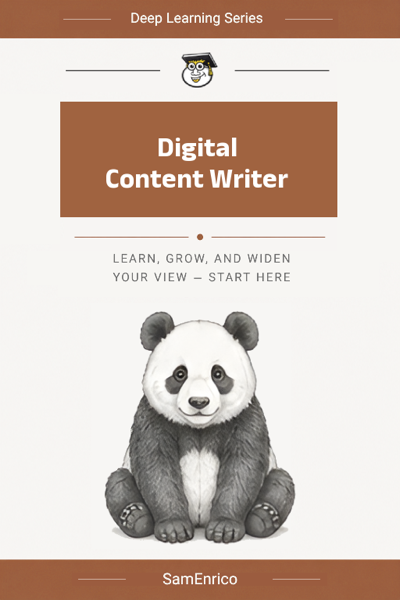
Digital Content Writer eBook
A Coursebook on Digital Content Writer
by Hope Brittny
A Coursebook on Digital Content Writer
Formats
Free sample
Chapter 1: The Scalable System--–- Most new writers believe they have a talent problem. They sit in front of a blinking cursor, hands hovering over the keyboard, and whisper to themselves: I’m just not a good writer. Or worse: I don’t have the gift. They read a beautifully crafted essay or a viral Linked In post and assume the person who wrote it was visited by a muse in the middle of the night. They imagine that great writing flows out of great writers like water from a spring—effortless, pure, inevitable.That is a lie.
And it is the most expensive lie you will ever believe.The truth—the uncomfortable, unglamorous, utterly liberating truth—is that digital writing is not a talent. It is a system. And systems can be learned, practiced, debugged, and scaled. The difference between a writer who struggles to book a single 50clientandawriterwhocommands50 client and a writer who commands 50clientandawriterwhocommands500 per blog post is not a mystical gap in ability. It is a gap in process.
The former writes when inspiration strikes. The latter writes on demand, for any audience, about any topic, because they have built a repeatable machine for solving problems with words.This chapter dismantles the myth of the tortured artist and replaces it with something far more useful: the mindset of a growth strategist. You will learn why most digital content fails (it has nothing to do with grammar), the five levels of content creators (and which level is currently keeping you poor), and the single cognitive bias that destroys otherwise smart writers. By the end of this chapter, you will never look at a blank page the same way again.The Myth of the Natural-Born Writer Let me tell you about the first time I got paid to write. I was twenty-two years old, freshly graduated with an English degree that had taught me how to analyze Paradise Lost but not how to write a subject line that anyone would open.
A local business owner offered me fifty dollars to write five blog posts about HVAC maintenance. I had never changed an air filter in my life. I did not know what HVAC stood for. I spent twelve hours on the first post, agonizing over every sentence, convinced that my lack of “talent” for heating and cooling systems meant I was a fraud.That post got seventeen views. Seventeen.
My mother accounted for three of them.I assumed the problem was me. I assumed I simply wasn’t a “natural” writer for industrial topics. It took me another two years and dozens of failed projects to realize the truth: I didn’t have a system. I was treating every piece of content as a unique snowflake, hand-crafted from scratch, rather than a repeatable solution to a predictable problem. The HVAC post failed not because I lacked talent, but because I had no framework for understanding what the reader actually wanted.Here is what the reader wanted: How do I stop my air conditioner from making that noise?
They did not want literary prose. They did not want wit or elegance or a clever turn of phrase. They wanted an answer, fast, in plain English, with bullet points they could show to their husband. My twelve-hour masterpiece had given them a 900-word meditation on the history of climate control.Talent had nothing to do with it. I was solving the wrong problem.Every successful digital content writer eventually learns this lesson.
The best-selling authors of books on content strategy—Ann Handley, Donald Miller, Nicolas Cole—all converge on the same point: writing for the internet is not self-expression. It is problem-solving at scale. The writer who understands this will always outperform the writer who waits for inspiration, because problems are infinite and repeatable. Inspiration is not.The Curse of Knowledge: Why Smart People Write Terrible Content There is a cognitive bias that explains more bad content on the internet than any other single cause. It is called the Curse of Knowledge.
It works like this: once you know something, it becomes nearly impossible to imagine what it was like not to know it.A software engineer writes a help article that assumes you understand what an API is. A nutritionist writes a meal plan that assumes you know the difference between soluble and insoluble fiber. A marketing director writes a brief that assumes everyone already cares about quarterly KPIs. In every case, the expert is cursed. They cannot unlearn what they know, so they cannot write for the beginner who needs them most.The Curse of Knowledge is the number one reason digital content fails.
It is why white papers are unreadable. It is why most blog posts get abandoned after the first paragraph. It is why your email newsletter has a 2% open rate. You are writing for yourself—or for other experts—rather than for the person who is confused, overwhelmed, and desperate for clarity.Let me give you a concrete example. Here is a sentence written by someone under the Curse of Knowledge:“Leveraging synergistic paradigms to optimize cross-functional deliverables requires a nuanced understanding of stakeholder engagement vectors.”That sentence is nonsense.
But the person who wrote it probably felt very smart. Now here is the same idea written by someone who has broken the curse:“To get different teams to work together well, you need to understand what each person actually cares about.”The second sentence is not more talented. It is more empathetic. The writer paused and asked: What does the reader actually need to know? Not What can I say to prove I am smart?Every chapter in this book will return to the Curse of Knowledge because it is the single greatest barrier between you and a reader’s attention.
In Chapter 4, you will see how the Curse of Knowledge destroys headlines. In Chapter 7, you will see how it kills email subject lines. In Chapter 9, you will see how it empties video retention graphs. The cure is always the same: write for a specific person who knows less than you do, and write as if you are explaining it to them over coffee.The Five Levels of Content Creators (And Which One You Are)Not all writers are created equal. More importantly, not all writers are stuck where they are.
After analyzing hundreds of digital content creators across freelance platforms, marketing agencies, and in-house teams, a clear pattern emerges. Writers progress through five distinct levels. Each level requires a different skill set. Most writers get stuck not because they lack talent, but because they are trying to apply Level 5 strategies before they have mastered Level 3.Let me walk you through each level. As you read, be honest with yourself about where you currently sit.
There is no shame in being at Level 1 or 2. The shame is in pretending you are at Level 4 when your fundamentals are weak.Level 1: The Consumer At Level 1, you consume content but create nothing. You read blog posts, watch You Tube videos, scroll through Linked In, and save articles to Pocket that you will never open again. You have opinions about what good writing looks…
This is the end of the free sample. Get the eBook to keep going. Buy now
About this book
Details
- Author
- Hope Brittny
- Publisher
- SamEnrico
- Language
- English
- Genre
- Non-Fiction, Informative, Educational
- Released
- 2026-05-25
- Pages (approx.)
- 139
- Available as
- eBook, Audiobook

Read better in the ZLOADR app
Your eBooks on your phone or tablet. Sign in with your SamEnrico account and start reading.
More by Hope Brittny
 Purpose Driven Longevity WorkbookHope Brittny$11.99
 The Gambling Parent MemoirHope Brittny$11.99
 The Hearst Ranch LegacyHope Brittny$11.99
 Growth Hormone DHEA LinkHope Brittny$11.99
 Whispers of the Forgotten: The Last Echoes of the Library of AlexandriaHope Brittny$11.99
 Mobile Money Aggregators for Exporter PayoutsHope Brittny$12.99
 How to Start a Oil Based Sealants Business (Beginners Guide)Hope Brittny$11.99