
Non-FictionSelf-HelpDigital Wellness
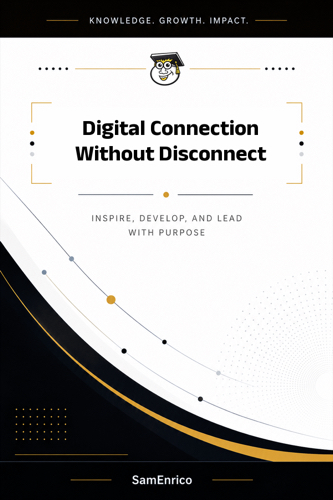
Digital Connection Without Disconnect eBook
Uses online communities and video calls intentiona
Uses online communities and video calls intentionally while avoiding the comparison trap that worsens loneliness.
Formats
Free sample
Chapter 1: The Participation Paradox--–- The screen glowed blue in the darkness. It was 11:47 PM, and Sarah had just spent two hours and fourteen minutes scrolling through Instagram. She had watched a former colleague get promoted, an acquaintance from college get engaged, a stranger’s dog do a backflip, and seventeen different versions of beach sunsets. She had liked forty-three posts, watched twenty-two stories, and commented exactly three times—a fire emoji, a heart emoji, and the word “Congrats!” on a baby announcement from someone she hadn’t spoken to in six years.She put the phone down and felt… empty.Not just empty. Lonely.
The kind of lonely that sits in your chest like a stone. She had just spent over two hours “connecting” with other humans, yet she had never felt more isolated. She knew what her coworker ate for breakfast, where her cousin was vacationing, and that a girl from high school was training for a marathon. But when she tried to think of the last time someone had asked her how she was really doing—not in a passing “how are you?” in a crowded hallway, but with actual curiosity—she couldn’t remember.Sarah’s experience is not unusual. It is, in fact, the defining emotional signature of our age.
We have more access to other humans than any generation in history. We carry devices in our pockets that can instantly connect us to nearly anyone on the planet. And yet, loneliness has become an epidemic. In 2023, the United States Surgeon General declared loneliness a public health crisis, warning that lacking social connection carries health risks equivalent to smoking fifteen cigarettes a day. A Harvard study found that thirty-six percent of Americans report feeling “serious loneliness”—not just occasionally, but as a chronic condition.
Among young adults, the number climbs to sixty-one percent.We are connected. And we are lonely.This is the Participation Paradox.The Paradox Defined The Participation Paradox is a simple observation with devastating implications: the more time you spend passively consuming digital content, the less socially connected you feel. Not the same. Not slightly less. Less.
Actively less.This runs counter to everything we intuitively believe about technology. Surely, being on social media means being social. Surely, watching someone’s life unfold on a screen means you are part of it. Surely, two hundred friends on Facebook means you have two hundred friends.Surely not.The paradox exists because we have confused two fundamentally different activities: social browsing and social bonding. They look similar on the surface.
Both involve screens. Both involve other people. Both happen in the same apps. But neurologically, emotionally, and relationally, they could not be more different.Social browsing is what you do when you scroll. You watch.
You like. You lurk. You absorb the highlights of other people’s lives without any reciprocity, any vulnerability, or any shared experience. You are a spectator at a game you are not playing. Social bonding, by contrast, is interactive.
It requires back-and-forth. It requires risk—the risk of being seen, the risk of saying something imperfect, the risk of asking for help or admitting failure. Social bonding triggers the release of oxytocin, the neurochemical associated with trust and attachment. Social browsing triggers dopamine, the neurochemical associated with anticipation and reward. Dopamine says “more.” Oxytocin says “enough.”Here is the cruel trick: social browsing feels productive.
You are, after all, checking in on people. You are staying informed. You are maintaining awareness. But awareness is not relationship. Knowing that your friend went to a concert is not the same as hearing about it from her voice, or seeing the excitement in her eyes, or laughing with her about the terrible opening band.
One is data. The other is connection.The Participation Paradox, then, is not a failure of technology. It is a failure of distinction. We have collapsed seeing into knowing, and knowing into caring. But seeing a highlight reel tells you nothing about a person’s struggles.
Knowing that someone exists does not mean you matter to them. And caring—real caring—requires showing up, not just showing your face on a screen.False Intimacy and the Highlight Reel There is a particularly insidious form of the Participation Paradox that deserves its own name: false intimacy. False intimacy is the feeling that you know someone deeply because you have consumed their curated content, when in fact you know almost nothing about them at all.Consider your closest friends. How did you become close? Almost certainly through shared experiences, mutual vulnerability, and the slow accumulation of trust over time.
You saw each other at your worst—tired, frazzled, unshowered, crying, angry, confused. You exchanged stories not of triumphs but of failures. You asked for help and received it. You fought and repaired.Now consider the people you follow online. What do you know about them?
You know their best angles. You know their vacation destinations. You know their career wins, their relationship milestones, their perfectly plated meals, their children’s achievements. You know what they want you to know. You know the version of themselves that has been edited, filtered, captioned, and curated.This is not intimacy.
This is a one-way mirror.The danger of false intimacy is that it satisfies the craving for connection without delivering its benefits. Your brain receives a signal that you have “checked in” on someone, and it releases a small reward. But that reward is not attachment. It is not trust. It is not the warm, embodied feeling of being known.
It is the hollow ping of a notification—gone as soon as it arrives.Worse, false intimacy actively undermines real intimacy. Why? Because the time you spend consuming highlight reels is time you are not spending cultivating real relationships. Every hour spent scrolling is an hour not spent texting a friend to ask how they’re actually doing, or calling your mother, or scheduling coffee with a colleague you like. Social browsing does not replace social bonding.
It competes with it. And it is winning.The Case of Twenty Zooms Let me tell you about Michael. Michael is a thirty-four-year-old graphic designer who lives alone in a city far from his family. When the pandemic hit, he did everything right. He joined Zoom trivia with his college friends.
He attended virtual happy hours with his coworkers. He signed up for an online drawing class. He joined a Discord server for people who like indie music. He even started attending a weekly “co-working” video call where everyone muted themselves and just worked in parallel.Over the course of one month, Michael participated in twenty different group video calls. Twenty.
That is nearly one per day, plus weekends. By any objective measure, Michael was doing the work. He was showing up. He was connecting.And yet, when I interviewed him for this book, he said something that stopped me cold. “I was lonelier that month than I’ve ever been in my life.”How could that be?
Michael was doing everything right. He was on the calls. He was present. He was trying.But then I asked him a follow-up question. “On those twenty calls, how…
This is the end of the free sample. Get the eBook to keep going. Buy now
About this book
Details
- Author
- Landers Iesha
- Publisher
- SamEnrico
- Language
- English
- Genre
- Non-Fiction, Self-Help, Digital Wellness
- Released
- 2026-06-10
- Pages (approx.)
- 128
- Available as
- eBook, Audiobook

Read better in the ZLOADR app
Your eBooks on your phone or tablet. Sign in with your SamEnrico account and start reading.
More by Landers Iesha
 Beginner Swimming Fitness GuideLanders Iesha$11.99
 Vacation Rental Insurance GuideLanders Iesha$11.99
 Zumba Modifications For Seniors HandbookLanders Iesha$11.99
 Sound Healing for Chronic PainLanders Iesha$11.99
 The Great Emu War: When Australia Tried to Fight BirdsLanders Iesha$11.99
 Frozen in Time: The Lost Voyage of Pytheas the ExplorerLanders Iesha$11.99
 Understanding DermoodontodysplasiaLanders Iesha$17.99
 UI UX Bootcamp CertificateLanders Iesha$12.99
 FinCEN Identifier SystemLanders Iesha$12.99FinCEN Identifier SystemLanders Iesha$12.99
 Ultimate Handbook Guide to Suizhou : (China) Travel GuideLanders Iesha$11.99
 Supplier Quality Assurance EngineerLanders Iesha$11.99
You may also like
 Hong Kong Handover 1997Dunn Johnnie$11.99
 Zumba For Postnatal Recovery CourseNeal Christian$11.99
 Zumba for BeginnersLadner Nikia$11.99
 YouTube Comment Mining GuideHumes Pandora$12.99
 Worry Box MeditationCarlin Rudy$11.99
 Workplace Stress MeditationNguyen Lynn$11.99
 Workplace Stress and Sleep RepairHawley Ivory$11.99
 Workplace Perfectionism CureDelaney Jeffry$11.99
 Workplace Injustice Anger GuideWallen Isabelle$11.99
 Work Addiction and Burnout LinkGreenwood Ester$11.99
 Women in Yoga and WellnessBeattie Galina$11.99
 Women in Stand Up ComedyChun Evangeline$11.99