
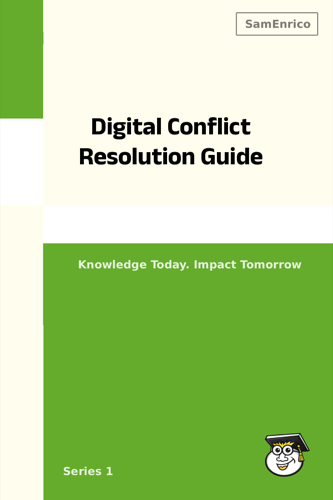
Digital Conflict Resolution Guide eBook
De escalates tense remote disagreements.
by Mauro Mario
De escalates tense remote disagreements.
Formats
Free sample
Chapter 1: The Invisible Crack--–- The message that started the war was seven words long. "Let's not overcomplicate this, okay?" It arrived on a Thursday afternoon in a Slack channel shared by fourteen people. The sender, a senior designer named Priya, had intended it as a gentle nudge toward simplicity. The receiver, a product manager named James, read it as a dismissal of his last three days of work. He didn't reply in the channel.
Instead, he screenshot the message, sent it to a colleague with a single eye-roll emoji, and began drafting a response that he would polish for forty-five minutes before sending. By Monday, two other team members had chosen sides. By Wednesday, a project that was already behind schedule had stopped moving entirely. All because of seven words that no one had meant as an attack and no one had received as neutral.If you have worked remotely for more than six months, you have lived some version of this story. Perhaps the channel was different—email, Google Docs, a comment on a Figma file, a Teams chat.
Perhaps the words were different—"Per my last message," "As I said before," "I'll let you figure it out." But the anatomy of the incident was the same: a gap between intention and interpretation, invisible to both parties, wide enough to drive a wedge through a functioning team. This gap is the subject of this chapter. I call it the invisible crack, and understanding it is the first step toward closing it.The Paradox of Polite People Writing Rude Things The most bewildering feature of digital conflict is that it so often involves people who are, in every other context, decent, thoughtful, and self-aware. Priya had never raised her voice at a colleague. She had a reputation for kindness.
James was not a complainer or a grudge-holder; he had been described in his last performance review as "unusually collaborative." And yet, here they were, three days into a conflict that neither had wanted and neither fully understood.This paradox has a name. Psychologist John Suler called it the online disinhibition effect in a landmark 2004 paper, but the phenomenon itself is as old as the telegraph. Something about communicating through a screen lowers the psychological barriers that normally prevent us from saying things we would regret. Suler identified six factors that create this effect, and each one was present in Priya and James's exchange.Anonymity is the first factor. True anonymity is rare in workplace tools—your name is attached to every message.
But perceived anonymity is different. In a large Slack channel, a sense of invisibility creeps in. "No one will remember this tomorrow" becomes an unconscious permission slip for sharpness. Priya was not anonymous, but she was one of fourteen faces in a thread. The psychological weight of that single "okay?" felt lighter than it would have in a two-person meeting.Invisibility is the second factor.
When you cannot see the person you are addressing, your empathy system—specifically, the mirror neurons that allow you to feel what another person feels—operates at half power. You are typing into a void. The person on the other end becomes abstract. This is why the same manager who would never interrupt a direct report in person will send a "Quick question" at 11:00 PM without a second thought. They are not being cruel.
They are being blind.Asynchronicity is the third factor. In a live conversation, feedback is immediate. You speak, you see the reaction, you adjust. Online, you write in isolation, often long after the triggering event, and your brain fills the silence with self-justifying narratives. By the time James read Priya's message, she had already moved on to another task, unaware that her seven words were landing like stones in still water.Solipsistic introjection is the fourth factor, and it is the most deceptive.
When you read someone else's words online, your brain unconsciously assigns them a tone, a face, and an intent drawn from your own emotional state. If you are already frustrated, neutral words read as hostile. If you are already defensive, a simple question reads as an accusation. James was tired, overworked, and privately worried about the project's timeline. When he read "Let's not overcomplicate this, okay?" his brain did not hear Priya.
It heard every manager who had ever dismissed him.Dissociative imagination is the fifth factor. People treat online spaces as less real than physical spaces. In a video game, you might shoot an avatar without guilt because "it's not real." In workplace chat, a similar dissociation occurs: the conversation feels less consequential, less permanent, less weighty. The delete button creates an illusion of impermanence, even though screenshots last forever and memories last longer.Minimization of authority is the sixth factor. In person, status is visible—office size, body language, the way people arrange themselves around a table.
Online, everyone occupies the same pixelated rectangle. This flattening can be democratizing, but it also removes the status-based brakes that normally prevent conflict. A junior employee feels freer to challenge a senior executive. A senior executive feels freer to dismiss a junior employee's concern. Neither is wrong to feel that freedom.
But both are more likely to crack the invisible barrier between intention and interpretation.Two Kinds of Disinhibition: The Warm and the Wounding Not all disinhibition leads to conflict. The same psychological loosening that makes people rude also makes them vulnerable, generous, and unexpectedly kind. Suler divided the effect into two branches, and understanding the difference is essential.Benign disinhibition is the warm overshare. It is the colleague who admits in a team channel that they are struggling with burnout. It is the manager who shares a story about a past failure to make a junior employee feel less alone.
It is the teammate who types "I really appreciate you" to someone they barely know. Benign disinhibition accelerates trust and deepens relationships. Remote work would be colder, slower, and more isolating without it.Toxic disinhibition is the sharp reply. It is the email that ends with "Per my last message." It is the Slack thread that devolves from disagreement to personal attack. It is the comment in a Google Doc that makes someone close their laptop and walk away.
Toxic disinhibition destroys trust, creates conflict spirals, and leaves invisible cracks that widen over time.Here is the critical insight: the same person exhibits both forms, often in the same week, and the difference is not character but context. When you feel safe, seen, and regulated, disinhibition leans benign. When you feel threatened, unseen, or dysregulated, disinhibition leans toxic. The goal of this book is not to eliminate disinhibition—that would be impossible and undesirable. The goal is to recognize which form is emerging and to build the skills to steer toward the warm rather than the wounding.Why Your Brain Betrays You at the Worst Moment Behind every regrettable message is a brain that was, for a few seconds, operating at half capacity.
To understand why, we need to look at three brain structures that will appear throughout this book.The amygdala is your threat detection system. It is fast, automatic, and ancient. It does not…
This is the end of the free sample. Get the eBook to keep going. Buy now
About this book
Details
- Author
- Mauro Mario
- Publisher
- SamEnrico
- Language
- English
- Genre
- Non-Fiction, Self-Help, Conflict
- Released
- 2026-06-09
- Pages (approx.)
- 130
- Available as
- eBook, Audiobook

Read better in the ZLOADR app
Your eBooks on your phone or tablet. Sign in with your SamEnrico account and start reading.
More by Mauro Mario
 Night Stalker Ballistics EvidenceMauro Mario$11.99
 Email Efficiency HandbookMauro Mario$11.99
 Self Hypnosis for Confidence HabitsMauro Mario$11.99
 Franchising Your Local Brand Across Borders Insurance CoverageMauro Mario$11.99
 The Great Penguin Rescue: A Tale of Survival and HumanityMauro Mario$11.99
 Frozen Fortress: The Impossible Siege of the Arctic Weather StationMauro Mario$11.99
 Understanding CystinuriaMauro Mario$17.99
 Collecting Rocks and MineralsMauro Mario$11.99
 Waste To Energy Tax GuideMauro Mario$12.99
 Black Friday One Page PlanMauro Mario$12.99
 How to Become a Checkroom ChiefMauro Mario$11.99
You may also like
 Hong Kong Handover 1997Dunn Johnnie$11.99
 Zumba For Postnatal Recovery CourseNeal Christian$11.99
 Zumba for BeginnersLadner Nikia$11.99
 YouTube Comment Mining GuideHumes Pandora$12.99
 Worry Box MeditationCarlin Rudy$11.99
 Workplace Stress MeditationNguyen Lynn$11.99
 Workplace Stress and Sleep RepairHawley Ivory$11.99
 Workplace Perfectionism CureDelaney Jeffry$11.99
 Workplace Injustice Anger GuideWallen Isabelle$11.99
 Work Addiction and Burnout LinkGreenwood Ester$11.99
 Women in Yoga and WellnessBeattie Galina$11.99
 Women in Stand Up ComedyChun Evangeline$11.99