
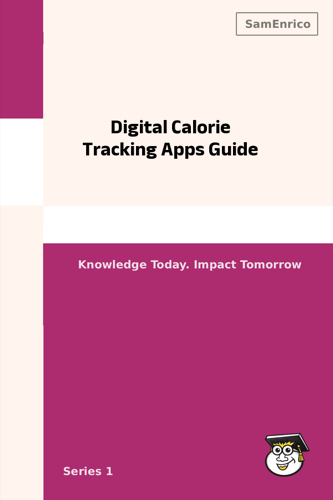
Non-FictionHealth & WellnessApp Reviews
Digital Calorie Tracking Apps Guide eBook
Compare MyFitnessPal, Lose It, and Cronometer to f
by Smyth Tawnya
Compare MyFitnessPal, Lose It, and Cronometer to find the best tool for your style.
Formats
Free sample
Chapter 1: The Memory Thief--–- Every night, while you sleep, your brain commits a quiet act of theft. It does not steal your wallet or your jewelry. It steals something far more valuable: an accurate record of what you ate that day. By the time you wake up, the handful of almonds you grabbed while making dinner, the three sips of your coworker's latte, and the last corner of your child's peanut butter sandwich have vanished from your memory as if they never happened. You are not lazy.
You are not undisciplined. You are simply human.This is the single most important truth about weight management that no diet book has ever told you: your memory is not designed to track calories. Evolution never needed it to. For 99.9 percent of human existence, the challenge was finding enough food, not remembering every bite. Your brain evolved to help you locate calories, consume them efficiently, and then forget them so you could focus on survival tasks like avoiding predators and finding shelter.The result is a biological system that works against every modern weight loss goal.
Your brain actively hides calories from you. A digital calorie tracking app does not make you more virtuous. It does not require superhuman willpower. It simply makes you more observant. And observation, it turns out, is the only ingredient you have been missing.The Experiment That Changed Everything In 1992, a young psychologist named Eric Robinson conducted a study that would reshape how researchers think about eating behavior.
He invited participants to a movie theater and gave them either a large bucket of popcorn or a medium bucket. The popcorn was stale—thirteen days old, chewy, and objectively unpleasant. After the movie, Robinson measured how much each person ate.People with large buckets ate 34 percent more popcorn than people with medium buckets—even though everyone agreed the popcorn tasted bad. When asked, they had no idea they had eaten more. They did not feel fuller.
They did not enjoy the experience more. They simply ate because the container was larger.This is the power of environmental cues over conscious choice. Your brain does not decide how much to eat based on hunger alone. It decides based on plate size, package size, social norms, and habit. And then it forgets it made those decisions at all.The popcorn study has been replicated dozens of times with different foods, different settings, and different populations.
The result is always the same: people eat more when more food is in front of them, and they have no memory of having done so.Now consider what happens when you introduce a food log. In a 2008 study of nearly 1,700 participants, researchers found that the single best predictor of weight loss success was not exercise frequency, not macronutrient composition, not even total calorie restriction. It was food logging consistency. People who logged their food at least five days per week lost twice as much weight as those who logged less frequently—regardless of what they ate.The log itself was the intervention. Not the calorie target.
Not the diet plan. Just the act of writing things down.Why Your Brain Hides Food From You To understand why food logging works, you must first understand how memory fails. The human brain processes approximately eleven million bits of sensory information per second. Your conscious mind can handle about fifty of those bits. Everything else is filtered, compressed, or discarded.Food intake falls squarely into the discard pile for three reasons.First, eating is repetitive.
Your brain is wired to ignore repeated stimuli. The first bite of a meal registers. The thirtieth bite does not. This is why you can eat an entire bag of chips while watching television and genuinely believe you only had a few. Your brain stopped paying attention after the first handful.Second, eating is often automatic.
You eat while driving, while working, while scrolling through social media. Your attention is elsewhere, so your memory never encodes the eating event. Later, when you try to recall what you ate, there is simply no memory to retrieve.Third, eating involves small items. Individual nuts, bites of food taken while cooking, sips of beverages—these are considered trivial by your brain’s prioritization system. It allocates memory resources to events that might threaten your survival or advance your goals.
A single grape does not qualify.Psychologists call this phenomenon “food amnesia,” and it affects everyone. In a study at Cornell University, researchers asked participants to record everything they ate for seven days. Unbeknownst to the participants, the researchers also secretly photographed every meal. At the end of the week, participants compared their logs to the photographs. On average, people forgot 22 percent of the calories they had consumed.Let me repeat that.
People forgot more than one out of every five calories they ate. If you consume 2,500 calories per day, food amnesia means you are genuinely unaware of approximately 500 to 600 of those calories. That is the difference between weight loss and weight gain for most people.The solution is not to try harder to remember. The solution is to stop relying on memory entirely. A digital food log provides an external, permanent, objective record.
When you log a food immediately—using a barcode scanner, a search bar, or a camera—you bypass your brain’s forgetting mechanism completely.The Hawthorne Effect: How Observation Changes Behavior In the late 1920s, researchers at the Hawthorne Works electrical plant in Chicago designed a study to determine how lighting conditions affected worker productivity. They expected that brighter lights would increase output. What they found was far stranger.Productivity improved when lights were brightened. Productivity also improved when lights were dimmed. Productivity improved when lights were left unchanged but workers were told they were being studied.
The simple act of observation—knowing that someone was watching—changed behavior, regardless of the actual conditions.This is the Hawthorne Effect, and it is one of the most robust findings in behavioral science. When people know they are being observed, they perform better. The observer does not need to offer rewards or punishments. Observation alone is sufficient.A food log turns you into the observer of your own eating. You are not judging yourself.
You are not restricting yourself. You are simply recording. And yet, study after study shows that the simple act of keeping a food log produces a 15 to 20 percent reduction in caloric intake within the first week—without any intentional dieting.Why? Because awareness disrupts autopilot.Consider your typical afternoon. You walk past the office break room, see a bowl of candy, and grab a handful of mini chocolates without thinking.
You eat them while reading emails. Thirty minutes later, you have no memory of eating them. Your brain classified that action as irrelevant background noise.Now imagine that same scenario with a food log. The moment you decide to record a piece of candy, you must pause, acknowledge it, and enter it. That pause gives your prefrontal cortex—the thinking, decision-making part of your brain—a chance to override your basal ganglia, the habit-driven part.
Sometimes you still eat the candy. But often, the mere fact of having to log it makes you skip it.…
This is the end of the free sample. Get the eBook to keep going. Buy now
About this book
Details
- Author
- Smyth Tawnya
- Publisher
- SamEnrico
- Language
- English
- Genre
- Non-Fiction, Health & Wellness, App Reviews
- Released
- 2026-06-09
- Pages (approx.)
- 123
- Available as
- eBook, Audiobook

Read better in the ZLOADR app
Your eBooks on your phone or tablet. Sign in with your SamEnrico account and start reading.
More by Smyth Tawnya
 Recovery After Burnout HandbookSmyth Tawnya$11.99
 Call Center System DesignSmyth Tawnya$11.99
 Empathy for Angry ChildrenSmyth Tawnya$11.99
 The Lil Wayne Mixtape KingSmyth Tawnya$11.99
 The Iron Admiral: Afonso de Albuquerque and the Birth of the Portuguese EmpireSmyth Tawnya$11.99
 Learn to Play the PrimoSmyth Tawnya$11.99
 Startup Contribution MarginSmyth Tawnya$12.99
 Real Estate Climate InsuranceSmyth Tawnya$12.99
 Snorkeling (Snorkelling)Smyth Tawnya$11.99
 How to Start a Development Capital Company Business (Beginners Guide)Smyth Tawnya$11.99
You may also like
 Hong Kong Handover 1997Dunn Johnnie$11.99
 Zumba For Postnatal Recovery CourseNeal Christian$11.99
 Zumba for BeginnersLadner Nikia$11.99
 YouTube Comment Mining GuideHumes Pandora$12.99
 Worry Box MeditationCarlin Rudy$11.99
 Workplace Stress MeditationNguyen Lynn$11.99
 Workplace Stress and Sleep RepairHawley Ivory$11.99
 Workplace Perfectionism CureDelaney Jeffry$11.99
 Workplace Injustice Anger GuideWallen Isabelle$11.99
 Work Addiction and Burnout LinkGreenwood Ester$11.99
 Women in Yoga and WellnessBeattie Galina$11.99
 Women in Stand Up ComedyChun Evangeline$11.99