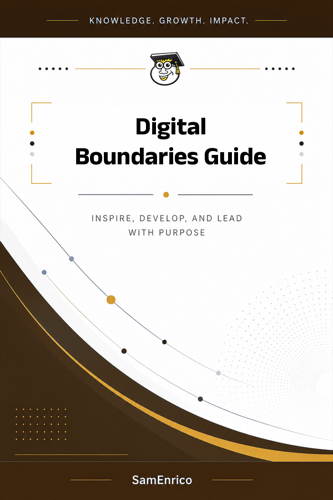
Digital Boundaries Guide eBook
Manages email, text, and social media expectations
Manages email, text, and social media expectations with others.
Formats
Free sample
Chapter 1: The Hijacked Mind...--–- Every morning, before your feet touch the floor, you reach for it. The rectangle. The black mirror. The little slab of glass and silicon that has, over the past fifteen years, quietly inserted itself into the most intimate spaces of your life. You check it while the kettle boils.
You check it while the traffic light is red. You check it in the elevator, in the bathroom stall, in the thirty-seven seconds between the end of one meeting and the start of the next. And if you are like half the adults on this planet, you have a name for this pattern. You call it addiction.Not a casual habit. Not a quirky dependence.
Addiction.The statistic lands like a confession: half of all adults report feeling addicted to their smartphones. Not teenagers, not the generation raised on i Pads, but grown adults with jobs and mortgages and children and responsibilities. They say it quietly, often with shame, as if admitting to a secret they cannot quite believe about themselves. I am addicted to my phone. But here is the question this chapter will answer, and it is a question no one has asked you directly before: What if the addiction is not your fault?
What if the problem is not your willpower, your discipline, or your character—but the device itself? What if every buzz, every ping, every little red notification dot has been designed, tested, and optimized to do one thing, and one thing only: to keep you reaching for the rectangle, over and over and over again, long after it stopped serving you?This chapter is called The Hijacked Mind for a reason. Because that is what has happened. Your attention has been hijacked. Not by accident.
Not by oversight. By design.The Slot Machine in Your Pocket Let me tell you about a machine. This machine has a lever on its side and a light that flashes when you pull it. Most of the time, when you pull the lever, nothing happens. No reward.
No coins. Just a dull clunk and the faint hum of disappointment. But sometimes—rarely, unpredictably—the machine pays out. Lights flash. Bells ring.
Coins pour into the tray. And here is the strange thing: the unpredictability is not a flaw. It is the point. When the machine pays out every single time, you get bored. The pleasure fades.
But when it pays out sometimes, when the reward is variable, you cannot stop pulling the lever. Your brain becomes locked in a loop. Pull. Wait. Check.
Maybe this time. Maybe now. The machine, of course, is a slot machine. And the slot machine, of course, is your phone.This is not a metaphor. It is neuroscience.Dr.
Adam Alter, a psychologist at New York University and the author of Irresistible, spent years studying why certain products and behaviors become compulsive. His conclusion is unsettling: the most addictive technologies are not the ones that reward you every time. They are the ones that reward you unpredictably. He calls this mechanism variable rewards, and it is the same psychological lever that made the one-armed bandit the most profitable invention in the history of gambling. When you pull a slot machine lever, you do not know what will happen.
That uncertainty triggers a spike of dopamine—not after the reward, but in anticipation of it. Your brain is not rewarding you for winning. Your brain is rewarding you for wondering if you might win.Now look at your phone.You hear a ding. You do not know who it is. It could be your partner saying "I love you." It could be a work emergency.
It could be a spam email from a mattress company. The uncertainty—the variable reward—triggers the same dopamine spike as a slot machine. You check. Most of the time, the reward is trivial or nonexistent. But sometimes, just often enough to keep you hooked, it is something good.
A kind word. A funny photo. A resolution to a problem. And because you never know which ding will be the good one, you check every single one. You check your phone fifty times a day.
A hundred times. A hundred and fifty times. Not because you are weak. Because you are human. And the machine was built to exploit exactly that.Dr.
Alter's research found that half of all adults feel they are addicted to their phones. Half. That is not a fringe phenomenon. That is a public health crisis wearing a very thin disguise. And the companies that built these machines—Apple, Google, Facebook, Tik Tok, Snapchat, every app developer who ever designed a notification—they know exactly what they are doing.
They employ neuroscientists. They run thousands of A/B tests. They optimize for one metric, and one metric only: time on device. Not happiness. Not connection.
Not productivity. Time. Your time. Because every minute you spend staring at the rectangle is a minute they are selling your attention to the highest bidder.The Dopamine Loop: Trigger, Anticipation, Check, Reward, Repeat Let me show you the loop. It is simple, elegant, and devastating.Step One: Trigger.
Something external pulls your attention. A ding. A buzz. A vibration. A red dot on an app icon.
A silent notification that changes the color of a badge from zero to one. Your brain does not have to decide to pay attention; the trigger is designed to bypass your prefrontal cortex entirely. It hits your brainstem, the ancient part of your nervous system that responds to sudden changes in the environment. A predator rustles the grass; you turn. A phone buzzes on the table; you look.
Same circuit.Step Two: Anticipation. Here is where the dopamine enters. Your brain releases a small burst of the neurotransmitter not after you check, but before. In the moment between the trigger and the action, your brain imagines the possible rewards. A message from a loved one.
News about something you were waiting for. Validation in the form of likes, hearts, upvotes, retweets. The anticipation is pleasurable. That is the trap. You are not checking because you need the information.
You are checking because the act of checking feels good in the moment before you know what you will find.Step Three: Check. You pick up the phone. You unlock it. You open the app. This takes less than two seconds, but in those two seconds, your dopamine is at its peak.
You are, neurochemically speaking, high.Step Four: Reward (or Not). Most of the time, the reward is weak. A spam email. A notification that your neighbor liked a photo from three weeks ago. An update from a group chat about nothing.
But sometimes—just sometimes—the reward is strong. A funny text from a friend. Good news. A compliment. And here is the cruel genius of variable rewards: the occasional strong reward trains your brain to tolerate the frequent weak rewards.
You keep pulling the lever because this time could be the jackpot.Step Five: Repeat. The loop takes less than ten seconds from trigger to resolution. And because the triggers are endless—notifications arrive every few minutes, sometimes every…
This is the end of the free sample. Get the eBook to keep going. Buy now
About this book
Details
- Author
- Franco Harriette
- Publisher
- SamEnrico
- Language
- English
- Genre
- Non-Fiction, Self-Help / Digital
- Released
- 2026-06-06
- Pages (approx.)
- 136
- Available as
- eBook, Audiobook

Read better in the ZLOADR app
Your eBooks on your phone or tablet. Sign in with your SamEnrico account and start reading.
More by Franco Harriette
 Immigrant Parent ExpectationsFranco Harriette$11.99
 Angelversary TraditionsFranco Harriette$11.99
 Stimulant Relapse PreventionFranco Harriette$11.99
 Low Carb Convenience Food SwapsFranco Harriette$11.99
 Hotel Booking PersuasionFranco Harriette$11.99
 Body Camera Impact On MemoryFranco Harriette$11.99
 The Siege of Constantinople: The Last Stand of the Byzantines (1453)Franco Harriette$11.99
 The Hong Kong Improv Revolution: How a Handful of Rebels Changed Comedy in AsiaFranco Harriette$11.99
 How to Become a Roller RepairerFranco Harriette$11.99
 How to Produce Golf TowelsFranco Harriette$11.99
 A Collector's Handbook to the Daimler Double Six Series IiFranco Harriette$11.99
 Freemium Models Low Broadband GuideFranco Harriette$12.99