
Non-FictionSelf-HelpDigital Etiquette
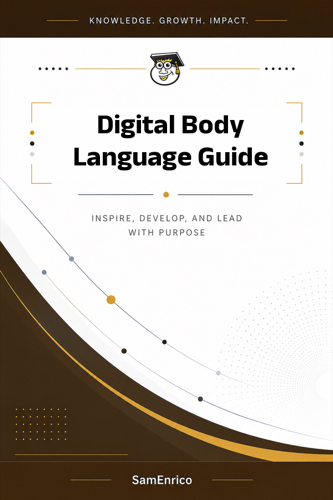
Digital Body Language Guide eBook
Interprets tone, punctuation, and response time.
by Kay Ozie
Interprets tone, punctuation, and response time.
Formats
Free sample
Chapter 1: The 93% Illusion--– The first time I realized I had a problem with digital body language, I was standing in my kitchen, staring at my phone, convinced that my marriage was falling apart because of a period.Not a menstrual period. A punctuation period.My wife had texted: "Dinner at 7. Okay."Three words. One period. And I had spent the next forty-five minutes cycling through every possible meaning of that period.
Was she angry? Was she tired of me? Had she finally reached her limit with my habit of leaving coffee mugs in the living room? I re-read the message seventeen times. I compared it to texts she had sent earlier in the week.
"Looking forward to seeing you tonight!" had an exclamation point. "Can you pick up milk?" had no period at all. But this message had a period. A deliberate, intentional, cold period.I walked into the living room where she was reading a book. "Are you okay?" I asked.She looked up, confused.
"Yes. Why?""Your text," I said. "You used a period."She stared at me for a long moment. Then she laughed—not a cruel laugh, but the kind of laugh that comes from realizing something obvious that someone else has completely missed. "I was typing with one hand," she said.
"I had a glass of wine in the other. The period was an accident."I had spent forty-five minutes of my life spiraling over an accident.That was the moment I realized that something had gone terribly wrong with the way we communicate. We had traded the richness of face-to-face conversation for the convenience of text-based messaging, and we had never developed a translation guide for what we lost. We were all walking around with ancient brains designed to read faces, voices, and bodies, trying to decode flat, silent strings of characters. And we were failing, constantly and catastrophically.This book is the translation guide I wished I had that night in my kitchen.The Most Important Number You Will Ever Read Let me give you a number that will change everything about how you read and send digital messages: 93 percent.In 1967, a psychologist named Albert Mehrabian at UCLA published a study that became one of the most cited—and most misunderstood—pieces of communication research in history.
Mehrabian was interested in how people communicate feelings and attitudes. He conducted two experiments. In the first, he had women say the word "maybe" in different tones of voice while listeners tried to guess the intended meaning. In the second, he had women say single words while listeners looked at photos of different facial expressions.His findings were striking. When there was a mismatch between words, tone, and facial expression, people relied most heavily on facial expression (55 percent), then tone of voice (38 percent), and finally the actual words (7 percent).Let me say that again.
In face-to-face communication about emotions and attitudes, only 7 percent of the meaning comes from the words you choose. Ninety-three percent comes from how you say those words—your posture, your facial expressions, your vocal inflections, your gestures, your eye contact, your breath, your pauses.Now consider what happens when you send a text message. You strip away 100 percent of the facial expressions. One hundred percent of the vocal tone. One hundred percent of the posture and gestures and eye contact.
You are left with only the words—7 percent of the original signal.And then you act surprised when someone misinterprets you.I am not telling you this to make you anxious. I am telling you this because you cannot fix a problem you do not understand. The translation gap is not a moral failure. It is not a sign that people are too sensitive or that you are too cold. It is a mathematical reality.
You are trying to communicate 100 percent of your meaning through a channel that carries only 7 percent of the signal. Something has to give. What gives is clarity, connection, and trust.The Scene That Launched a Thousand Misunderstandings Let me paint you a scene that happens somewhere in the world every few seconds.Sarah is a project manager at a marketing agency. She has been working eighty-hour weeks to land a major client. Her team is exhausted but hopeful.
At 6:47 PM on a Friday, she sends a message to her designer, James, who has been struggling with a complex animation."Let's circle back on the animation Monday. Have a good weekend."Sarah types this quickly before packing up her bag. She is tired. She is not angry. She is not passive-aggressive.
She is just ready to go home.James receives the message at 6:48 PM. He reads it three times. "Let's circle back" feels ominous to him. In his last job, "let's circle back" was code for "you messed up and I am too polite to say so." The period at the end of the sentence feels final. The absence of an exclamation point feels cold.James spends the next hour re-working the animation.
He sends Sarah a new version at 7:52 PM. He does not enjoy his weekend. He feels anxious and resentful.Sarah wakes up on Monday morning to James's email. She is confused. She did not ask for a new version.
She told him to rest. Now she has to spend the first hour of her week figuring out what happened.Neither Sarah nor James is wrong. Both are doing their best with an inadequate tool. But their relationship is now slightly worse than it was before. The trust account has been debited.
Over time, hundreds of these small debits add up to a relationship that feels fraught, exhausting, and difficult.I have seen this pattern play out in every workplace I have ever studied. In every friendship. In every family. The medium is the message, and the message is ambiguity.The Four Channels of Digital Body Language If we are going to fix this problem, we need a shared vocabulary for what we are losing and what we are building in its place. I call the new set of signals Digital Body Language.
It has four primary components. You will see these terms throughout this book, so let us name them clearly now.Component One: Punctuation.In physical space, a smile signals warmth. In digital space, an exclamation point signals warmth. A period signals neutrality or finality. An ellipsis signals hesitation, mystery, or passive aggression.
A question mark can signal curiosity or accusation, depending on context.These translations are not universal. They vary by generation, culture, and relationship. But they are real. Ignoring them is like ignoring someone's frown in a face-to-face conversation. You can do it, but you will pay a price.Component Two: Response Time.In physical space, silence can mean listening, thinking, disagreement, respect, discomfort, or hostility.
You know which one it is because you can see the other person's face. In digital space, a delayed reply carries the same range of meanings, but you cannot see the face. So your brain fills in the blank. And because of the negativity effect—which we will explore in depth in Chapter 2—your brain almost always fills in the worst possible meaning.Did they not reply because…
This is the end of the free sample. Get the eBook to keep going. Buy now
About this book
Details
- Author
- Kay Ozie
- Publisher
- SamEnrico
- Language
- English
- Genre
- Non-Fiction, Self-Help, Digital Etiquette
- Released
- 2026-06-08
- Pages (approx.)
- 127
- Available as
- eBook, Audiobook

Read better in the ZLOADR app
Your eBooks on your phone or tablet. Sign in with your SamEnrico account and start reading.
More by Kay Ozie
 Collaborative Analogies GuideKay Ozie$11.99
 Teeth in Aircraft AccidentsKay Ozie$11.99
 Student Evacuation PlansKay Ozie$11.99
 Meditation Flow State BridgeKay Ozie$11.99
 Learning Before ScrollingKay Ozie$11.99
 Acupuncture for Low LibidoKay Ozie$11.99
 Self Hypnosis for EndometriosisKay Ozie$11.99
 The Silent Witness: The DNA Breakthrough That Solved a 30-Year-Old MurderKay Ozie$11.99
 The Golden Voice of Shanghai: Li Xianglan’s Secret War of SongKay Ozie$11.99
 A Collector's Handbook to the Wartburg TouristKay Ozie$11.99
 How to Produce Pillow FormsKay Ozie$11.99
 Startup Launch Cheat SheetKay Ozie$12.99
You may also like
 Hong Kong Handover 1997Dunn Johnnie$11.99
 Zumba For Postnatal Recovery CourseNeal Christian$11.99
 Zumba for BeginnersLadner Nikia$11.99
 YouTube Comment Mining GuideHumes Pandora$12.99
 Worry Box MeditationCarlin Rudy$11.99
 Workplace Stress MeditationNguyen Lynn$11.99
 Workplace Stress and Sleep RepairHawley Ivory$11.99
 Workplace Perfectionism CureDelaney Jeffry$11.99
 Workplace Injustice Anger GuideWallen Isabelle$11.99
 Work Addiction and Burnout LinkGreenwood Ester$11.99
 Women in Yoga and WellnessBeattie Galina$11.99
 Women in Stand Up ComedyChun Evangeline$11.99