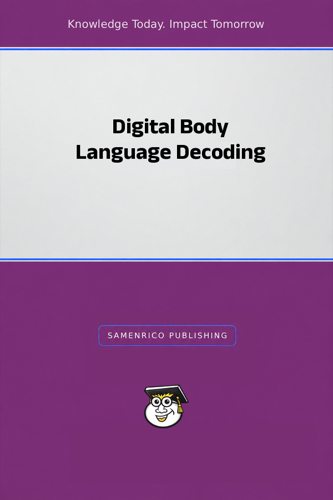
Digital Body Language Decoding eBook
Interprets tone and intent in written messages.
Interprets tone and intent in written messages.
Formats
Free sample
Chapter 1: The $10 Million "K"--–- The email arrived at 11:47 PM on a Tuesday. It contained exactly one letter: "K." No period. No exclamation. No follow-up. Just the eleventh letter of the alphabet, lowercase, sitting alone in the response field like a loaded gun.Within forty-eight hours, a deal worth ten million dollars had evaporated.
The venture capitalist who received that "K" later explained it to his partners this way: "I didn't hear agreement. I heard dismissal. I heard 'I'm done with this conversation.' I heard a door slamming in a room where I couldn't see the door."The sender, a founder who had stayed up late reviewing term sheets, had meant something entirely different. He had been exhausted. His phone screen was at one percent battery.
He had typed "K" as shorthand for "I acknowledge receipt of your detailed proposal, I am processing the information, and I will provide a substantive response in the morning after I have slept and reviewed the numbers with my CFO." But none of that context traveled through the wire. Only the "K" arrived. And it landed like a slap.This is not an isolated incident. This is not a cautionary tale about one exhausted founder and one sensitive investor. This is the daily reality of communication in the twenty-first century.
Every day, billions of people send and receive digital messages that carry emotional weights their senders never intended and their receivers cannot escape. A period becomes a punishment. A delay becomes a dismissal. An exclamation point becomes a scream. And in the absence of the human face, the human voice, the human body, our brains invent meanings that are almost always worse than the truth.Welcome to the crisis of digital body language.
And welcome to the solution.The Great Unlearning For approximately two hundred thousand years, human beings communicated face to face. We evolved to read each other. Our brains developed specialized regions—the fusiform face area, the superior temporal sulcus—dedicated entirely to processing the social signals emitted by other humans. We learned to detect a raised eyebrow in one-fifteenth of a second. We learned to distinguish a genuine smile (which involves the orbicularis oculi muscle around the eyes) from a fake smile (which involves only the zygomatic major muscle around the mouth) with ninety percent accuracy.
We learned that a person who mirrors our body posture is likely agreeing with us, while a person who turns their torso away is likely disengaging.Then, in the blink of an evolutionary eye, we abandoned all of it.Email arrived in the 1990s. Text messaging exploded in the 2000s. Slack and Teams and Whats App and We Chat colonized the 2010s. And by the time the COVID-19 pandemic forced the global workforce onto Zoom in 2020, the average professional was sending and receiving over one hundred twenty digital messages per day—almost all of them stripped of every cue our brains had spent two hundred millennia learning to read.We did not evolve for this. And our failure to adapt is not a personal failing.
It is a design flaw in the human animal, exposed by technology that moved faster than biology.This chapter introduces the central problem that the rest of this book will solve: the catastrophic gap between what we intend to communicate in writing and what others actually hear. We call this gap Digital Empathy Deficit Disorder—not a clinical diagnosis, but a useful framework for understanding why digital communication exhausts, infuriates, and alienates us more than any other form of human interaction.The Anatomy of a Misunderstanding Let us examine the "K" incident more closely, because it contains every element of digital body language failure.What the sender intended: Acknowledgment, agreement to continue the conversation later, a neutral placeholder indicating receipt.What the receiver perceived: Dismissal, contempt, a desire to end the conversation permanently.What was actually present in the message: One letter, no punctuation, no emoji, no timestamp indicating the sender's exhaustion or low battery.What the receiver's brain did in response: Filled in the missing context with the most emotionally threatening interpretation available. This is not a bug in the receiver's personality. It is a feature of human neurobiology.The psychologist Daniel Kahneman, in his work on cognitive biases, identified what he called the "affect heuristic"—the tendency of human brains to make quick judgments based on emotional valence before engaging in slower, more analytical thinking. When your brain sees a "K" where it expected warmth or professionalism, it does not pause to consider alternative explanations.
It does not think, "Perhaps the sender is tired." It thinks, "This person doesn't respect me." And that judgment happens in milliseconds, before you have any conscious awareness of making it.This is why digital body language matters more than most people realize. It is not about etiquette. It is not about politeness. It is about the fundamental architecture of the human brain, which was never designed to interpret a lowercase letter as anything other than a threat when warmth was expected.The Loss of Context: What Screens Steal In face-to-face communication, context is everywhere. You see the other person's posture, their eye contact, their facial expressions.
You hear their tone of voice, their pacing, their pauses. You sense their physical proximity—whether they lean in or lean back. You smell them, even if unconsciously. You feel the temperature of the room, the ambient noise, the presence of other people.In digital communication, all of this evaporates. What remains is pure text—or, in the case of voice and video calls, a degraded simulacrum of real presence.
And the human brain, confronted with this poverty of information, does not simply accept it. It compensates. It invents. It hallucinates.The psychologist Albert Mehrabian famously proposed that communication is seven percent verbal (words), thirty-eight percent vocal (tone of voice), and fifty-five percent visual (body language). While subsequent research has complicated this exact ratio, the core insight remains: the vast majority of meaning in human communication comes from nonverbal cues.
When you remove those cues, you are left with less than ten percent of the original signal. And the brain, desperate to reconstruct meaning, fills in the remaining ninety percent with whatever it fears most.This is the loss of context phenomenon—a term borrowed from David Lieberman's work in forensic psychology, adapted here to explain why digital messages consistently feel worse than they are. The loss of context is not a minor inconvenience. It is the primary driver of digital conflict, the source of most workplace misunderstandings, and the reason why a simple "K" can destroy a ten-million-dollar deal.Consider a second example. A manager sends an email to her team that says, "We need to talk about the Q3 numbers." She intends it as a neutral statement of fact, a prelude to a collaborative problem-solving session.
But the team reads it as a threat. "We need to talk" is among the most anxiety-producing phrases in the English language, precisely because it provides no context. Are the numbers good? Are they bad? Is someone getting fired?
The manager knows the answers. The team does not. And their brains, starved of context, assume the worst.The manager could…
This is the end of the free sample. Get the eBook to keep going. Buy now
About this book
Details
- Author
- Benedict Claribel
- Publisher
- SamEnrico
- Language
- English
- Genre
- Non-Fiction, Self-Help, Digital Etiquette
- Released
- 2026-06-09
- Pages (approx.)
- 151
- Available as
- eBook, Audiobook

Read better in the ZLOADR app
Your eBooks on your phone or tablet. Sign in with your SamEnrico account and start reading.
More by Benedict Claribel
 Anxiety Habit Self Hypnosis ManualBenedict Claribel$11.99
 Richard Ramirez Religious ConversionBenedict Claribel$11.99
 Meeting Start End ProtocolBenedict Claribel$11.99
 Dwight Eisenhower Interstate GeneralBenedict Claribel$11.99
 The Frozen Mind: Early Neuroscience in the Age of ExplorationBenedict Claribel$11.99
 Breaking the Sound Barrier: The Untold Story of Chuck Yeager's Secret MissionsBenedict Claribel$11.99
 Understanding Cystathionine Beta Synthetase DeficiencyBenedict Claribel$17.99
 Buyer PlannerBenedict Claribel$11.99
 Heat Pump Tax Credit GuideBenedict Claribel$12.99
 Nonprofit Marketing One PageBenedict Claribel$12.99
 A Beginners Guide to Balut (Volume 1)Benedict Claribel$11.99