
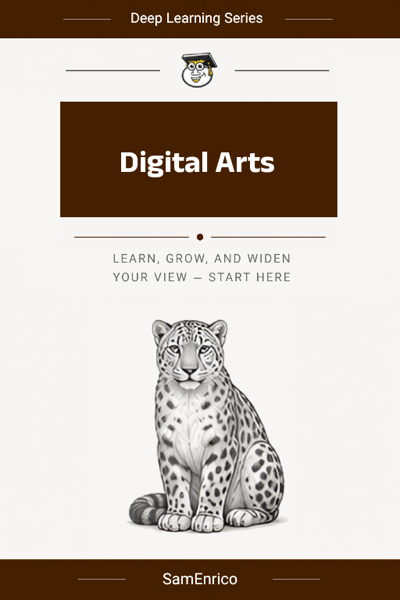
Non-FictionInformativeEducational
Digital Arts eBook
A Coursebook on Digital Arts
by Hundley Maud
A Coursebook on Digital Arts
Formats
Free sample
Chapter 1: The Pixels Within--– The first time I opened a digital art program, I sat staring at a blank white canvas for forty-five minutes. The cursor blinked at me—small, patient, accusatory. I had drawn on paper since I was old enough to hold a crayon. I had painted with acrylics in a cramped studio that smelled like turpentine and regret. But this glowing rectangle in front of me felt different.
It felt like a lie waiting to happen. Or perhaps, it felt like the truth finally catching up.This book is not about software. It is not about keyboards, tablets, or the difference between a Wacom and an i Pad. Those tools will change—they always do. What will not change is the question that froze me in front of that blank screen: Am I still making art, or am I just telling a machine what to do?For over two decades, I have taught digital arts in university classrooms, online courses, and cramped studio apartments where students balanced laptops on stacked textbooks.
I have watched teenagers create astonishing animations on phones that cost less than a single tube of professional oil paint. I have watched traditional painters weep with frustration when their first digital strokes came out wrong—slippery, lifeless, wrong. And I have watched those same painters, weeks later, discover something the physical world could never give them: the ability to undo. To iterate. To fail at no cost and try again immediately.That is the gift and the curse of digital art.
The stakes are lower, so the risks can be higher. But without understanding what digital art is—beyond the buzzwords and the software demos—you are just pushing pixels around. You are a technician following recipes, not an artist making choices.This chapter will not teach you how to draw. It will not teach you which brush setting to use. What it will do is give you a map.
A map of a territory that has been fought over since the 1950s, when engineers first coaxed glowing patterns out of oscilloscopes and called them art. By the end of this chapter, you will understand why the debate between "tool" and "medium" matters to your work. You will know the difference between computer art, net.art, and generative AI. And you will set up your digital workspace not as a technical chore, but as a creative ritual.Because here is the secret that no software manual will tell you: The machine does not make art. You do.
The machine just makes copies.What Digital Art Is (And What It Is Not)Let us start with a definition that will annoy everyone equally. Digital art is any artistic work or practice that uses digital technology as an essential part of the creative or presentation process. That definition comes from the lack of a better one. The problem is that almost everything is digital now. Photographers edit in Lightroom.
Printmakers scan and manipulate before etching. Even a painter who takes a photo of their canvas and posts it on Instagram has now entered the digital realm.So let us tighten the definition for the purpose of this book. Digital art, as we will use the term, means art that cannot exist without computation. If you remove the computer, the software, or the code, the artwork ceases to function. A digital painting is not just a painting made on a tablet—it is a painting whose undo history, layer structure, and resolution independence are part of its identity.
A net.art piece from 1996 is not just a website—it is a specific arrangement of HTML tags that only renders correctly in a Netscape browser, and that obsolescence is part of the meaning.This is a harder standard. It excludes a photographer who scans film negatives (that is just photography with a digital intermediate). It includes a generative artwork that produces infinite variations based on an algorithm. It excludes a novel typed in Microsoft Word (the computation is incidental). It includes an interactive narrative that changes based on user input.Why does this matter?
Because if you are going to spend hours, days, or years learning this craft, you deserve to know what makes it distinct. Traditional art has limitations that are also its strengths. Canvas has texture. Paint dries. Clay hardens.
These constraints force decisions. Digital art has different constraints—the screen’s backlight, the file size, the rendering time, the software’s hidden assumptions—and understanding those constraints is the first step to mastering them.The Tool vs. Medium Debate Here is the argument that has divided art departments since the 1980s. One side says: the computer is just a tool. It is a fancy paintbrush, a faster eraser, a more convenient darkroom.
The art is still the art. The other side says: the computer is a medium, not a tool. A medium has its own language. You cannot translate a watercolor into a digital file without losing something essential, just as you cannot translate a poem into a spreadsheet without violence.I am on the medium side, but I understand the tool side. The tool side is comforting.
It says that everything you already know about art still applies. Color theory, composition, value, anatomy—none of that changes. And that is true. Chapter 2 of this book will spend hundreds of words proving that very point. But the medium side asks a harder question: What can digital art do that nothing else can?Consider the undo button.
On paper, every mark is permanent. You can cover it with white paint, but the ghost remains. In digital, you can delete a stroke entirely, as if it never happened. That changes your psychology as an artist. You take more risks.
You work faster. You iterate more. Over time, that changes the kind of art you make—more experimental, more provisional, more willing to fail.Consider layers. On canvas, you paint wet-on-wet or you wait for drying. In digital, you can separate your sketch, your underpainting, your color, your lighting, your texture, and your post-effects onto different layers that never touch each other.
You can delete your sketch without harming the color. You can change the lighting after the painting is "finished." That is not just a faster workflow. That is a different way of thinking about how an image is constructed.Consider resolution independence. On paper, a 2-inch drawing is a 2-inch drawing. Enlarge it ten times and you see fibers and smudges.
In digital, a vector graphic has no native resolution. It can be printed on a business card or the side of a building with zero quality loss. That changes what you can do with the art after it is made.So yes, the computer is a tool. But it is a tool that reshapes your thinking. And a tool that reshapes your thinking is, by definition, a medium.A Very Brief History (Do Not Skip This)Every working artist I know hated art history until they needed it.
Then they suddenly needed it desperately. You do not need to memorize dates. You do need to know that digital art did not appear from nowhere in 1995…
This is the end of the free sample. Get the eBook to keep going. Buy now
About this book
Details
- Author
- Hundley Maud
- Publisher
- SamEnrico
- Language
- English
- Genre
- Non-Fiction, Informative, Educational
- Released
- 2026-05-06
- Pages (approx.)
- 151
- Available as
- eBook, Audiobook

Read better in the ZLOADR app
Your eBooks on your phone or tablet. Sign in with your SamEnrico account and start reading.
More by Hundley Maud
 Public Speaking For DoctorsHundley Maud$11.99
 Caregiver Sabbath GuideHundley Maud$11.99
 Binge Eating Trigger Log CourseHundley Maud$11.99
 SSRI for PMDD GuideHundley Maud$11.99
 Graduate Student Burnout PreventionHundley Maud$11.99
 The Lost Caravans of the White Desert: Antarctica’s Ancient Trade RoutesHundley Maud$11.99
 The Last Arrow: The Untold Story of the 1972 Munich OlympicsHundley Maud$11.99
 Voiceover Plosive Fix GuideHundley Maud$12.99
 EU Member State VariationsHundley Maud$12.99
 Understanding Ectodermal Dysplasia Mental Retardation SyndactylyHundley Maud$17.99
 How to Become a Automobile RacerHundley Maud$11.99
You may also like
 Hong Kong Handover 1997Dunn Johnnie$11.99
 Zumba For Postnatal Recovery CourseNeal Christian$11.99
 Zumba for BeginnersLadner Nikia$11.99
 YouTube Comment Mining GuideHumes Pandora$12.99
 Worry Box MeditationCarlin Rudy$11.99
 Workplace Stress MeditationNguyen Lynn$11.99
 Workplace Stress and Sleep RepairHawley Ivory$11.99
 Workplace Perfectionism CureDelaney Jeffry$11.99
 Workplace Injustice Anger GuideWallen Isabelle$11.99
 Work Addiction and Burnout LinkGreenwood Ester$11.99
 Women in Yoga and WellnessBeattie Galina$11.99
 Women in Stand Up ComedyChun Evangeline$11.99