
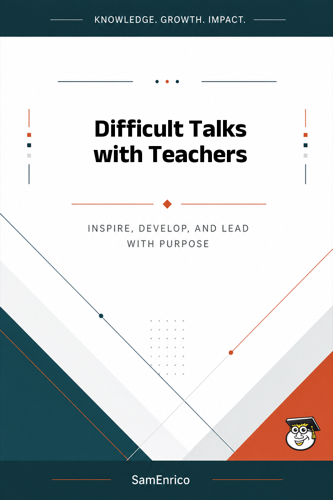
Difficult Talks with Teachers eBook
Advocates for child's needs without becoming adver
Advocates for child's needs without becoming adversarial.
Formats
Free sample
Chapter 1: The Sweaty Palms Are Lying-- You are standing in a fluorescent-lit hallway. The door to the classroom is closed. Behind it, a teacher is arranging papers, checking emails, or maybe just taking three deep breaths before the next conference. You have ten minutes until your name is called. Your palms are damp.
Your heart is tapping an uneven rhythm against your ribs. You have gone over what you want to say at least fourteen times since breakfast, and now your mind is a blank slate except for one looping thought: What if they think I am that parent?That parent. You know exactly what it means. The parent who complains too much. The parent who does not understand how hard teachers work.
The parent whose emails make the principal sigh before opening them. The parent who shows up with a binder full of grievances and a voice tight with accusation. Every parent who has ever advocated for a child has felt the gravitational pull of that fear. What if speaking up makes things worse? What if the teacher labels your child as difficult because you spoke up?
What if you are overreacting?Let me tell you something that no one says in those waiting rooms. The sweaty palms are lying to you. The racing heart is misreading the situation. Your body is treating a parent-teacher conference like a threat to your survival, and it is wrong. This chapter is going to show you why your fear is not only normal but also misplaced, why silence is far more dangerous than speaking up, and why schools actually depend on parents like you to identify problems early.
By the end of this chapter, you will have a new framework for advocacy that sits squarely between aggression and passivity, and you will have taken the first step toward becoming what this book calls a Partner Parent.The Fear Is Real, But It Is Wrong Let us start with an honest confession. The fear you feel is not a character flaw. It is a biological response that has been hijacked by a modern situation your nervous system does not know how to categorize. Thousands of years ago, when your ancestors saw a predator, their palms sweated, their hearts raced, and their muscles prepared to fight or flee. That same system activates today when you walk into a school.
Your body does not know the difference between a tiger and a teacher holding a grade book. It just knows you are about to be evaluated, judged, and potentially dismissed.But here is the problem with that ancient wiring. It tells you to either attack or run away. Neither option works in a parent-teacher conference. Attacking means you become the very parent you fear being labeled as.
Running away means you stay silent while your child struggles. The sweaty palms are urging you to do something that will not help your child. That is why this chapter exists. To convince you that the fear is real but the story it tells you is wrong.I have interviewed dozens of parents for this book, and the pattern is unmistakable. Nearly every parent who has ever walked into a difficult conversation with a teacher has felt the same dread.
They worried about being labeled difficult. They worried about retaliation against their child. They worried that they did not have the right vocabulary or the right evidence or the right to speak at all. And yet, the parents who overcame that fear almost always reported the same outcome. The teacher was not nearly as intimidating as they had imagined.
The conversation was not nearly as adversarial as they had feared. And their child benefited enormously from their willingness to speak.The parents who did not overcome the fear reported a different outcome. They stayed silent. The problem continued. Their child continued to struggle.
And eventually, the school noticed the problem anyway, but by then it had grown larger and harder to solve. Silence did not protect anyone. It only delayed the inevitable and made the eventual conversation harder.The Real Cost of Staying Silent Let me be very clear about something. Staying silent feels like the safe choice in the moment. You avoid potential conflict.
You preserve the image of being a reasonable, easygoing parent. You do not risk being labeled difficult. But the cost of that safety is paid by your child, in real time, every day.Imagine your child comes home from school three days in a row saying that math class makes their stomach hurt. They cannot explain why. They just know that when the teacher calls on them, their face gets hot and their words get stuck.
You suspect something is wrong, but you tell yourself it is probably nothing. Maybe they just need more sleep. Maybe they are being dramatic. Maybe the teacher is fine and your child is just adjusting.So you wait. A week passes.
Two weeks. The stomachaches become morning tears. The morning tears become requests to stay home. The requests to stay home become a pattern of absences. Now the school is calling you, not about math, but about truancy.
Now the conversation is not a gentle check-in. It is a formal notice. Now the teacher is defensive because they have been blindsided. Now you are defensive because you have been worried for weeks. The gap between what your child needed and what the system provided has grown wider and harder to close, and silence is the reason.This is not a hypothetical scenario.
This is the story of nearly every parent I have worked with who regretted not speaking up sooner. The schools almost always say the same thing when you finally do speak up. "We wish you had told us earlier." And they mean it. Because schools are not psychic. Teachers see your child for six hours a day, often in a room with twenty-five other children.
They miss things. They misinterpret things. They assume that if a parent is not complaining, everything is fine. Your silence reads to them as consent.Speaking up early is not a burden on the school. It is a gift.
You are providing data that the teacher cannot collect on their own. You are helping them do their job better. When you reframe advocacy that way, the sweaty palms start to lose their power. You are not a nuisance. You are a necessary data point.Introducing the Real Enemy Most parents walk into difficult conversations with a clear but unhelpful picture of who the enemy is.
They assume the enemy is the teacher. Or the principal. Or the school district. Or the entire educational system. That assumption sets up every conversation as a battle, and in a battle, someone has to lose.
If you win, the teacher loses. If the teacher wins, you lose. That framework guarantees that someone walks away resentful, and usually, that someone is your child.I want to offer a different framework. One that will reappear throughout this book as our North Star. The enemy is not the teacher.
The enemy is not the principal. The enemy is not the school board or the superintendent or the state department…
This is the end of the free sample. Get the eBook to keep going. Buy now
About this book
Details
- Author
- Brunner Willena
- Publisher
- SamEnrico
- Language
- English
- Genre
- Non-Fiction, Self-Help, Education
- Released
- 2026-06-08
- Pages (approx.)
- 153
- Available as
- eBook, Audiobook

Read better in the ZLOADR app
Your eBooks on your phone or tablet. Sign in with your SamEnrico account and start reading.
More by Brunner Willena
 Discriminant Analysis Mapping CourseBrunner Willena$11.99
 Varicella Vaccine Chickenpox HistoryBrunner Willena$11.99
 Remote Retreats Budget HandbookBrunner Willena$11.99
 Etsy Digital Planner Case Study CourseBrunner Willena$11.99
 The Pink Panther Heist: The 1978 Monaco Diamond CaperBrunner Willena$11.99
 The Berlin Spy Who Vanished: The Cold War's Greatest Unsolved MysteryBrunner Willena$11.99
 Marketing Campaign ManagerBrunner Willena$11.99
 Understanding ChondrocalcinosisBrunner Willena$17.99
 Grief Support Board GuideBrunner Willena$12.99
 Global Team Comms Policy GuideBrunner Willena$12.99
 How to Become a Cake PullerBrunner Willena$11.99
You may also like
 Hong Kong Handover 1997Dunn Johnnie$11.99
 Zumba For Postnatal Recovery CourseNeal Christian$11.99
 Zumba for BeginnersLadner Nikia$11.99
 YouTube Comment Mining GuideHumes Pandora$12.99
 Worry Box MeditationCarlin Rudy$11.99
 Workplace Stress MeditationNguyen Lynn$11.99
 Workplace Stress and Sleep RepairHawley Ivory$11.99
 Workplace Perfectionism CureDelaney Jeffry$11.99
 Workplace Injustice Anger GuideWallen Isabelle$11.99
 Work Addiction and Burnout LinkGreenwood Ester$11.99
 Women in Yoga and WellnessBeattie Galina$11.99
 Women in Stand Up ComedyChun Evangeline$11.99