
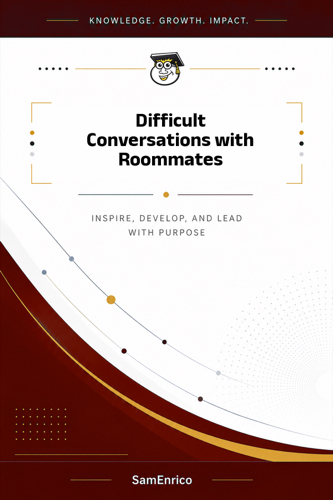
Difficult Conversations with Roommates eBook
Chores, guests, and rent talks.
Chores, guests, and rent talks.
Formats
Free sample
Chapter 1: Beyond the Note–- It is a truth universally acknowledged that a roommate in possession of a grievance must be in want of a sticky note. You have seen them: the little yellow squares multiplying on the refrigerator like a papery rash, each one shorter and more acidic than the last. "Please replace the toilet paper roll when you finish it." "Who left their laundry in the dryer for three days?" "The sink is not a storage unit for your dirty dishes." And then, the nuclear option: "I'm not your mother." The sticky note has become the default language of roommate conflict—a language that promises resolution but delivers only escalation, resentment, and a refrigerator that looks like a passive-aggressive bulletin board.This chapter dismantles the sticky note myth once and for all. We will explore why this seemingly harmless method of communication is actually the most destructive tool in the roommate arsenal, the psychology of passive-aggressive escalation, and the viral nightmare of the "I lick my cheese" saga. More importantly, you will learn the one alternative that actually works: the Roommate Charter, a living document that replaces fuzzy expectations with crystal-clear agreements.
By the end of this chapter, you will understand why the sticky note must die—and what to build in its place.The Anatomy of a Sticky Note Disaster Let us reconstruct a typical roommate conflict, frame by painful frame. This is not a hypothetical; it is a composite of dozens of real stories collected from interviews, Reddit threads, and therapy intake forms. The names have been changed, but the dynamics are painfully familiar.Day One, 8:47 PM: Jamie notices that the kitchen trash is overflowing. A piece of onion skin has drifted onto the floor like a tiny, smelly flag of surrender. Jamie's roommate, Alex, has been home all day.
Alex definitely saw the trash. Jamie feels a familiar flash of irritation but pushes it down. Jamie does not want to be "that roommate"—the nag, the enforcer, the one who turns every minor annoyance into a federal case. Instead, Jamie takes out the trash themselves, silently noting the injustice. Later that night, Jamie writes a note: "Hey, can we try to take the trash out before it starts falling on the floor?
Thanks!" The note is affixed to the refrigerator with a small magnetic flower.Day Two, 9:15 AM: Alex comes home from a night shift, exhausted, and sees the note. Alex feels immediately defensive. The plan was to take out the trash in the morning. The note feels like an accusation dressed up as a request. Alex grabs a pen and writes below it: "I was going to do it.
You didn't have to."Day Two, 6:30 PM: Jamie returns from work, sees the response, and feels their irritation spike. "You didn't have to" is not an apology; it is a dismissal. Jamie writes back: "Well, it was falling on the floor. Just trying to keep things clean."Day Three, 10:00 AM: Alex, who had a terrible shift and is running on three hours of sleep, reads this as a personal attack. The phrase "just trying to keep things clean" feels like a pointed comment on Alex's character.
Alex writes: "Maybe if you didn't leave your coffee mugs everywhere, the counter wouldn't be so cluttered that I can't even get to the trash can."Day Three, 7:15 PM: Jamie is now genuinely angry. The coffee mugs? Jamie's coffee mugs are on the counter for maybe an hour before they go in the dishwasher. Alex, on the other hand, left three pizza boxes on the counter for an entire week last month. Jamie writes: "My coffee mugs?
You left three pizza boxes on the counter for a week. A WEEK."Day Four: The notes have metastasized. Other roommates have been drawn in. The refrigerator is now a public square of grievances. A new note appears in a third handwriting: "Can we please just talk about this like adults?" Below it, someone has written: "We tried talking.
Jamie doesn't listen." Below that: "I'm literally right here. I can hear you writing notes about me." Below that: "Then say something to my face." Below that: "Fine. The trash is your job now since you care so much." Below that: "That's not how this works." Below that: "I'm not your mother."What started as a full trash can has become a full-scale household war. And crucially, no actual conversation has occurred. No one has looked another person in the eye.
No one has said, "Hey, I'm feeling frustrated about the trash situation. Can we talk about a system?" No one has apologized, compromised, or even acknowledged the other person's perspective. The notes have done what notes always do: they have escalated.The Three Fatal Flaws of the Sticky Note Method Why does this happen every single time? The answer lies in three structural flaws that make sticky notes a guaranteed failure for conflict resolution. Understanding these flaws is the first step to escaping them.Flaw One: The Absence of Tone Human communication is mostly non-verbal.
According to research by psychologist Albert Mehrabian, only 7% of emotional meaning comes from words. The rest comes from tone of voice (38%) and body language (55%). When you leave a sticky note, you strip away 93% of your message's information. You are left with the driest, most ambiguous bones of language.Consider the simple phrase "Please take out the trash." Spoken with a gentle smile and a light touch on the shoulder, it sounds like a collaborative request. Spoken with a flat voice and crossed arms, it sounds like an accusation.
On a sticky note, it sounds like both and neither. The reader supplies their own tone—and they will almost always supply the worst possible one. This is not because they are paranoid or difficult; it is because the human brain is wired to detect threats. In the absence of reassuring cues, the brain defaults to a threat interpretation. Your neutral note becomes a hostile note in the mind of your roommate, and suddenly you are fighting about something you never actually said.Flaw Two: The Missing Accountability Loop A sticky note is a one-way message.
You send it into the void and hope for the best. You do not know if your roommate read it, understood it, agreed with it, or laughed at it and threw it away. You only know whether the trash eventually got taken out—and if it did, you do not know if it was because of the note or in spite of it.This ambiguity creates an anxiety loop. You check the refrigerator to see if the note is still there. You add a postscript.
You wonder if they are ignoring you on purpose. You start keeping score: "I left the note on Tuesday, and it's now Thursday, and the dishes are still in the sink." The absence of an accountability loop transforms a simple request into a test of character. The other person is not just failing to take out the trash; they are failing you, personally, deliberately. You have no evidence of this, but the vacuum of information fills itself with the worst possible conclusions.In a real conversation, the accountability loop…
This is the end of the free sample. Get the eBook to keep going. Buy now
About this book
Details
- Author
- Strickland Sophie
- Publisher
- SamEnrico
- Language
- English
- Genre
- Non-Fiction, Self-Help, Housing
- Released
- 2026-06-05
- Pages (approx.)
- 136
- Available as
- eBook, Audiobook

Read better in the ZLOADR app
Your eBooks on your phone or tablet. Sign in with your SamEnrico account and start reading.
More by Strickland Sophie
 Vitamin A Beta Carotene SafetyStrickland Sophie$11.99
 Estate Planning SimplifiedStrickland Sophie$11.99
 Self Hypnosis for Weight LossStrickland Sophie$11.99
 Boomer Gaming HabitsStrickland Sophie$11.99
 Neighbor Conflict AssertiveStrickland Sophie$11.99
 Sterilization Tubal LigationStrickland Sophie$11.99
 Senior Rural Isolation EsteemStrickland Sophie$11.99
 The Visionaries of Stone and Sky: Architects Who Built the WestStrickland Sophie$11.99
 The Lost Greens of Timbuktu: Golf's Forgotten Renaissance in Medieval AfricaStrickland Sophie$11.99
 Indian Rhinoceroses: One-horned RhinoStrickland Sophie$11.99
 A Collector's Handbook to the Vanden Plas Princess 4-litre RStrickland Sophie$11.99
 Your Family Money ScriptsStrickland Sophie$12.99
You may also like
 Hong Kong Handover 1997Dunn Johnnie$11.99
 Zumba For Postnatal Recovery CourseNeal Christian$11.99
 Zumba for BeginnersLadner Nikia$11.99
 YouTube Comment Mining GuideHumes Pandora$12.99
 Worry Box MeditationCarlin Rudy$11.99
 Workplace Stress MeditationNguyen Lynn$11.99
 Workplace Stress and Sleep RepairHawley Ivory$11.99
 Workplace Perfectionism CureDelaney Jeffry$11.99
 Workplace Injustice Anger GuideWallen Isabelle$11.99
 Work Addiction and Burnout LinkGreenwood Ester$11.99
 Women in Yoga and WellnessBeattie Galina$11.99
 Women in Stand Up ComedyChun Evangeline$11.99