
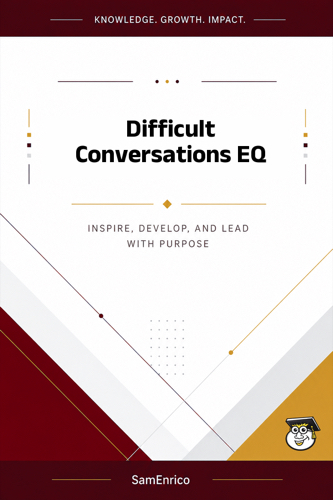
Free sample
Chapter 1: The 6-Second Hijack--–- The call came in at 2:47 on a Tuesday afternoon. Sarah, a senior product manager with twelve years of experience and an MBA from a top-tier school, had just finished a flawless presentation to the executive team. She knew the material cold. She had rehearsed her talking points three times. She had even meditated that morning, something she had read about in a leadership blog.
And yet, when her boss, David, looked up from his laptop and said, "Sarah, we need to talk about the Q3 timeline. What you presented just now doesn't match what we agreed to last month," something inside her chest collapsed. Her face flushed hot. Her mouth went dry. The words she had prepared—the rational, measured, emotionally intelligent responses she knew she should say—evaporated like water on a hot skillet.
What came out instead was a defensive, high-pitched, "Well, actually, if you look at the email from June 15th, you'll see that I raised concerns about the timeline twice." She heard herself say it and watched David's expression shift from neutral to annoyed. The meeting went downhill from there. By 3:15, she was back at her desk, heart still racing, replaying every stupid thing she had said. She knew better. She had read the books.
She had taken the workshops. So why, in the moment that mattered most, did her brain betray her?This is the central mystery of difficult conversations, and it is the problem that Chapter 1 exists to solve. You have probably lived this scene yourself in a thousand variations: the performance review that went off the rails, the argument with your partner where you said something unforgivable, the text exchange that spiraled into a three-hour fight about nothing, the meeting where you sat frozen while someone else took credit for your idea, the conversation with your teenager where you became your own unreasonable parent. In every case, you knew what you should have said. You knew the principles of good communication.
You had the script in your head. And then something happened—some internal switch flipped—and you became a person you did not recognize. A person who yelled. A person who cried. A person who went silent.
A person who agreed to things they later regretted. A person who walked away thinking, "That is not who I am."Here is the liberating truth: it was not a failure of character, or intelligence, or even communication skill. It was a failure of biology. In the moments that matter most, your brain was not sabotaging you because you are weak or unprepared. Your brain was doing exactly what it evolved to do: protect you from a threat.
The problem is that your brain cannot tell the difference between a saber-toothed tiger and a critical boss. It cannot distinguish between a physical attack and a harsh word. To your ancient limbic system, social threat feels exactly like mortal danger. And when your brain perceives mortal danger, it does not stop to ask whether you have a well-rehearsed "I" statement ready. It acts.
It hijacks. And you lose your words.This chapter is about that hijack. It is called "The 6-Second Hijack" because that is roughly the window of time you have—six seconds—between the moment your brain detects a threat and the moment your prefrontal cortex (the rational, language-processing, future-planning part of your brain) goes offline. In those six seconds, you have a choice. Not a full choice, not an easy choice, but a physiological intervention that can mean the difference between a conversation that repairs and a conversation that destroys.
By the end of this chapter, you will understand the neurobiology of conflict better than most psychologists. You will recognize the physical symptoms of an amygdala hijack in yourself and others. And you will have learned a set of techniques—the 6-Second Reset—that can restore your cognitive function in the middle of the most heated exchange. These techniques will not solve your difficult conversation. They will not give you the perfect script.
What they will do is get you from "crisis" to "functional." They will buy you the six seconds you need to access every other tool in this book.Let us begin with the brain.The Architecture of Panic To understand why you lose your words during difficult conversations, you need to understand three parts of your brain: the amygdala, the prefrontal cortex, and the insula. Do not worry—this will not be a neuroscience lecture. You do not need to memorize Latin names. But you do need to understand a simple map of what happens inside your skull when someone criticizes you, rejects you, or challenges your identity.The amygdala is a small, almond-shaped cluster of neurons buried deep in your temporal lobe. It is often called the brain's "alarm system," but that undersells its power.
A better metaphor is the amygdala as a smoke detector. A smoke detector does not think. It does not evaluate whether the smoke is from a burning building or from burnt toast. It simply detects the presence of smoke—any smoke—and screams. Your amygdala is the same.
It scans your environment constantly for signs of threat, and when it detects one, it triggers an immediate, full-body response before your conscious mind has even registered what is happening. This response is called the sympathetic nervous system activation, or more commonly, the fight-or-flight response.Here is the crucial detail for difficult conversations: your amygdala cannot distinguish between physical threats and social threats. When you are walking alone at night and hear footsteps behind you, your amygdala activates. When your boss says "we need to talk," your amygdala activates in exactly the same way. When your partner sighs and turns away from you in bed, your amygdala activates.
When you raise your hand in a meeting and no one acknowledges you, your amygdala activates. From the perspective of your ancient, evolutionarily ancient brain, social rejection was a death sentence. A human alone on the savannah did not survive. Being cast out from the tribe meant being eaten by predators. So your brain wired itself to treat social exclusion, criticism, and humiliation as literal threats to your survival.
This is not a metaphor. The same neural pathways light up in brain scans when someone experiences physical pain and when someone experiences social rejection.The second key player is the prefrontal cortex, or PFC. This is the part of your brain located right behind your forehead. It is the most recently evolved part of the human brain—sometimes called the "executive center." The PFC is responsible for everything that makes you distinctively human: language, reasoning, planning, impulse control, empathy, self-awareness, and the ability to imagine future consequences. When you are calm and safe, your PFC is in charge.
You can think clearly, choose your words carefully, consider the other person's perspective, and respond rather than react. When you are in a difficult conversation and everything is going well, your PFC is at the wheel.But here is the problem your amygdala does not care about your PFC. When the amygdala detects a threat, it does not send a polite memo to the PFC asking…
This is the end of the free sample. Get the eBook to keep going. Buy now
About this book
Details
- Author
- Williford Lashawna
- Publisher
- SamEnrico
- Language
- English
- Genre
- Non-Fiction, Self-Help / Conversations
- Released
- 2026-06-09
- Pages (approx.)
- 157
- Available as
- eBook, Audiobook

Read better in the ZLOADR app
Your eBooks on your phone or tablet. Sign in with your SamEnrico account and start reading.
More by Williford Lashawna
 Self Esteem Emotional NeglectWilliford Lashawna$11.99
 Personal Brand SEO BasicsWilliford Lashawna$11.99
 Lorazepam Alcohol Detox GuideWilliford Lashawna$11.99
 The Remote Work Life SeparationWilliford Lashawna$11.99
 Neurofeedback Trigger TrainingWilliford Lashawna$11.99
 Liquor Liability GuideWilliford Lashawna$11.99
 Inhibition And Working MemoryWilliford Lashawna$11.99
 The Timbuktu Scholars: Guardians of Africa's Lost WisdomWilliford Lashawna$11.99
 The Art of the Open Sea: Pythagoras and the Birth of Western NavigationWilliford Lashawna$11.99
 How to Produce Fireproof ProductsWilliford Lashawna$11.99
 Toy American Eskimo Dog: Small But BoldWilliford Lashawna$11.99
 How to Produce Salad Dressing Mixers and ShakersWilliford Lashawna$11.99