
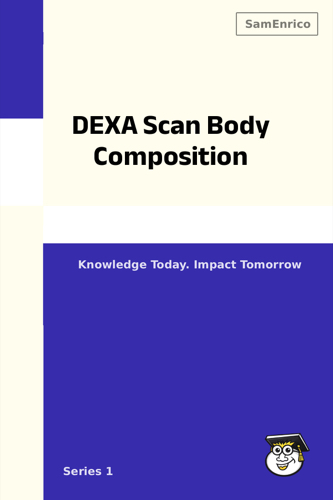
Non-FictionHealth & Wellness / Body Composition
DEXA Scan Body Composition eBook
undefined
undefined
Formats
Free sample
Chapter 1: The Scale Lied...--I want you to imagine something. Picture a woman—let's call her Sarah. She is forty-three years old, five feet six inches tall, and she weighs exactly one hundred and forty-five pounds. Every morning for the past seventeen years, Sarah has stepped onto a scale in her bathroom. Some days the number is one hundred and forty-three.
Some days it is one hundred and forty-seven. But most days, it hovers right around one hundred and forty-five. By every conventional measure, Sarah is a success story. Her body mass index is 23.4, which falls squarely in the "normal weight" category. Her doctor has never once mentioned her weight as a concern.
Her friends tell her she looks great. Sarah herself feels reasonably healthy—tired sometimes, yes, but who isn't? She assumes that because the scale has not changed much over the years, her body has not changed much either. She assumes she is fine.Now imagine that Sarah agrees to undergo a DXA scan—a dual-energy X-ray absorptiometry scan that measures not how much she weighs, but what that weight is made of. The results come back, and they stop her cold.
Sarah's total body fat percentage is thirty-eight percent. Her lean mass—the muscle, organ tissue, and protein stores that power every metabolic process in her body—falls below the tenth percentile for women her age. Her visceral adipose tissue, the fat that wraps around her internal organs like a suffocating blanket, measures one point two kilograms. That is enough to place her in the high-risk category for type 2 diabetes, cardiovascular disease, and metabolic syndrome. By the numbers that actually matter for long-term health and survival, Sarah is not fine at all.
She is, in the precise clinical terminology, "skinny fat." And the scale in her bathroom never warned her.This is the lie that we have all been sold. It is a lie repeated by doctors, fitness trainers, weight-loss programs, and well-meaning family members. It is the lie that your weight, and your weight alone, tells you something meaningful about your health. It does not. The scale cannot tell the difference between a pound of muscle and a pound of fat.
It cannot tell you if the five pounds you lost last week were fat, water, or precious muscle tissue that you will desperately need as you age. It cannot tell you that you have become metabolically obese while remaining outwardly thin. It cannot tell you that the number you have been obsessing over for years is almost completely useless as a predictor of your actual health trajectory. The scale is, at best, a crude instrument from a bygone era. At worst, it is a liar.
And it is time to stop believing it.This book exists because the scale is not the only lie. BMI, waist-to-hip ratios, body fat calipers, and even the expensive "smart scales" sold on Amazon all share the same fundamental limitation: they are guessing. They are making assumptions about your body that are often wrong. The DXA scan is different. It is not guessing.
It is not estimating based on electrical impedance or tape measure circumference. It is using the same fundamental physics as medical X-ray technology to literally see through your skin and measure, with remarkable precision, exactly how many grams of fat, grams of lean tissue, and grams of bone mineral are contained within your body. It is the closest thing we have to a truth-teller in the world of body composition.The Day Everything Changed Let me take you back to the moment that changed how I thought about weight, health, and the human body. I was twenty-eight years old, and I had just completed my first DXA scan as part of a research study I was participating in. Like most people, I had always assumed I was in pretty good shape.
I ran three times a week. I ate reasonably well. My weight had been stable for years. The scale said I was healthy, so I believed it. When the DXA results came back, I sat down with a researcher who walked me through the report line by line.
That conversation lasted forty-five minutes. By the end of it, I realized that everything I thought I knew about my body was wrong.My total body fat percentage was not the "average" I had assumed. It was significantly higher than average for my age and sex, but because I carried that fat evenly distributed rather than concentrated in my belly, no one had ever noticed. My lean mass, particularly in my legs, was lower than it should have been—a silent warning sign that I was already losing muscle at an age when I should have been at peak mass. And my visceral fat, which I had never even heard of before that day, was creeping into the danger zone.
I was not obese. I did not look overweight. But I was, by every meaningful metabolic metric, on a trajectory toward chronic disease. The scale never told me that. The scale could not tell me that.That DXA scan was a wake-up call.
It prompted me to change my diet, prioritize protein, add resistance training to my routine, and monitor my body composition rather than my weight. Eighteen months later, I repeated the scan. My body fat had dropped by six percent. My lean mass had increased by nearly four pounds. My visceral fat had fallen below the risk threshold.
My weight? It had gone up by two pounds. If I had been using the scale as my only metric of success, I would have thought I was failing. Instead, I was transforming my health from the inside out.This is why I wrote this book. Not because I am a bodybuilding coach or a weight-loss guru or a supplement salesperson.
I wrote this book because the DXA scan is the most underutilized tool in all of health and fitness, and most people—including many doctors—do not know how to interpret the results correctly. I wrote this book because millions of people are chasing the wrong numbers on the wrong devices, getting discouraged, giving up, or worse, becoming sicker while believing they are healthy. And I wrote this book because the science of body composition has advanced so dramatically in the past two decades that clinging to BMI and bathroom scales is no longer just outdated—it is actively harmful.What the Scale Cannot See The human body is not a single number. It is an incredibly complex system of fat tissue, muscle tissue, bone, water, organs, and connective tissue. When you step on a scale, you are measuring the gravitational pull of everything inside you—the bone broth you drank for breakfast, the water you retained because you ate salty food last night, the muscle you built over six months of training, and the fat that has accumulated around your liver.
The scale collapses all of this complexity into a single, meaningless digit. Then we take that digit and do something even more absurd: we divide it by height to calculate BMI, and we use that crude ratio to make life-altering health decisions.Consider the following. A…
This is the end of the free sample. Get the eBook to keep going. Buy now
About this book
Details
- Author
- Prentice Dotty
- Publisher
- SamEnrico
- Language
- English
- Genre
- Non-Fiction, Health & Wellness / Body Composition
- Released
- 2026-06-07
- Pages (approx.)
- 140
- Available as
- eBook, Audiobook

Read better in the ZLOADR app
Your eBooks on your phone or tablet. Sign in with your SamEnrico account and start reading.
More by Prentice Dotty
 IBS And Mold Exposure GuidePrentice Dotty$11.99
 Weekly Review Mastery GuidePrentice Dotty$11.99
 Habit Tracking JournalPrentice Dotty$11.99
 Career Disappointment RecoveryPrentice Dotty$11.99
 The Twelve Step Home Group GuidePrentice Dotty$11.99
 Cut Off Response GuidePrentice Dotty$11.99
 David Unaipon Australian VoicePrentice Dotty$11.99
 The Bronze Masters of Ife: Sculpting the Divine in Yoruba ArtPrentice Dotty$11.99
 The Pen and the Pitch: How Latin America's Sports Writers Shaped a ContinentPrentice Dotty$11.99
 How to Produce Train PartsPrentice Dotty$11.99
 A Collector's Handbook to the Hupmobile Aerodynamic 6Prentice Dotty$11.99
 German Raise for ImmigrantsPrentice Dotty$12.99
You may also like
 Hong Kong Handover 1997Dunn Johnnie$11.99
 Zumba For Postnatal Recovery CourseNeal Christian$11.99
 Zumba for BeginnersLadner Nikia$11.99
 YouTube Comment Mining GuideHumes Pandora$12.99
 Worry Box MeditationCarlin Rudy$11.99
 Workplace Stress MeditationNguyen Lynn$11.99
 Workplace Stress and Sleep RepairHawley Ivory$11.99
 Workplace Perfectionism CureDelaney Jeffry$11.99
 Workplace Injustice Anger GuideWallen Isabelle$11.99
 Work Addiction and Burnout LinkGreenwood Ester$11.99
 Women in Yoga and WellnessBeattie Galina$11.99
 Women in Stand Up ComedyChun Evangeline$11.99