
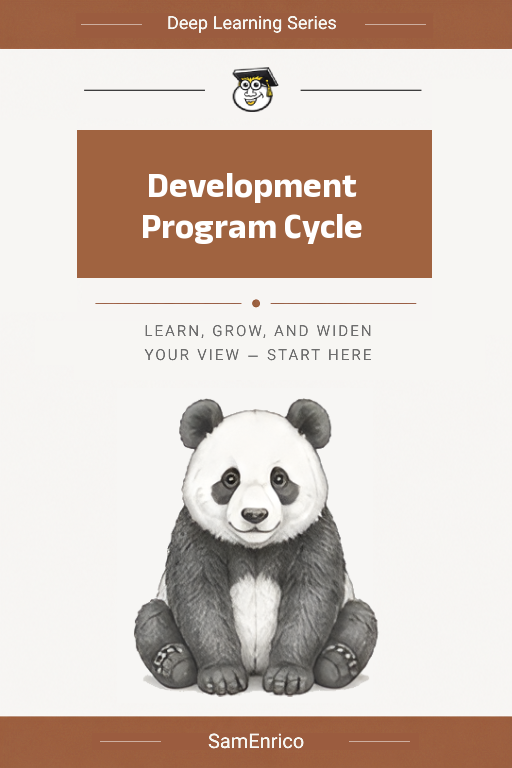
Development Program Cycle eBook
Learn project design, logical frameworks, and dono
by Howe Sabina
Learn project design, logical frameworks, and donor reporting for career growth.
Formats
Free sample
Chapter 1: The Promotion Trap...--You have probably felt it by now. The quiet frustration of submitting another quarterly report that no one seems to read. The sinking realization that your technical competence in running activities has not translated into the career acceleration you were promised. The uncomfortable truth that colleagues who seem to know less about your sector than you do keep getting promoted ahead of you.This is not a failure of your work ethic. It is a failure of your framework.Every day, thousands of dedicated development professionals wake up, go to their laptops, and execute tasks with remarkable efficiency.
They organize workshops. They manage logistics. They track that community health workers were trained and that latrines were built and that training manuals were printed. They do this work with passion, often in difficult and dangerous environments, for salaries that would embarrass their private sector peers. And then they wonder why, after five or seven or ten years, they are still writing reports for someone else to approve rather than being the one who signs off on strategy.The answer is brutal but liberating.
You are stuck in what this book calls the Promotion Trap. You have been rewarded for being a great executor of activities, so you keep being asked to execute more activities. Meanwhile, the people advancing into program director roles and country representative positions and senior technical advisor slots have something you do not. They have not just done the work. They have proven they can design the work, measure the work, and convince donors to fund the work.
They have moved from being task-completers to being results-articulators.This book is the bridge across that gap.The Development Program Cycle is the hidden curriculum of the aid industry. It is the sequence of stages that every funded project must pass through, from the moment a donor decides to spend money on a problem to the moment an evaluator decides whether that money made a difference. Mastering this cycle is not an academic exercise. It is the single most reliable predictor of career acceleration in the international development sector, across NGOs, United Nations agencies, bilateral donors, and social enterprises.I learned this lesson the hard way. Early in my career, I was exceptionally good at activity execution.
If you needed a training workshop organized in a remote province with three days' notice, I was your person. If you needed procurement completed before the fiscal year ended, I made it happen. My performance reviews used words like "reliable," "efficient," and "gets things done." And for three years, those reviews came with modest raises and heartfelt thanks. But they did not come with promotions.The breakthrough happened when a senior manager pulled me aside after yet another successful workshop and said something I have never forgotten. "You are excellent at delivering outputs," she told me.
"But you have no idea why those outputs matter in the chain of results, and you cannot prove to a donor that your work changed anything. Until you learn the cycle, you will keep being the person who implements other people's designs rather than the person who creates them."That conversation changed my trajectory. I spent the next six months learning exactly what this book teaches. I learned to build logical frameworks. I learned to design indicators that actually measure what matters.
I learned to write donor reports that tell a story of results rather than a list of activities. I learned to budget in a way that connects every dollar to an outcome. And within eighteen months, I had moved from being a project coordinator to a project manager to an acting country director.This is not a story about my exceptional talent. It is a story about the power of a framework. The people who advance in this sector are not necessarily the smartest or the hardest working.
They are the ones who have internalized the logic that donors use to decide what to fund, how to monitor what they have funded, and whether to fund it again. That logic is the Development Program Cycle.Why Your Current Skills Are Not Enough Let us be precise about the skills gap that this book addresses. Most early and mid-career development professionals are exceptionally good at what we will call Activity-Level Competencies. These are the skills of execution. You know how to write a terms of reference.
You know how to recruit a consultant. You know how to organize a stakeholder meeting. You know how to track that a deliverable was submitted on time. These are valuable skills. Without them, no project would ever happen.
But they are not the skills that unlock senior leadership.The skills that unlock senior leadership are what this book calls Cycle-Level Competencies. These are the skills of design, measurement, and persuasion. You know how to analyze a problem so deeply that the solution becomes obvious. You know how to build a logical framework that connects every activity to a measurable outcome. You know how to set indicators that donors trust.
You know how to write a proposal that aligns your project's logic with a donor's mandate. You know how to report progress in a way that makes a donor want to give you more money. You know how to evaluate whether your project actually worked and use those lessons to design the next project better.The difference between these two skill sets is not incremental. It is transformative. An activity-level professional is valuable to an organization.
A cycle-level professional is indispensable to an organization. One is a cost center that implements what others have designed. The other is a strategic asset who can win funding, manage complex projects, and represent the organization to donors. Guess which one gets promoted.Consider a concrete example. Two professionals work on a maternal health project.
Both are competent, dedicated, and hardworking. Professional A spends her day ensuring that community health workers attend their training sessions, that the training materials are printed and distributed, and that attendance sheets are signed and filed. She does this perfectly. At the end of the quarter, she reports that twenty training sessions were conducted and two hundred health workers were trained. She has delivered her outputs.Professional B also ensures the training sessions happen.
But she also understands the project's theory of change. She knows that training alone does not save lives. What saves lives is health workers actually changing their behavior in clinical settings. So she works with the monitoring team to design a pre-test and post-test that measures whether the training improved clinical knowledge. She advocates for adding a follow-up observation checklist to see whether trained health workers are applying new protocols.
When she writes her quarterly report, she does not just list the twenty trainings. She reports that average clinical knowledge scores increased from forty-two percent to seventy-eight percent, and that observed protocol compliance improved from thirty percent to sixty-five percent. She also notes that maternal complication referral rates have not yet improved, which she flags as a risk requiring management attention.Professional B has not done more activities than Professional A. She has done the same activities, plus a small amount of design…
This is the end of the free sample. Get the eBook to keep going. Buy now
About this book
Details
- Author
- Howe Sabina
- Publisher
- SamEnrico
- Language
- English
- Genre
- Non-Fiction, Non-Obvious Career, Program Cycle, Donor Reporting
- Released
- 2026-06-01
- Pages (approx.)
- 158
- Available as
- eBook, Audiobook

Read better in the ZLOADR app
Your eBooks on your phone or tablet. Sign in with your SamEnrico account and start reading.
More by Howe Sabina
 Contract Abstraction for In House CounselHowe Sabina$11.99
 Teacher Imposter Syndrome FixHowe Sabina$11.99
 Lenin AprilHowe Sabina$11.99
 Diarrhea in PregnancyHowe Sabina$11.99
 Sleep Consolidates Memory GuideHowe Sabina$11.99
 Parent Burnout PreventionHowe Sabina$11.99
 The Eighty Years WarHowe Sabina$11.99
 Vision Fast Leadership CourseHowe Sabina$11.99
 Listening to Suicidal FeelingsHowe Sabina$11.99
 The Lioness of Nubia: Amanishakheto and the Glory of KushHowe Sabina$11.99
 The Last Out: Kirk Gibson’s Impossible 1988 Walk-OffHowe Sabina$11.99
 Echoes of the Fire Mountain: The Scientist Who Listened to a VolcanoHowe Sabina$11.99