
Non-FictionInformativeEducational
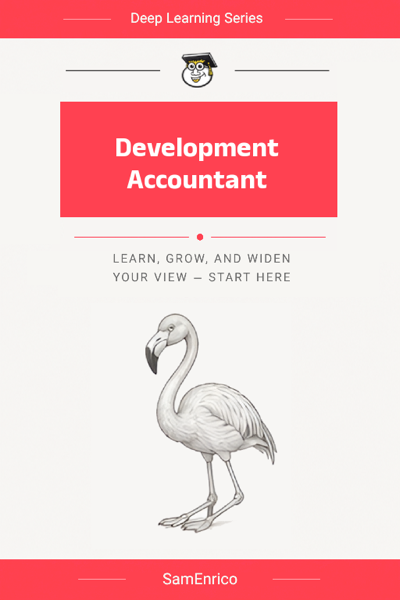
Development Accountant eBook
A Coursebook on Development Accountant
A Coursebook on Development Accountant
Formats
Free sample
Chapter 1: The Bean Counter’s Funeral...--The conference room smelled of stale coffee and desperation. Around a scratched glass table sat seven people: three software engineers picking at their hoodie strings, two product managers clutching laptops like shields, the CEO who had just hung up from an angry investor call, and Sarah—the senior accountant who had been with the company for eleven years.Sarah had prepared the monthly financial package. She had reconciled every bank account. She had booked every accrual. She had closed the books on time, as she did every month for 132 consecutive months.She was also about to be fired.Not today.
Not this meeting. But the writing was on the wall. The company had raised a Series B at a $200 million valuation eighteen months ago. They had hired eighty people. They had launched three new products.
And somehow, despite Sarah’s perfect books, they were running out of cash. The board wanted answers. The CEO had no answers. And Sarah—who knew exactly where every dollar had gone, just not why—had nothing to say that anyone wanted to hear.The CEO turned to her. "Sarah, can you explain why our development costs are up 40% year over year while our feature velocity is flat?"Sarah opened her mouth.
She had the numbers. Development costs: $4.2 million, capitalized basis, net of amortization, adjusted for deferred taxes. She could recite the journal entries from memory.But she had no idea why the velocity was flat. She didn't know what "velocity" meant. She didn't know that her capitalization policy—which she had copied from a template she found online in 2014—was turning everything into a long-term asset regardless of whether it worked.
She didn't know that the engineers had been spending 30% of their time fixing bugs in code that was already "capitalized," meaning those hours were being added to the balance sheet instead of hitting the P&L, hiding the true cost of the team’s technical debt.She gave the only answer she had: "I'll run a variance analysis and get back to you."The engineers exchanged glances. The product managers looked at their shoes. The CEO sighed.Two months later, Sarah was gone. Her replacement—a thirty-year-old former consultant who had never reconciled a bank statement but knew how to talk to engineers—was hired at a salary 60% higher than Sarah's. The new person didn't close the books faster.
They didn't know GAAP cold like Sarah did. But they knew how to ask the right questions. They knew that a capitalized hour was not the same as a valuable hour. They knew that the balance sheet was not a museum for failed experiments.This chapter is about why Sarah lost her job—and why you won't.This is not a chapter about accounting. It is a chapter about the death of backward-looking finance and the birth of a new role: the Development Accountant.The Funeral: Why Traditional Accounting Is Dying Let us be honest about something most accounting textbooks will not say.The traditional accountant—the one who reconciles, closes, and reports—is becoming obsolete.
Not because the work is unimportant. It is critically important. But because software is now doing that work faster, cheaper, and with zero errors.Consider what has happened in the last ten years:Bank feeds eliminated manual reconciliation. Optical character recognition automated invoice capture. AI now flags anomalies that used to require a senior accountant’s intuition.
Cloud ERPs have made the monthly close a five-day process instead of a fifteen-day process. By 2024, according to surveys by Gartner and Deloitte, over 70% of routine accounting transactions are processed without human intervention.The work that Sarah spent eleven years perfecting—the work that once made her indispensable—is now done by algorithms.But here is what the algorithms cannot do.Algorithms cannot sit between a product manager who wants to ship fast and an engineer who wants to refactor the codebase, and determine the financially optimal path. Algorithms cannot build a capitalization policy that survives an audit while maximizing EBITDA. Algorithms cannot look a CTO in the eye and say, "Your team's efficiency variance is not a problem yet, but if it continues for two more sprints, we will miss our runway target by six weeks."That work—the work of the Development Accountant—is not being automated. It is being paid more than ever before.
And it is the reason you are reading this book.The New Line: Operational vs. Development Accounting Before we go any further, we need to draw a line in the sand. It is the most important distinction in this entire book, and it will shape everything that follows.Operational Accounting (The Past)Operational accounting is backward-looking. It asks: What happened? It processes invoices, reconciles bank statements, pays vendors, closes the books, and produces financial statements.
It is essential. It is also increasingly automated. The operational accountant of the future will spend less time doing and more time reviewing what the software has already done.Key characteristics of operational accounting:Focus on historical accuracy Compliance with GAAP/IFRS as a primary goal Monthly or quarterly rhythm Output: financial statements and variance reports Stakeholders: external auditors, tax authorities, banks Development Accounting (The Future)Development accounting is forward-looking. It asks: What should happen? It forecasts ROI, runs scenario analyses, models product viability, allocates shared costs, capitalizes development expenses correctly, and prioritizes features based on financial return.
It is strategic. It is resistant to automation because it requires judgment, context, and human communication.Key characteristics of development accounting:Focus on future value creation GAAP/IFRS as a constraint, not a goal Daily or weekly rhythm (aligned with sprints)Output: recommendations and decisions Stakeholders: product managers, engineers, C-suite The Development Accountant does not stop being an accountant. They still need to know the rules. But they use the rules as a framework for action, not a cage for compliance.The Three Modes of the Development Accountant One of the most common points of confusion for accountants transitioning into development roles is knowing when to play which role. You cannot drive investment decisions every day.
You cannot enforce policies every day. You need a framework that tells you which hat to wear and when.This chapter introduces the Three Modes of the Development Accountant—a framework that will appear throughout this book and serve as your decision guide.Mode 1: Enforcer When to use: When rules are clear, non-negotiable, and have external consequences (audit, tax, regulatory).What you do: You implement mandated policies. You ensure compliance. You say "no" when the rules say no.Example: "ASC 350-40 requires this cost to be expensed, not capitalized. We don't have a choice.
If we capitalize it, our auditors will flag it, and we will have to restate."Mindset: This is not personal. You are not the bad guy. You are the guardian of the company's financial integrity. The rules exist for a reason, and your job is to apply them consistently.Duration: Mode 1 should be used only when necessary. Overuse creates friction and resentment.
Use it sparingly and explain the "why" every time.Mode 2: Partner When to use: When trade-offs exist and input is needed from multiple…
This is the end of the free sample. Get the eBook to keep going. Buy now
About this book
Details
- Author
- Fitzgerald Jennifer
- Publisher
- SamEnrico
- Language
- English
- Genre
- Non-Fiction, Informative, Educational
- Released
- 2026-05-18
- Pages (approx.)
- 158
- Available as
- eBook, Audiobook

Read better in the ZLOADR app
Your eBooks on your phone or tablet. Sign in with your SamEnrico account and start reading.
More by Fitzgerald Jennifer
 Dental Health On MATFitzgerald Jennifer$11.99
 No Brand Shopping RuleFitzgerald Jennifer$11.99
 Listening For Anxious PeopleFitzgerald Jennifer$11.99
 The Martha Washington First LadyFitzgerald Jennifer$11.99
 The Last Broadcast of the Hindenburg: A Press Secretary’s Cover-UpFitzgerald Jennifer$11.99
 How to Start a New Single-Family Housing Construction BusinessFitzgerald Jennifer$11.99
 AI for Documentation GenerationFitzgerald Jennifer$12.99
 Learn to Play the Roman TubaFitzgerald Jennifer$11.99
You may also like
 Hong Kong Handover 1997Dunn Johnnie$11.99
 Zumba For Postnatal Recovery CourseNeal Christian$11.99
 Zumba for BeginnersLadner Nikia$11.99
 YouTube Comment Mining GuideHumes Pandora$12.99
 Worry Box MeditationCarlin Rudy$11.99
 Workplace Stress MeditationNguyen Lynn$11.99
 Workplace Stress and Sleep RepairHawley Ivory$11.99
 Workplace Perfectionism CureDelaney Jeffry$11.99
 Workplace Injustice Anger GuideWallen Isabelle$11.99
 Work Addiction and Burnout LinkGreenwood Ester$11.99
 Women in Yoga and WellnessBeattie Galina$11.99
 Women in Stand Up ComedyChun Evangeline$11.99