
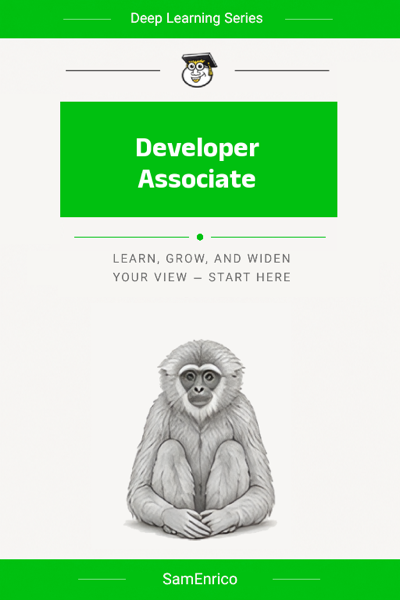
Non-FictionInformativeEducational
Developer Associate eBook
A Coursebook on Developer Associate
by Suarez Fred
A Coursebook on Developer Associate
Formats
Free sample
Chapter 1: The Saturday Morning Crash--It was 6:47 AM on a Saturday when Maria’s phone erupted.Not with a single notification—that would have been merciful. With thirty-seven of them. Pager Duty, Slack, email, and three direct phone calls from her manager. The e-commerce site she had helped build was down. Not slow.
Not glitchy. Down. The dreaded “503 Service Unavailable” stared back from every browser. Her team’s monolithic Rails application, which had worked perfectly on her laptop and passed all the tests in staging, had collapsed under the weight of a flash sale that went viral.For the next fourteen hours, Maria and three other engineers did what they had always done: they restarted servers, cleared caches, added more memory, and prayed. By Sunday morning, the site was back up.
By Monday, the post-mortem revealed the painful truth. A single database query that worked fine for ten thousand users turned into a sequential scan of death for two hundred thousand. The monitoring system had alerted them, but no one understood the alert because it was buried in a sea of false positives. The autoscaling group had tried to add more servers, but the database connection pool maxed out first. Everything failed together because everything was tied together.Maria’s story is not unique.
It happens every day. And it happens because most developers learn to write code that works on one computer, not code that survives a million computers. That is what this book is for.This chapter is not an overview. It is a reset. Everything you know about “how software works” assumed a world of fixed capacity, predictable networks, and servers that stay running forever.
That world is gone. Cloud-native development requires a different mindset, different tools, and a different definition of what it means to write “good code.” By the end of this chapter, you will understand why your Saturday mornings can be better, and you will have your hands on the actual tools you need to build systems that survive the unexpected.The Unlearning: Why Your Localhost Lies to You When you develop on your laptop, you live in a frictionless fantasy world. Your database is on the same machine, so latency is measured in microseconds. Your network never drops packets. Your disk never fills up.
Your CPU is yours alone. You restart your server and it comes back instantly. Your dependencies are all the right versions because you just installed them yesterday.Production is none of those things.In the cloud, your database might be in a different Availability Zone, fifty kilometers away, adding two milliseconds of latency to every query. Your network experiences packet loss, jitter, and the occasional transient failure that retries fix—if you remembered to implement retries. Your disk is shared storage with unpredictable I/O.
Your CPU is one of thousands on a hypervisor, and your noisy neighbor might be stealing cycles. When your server restarts, it might be because the underlying hardware failed, and your new instance is running on completely different infrastructure with a different IP address.The first lesson of cloud-native development is this: failure is not exceptional. Failure is normal.In traditional development, you write try-catch blocks for the errors you can imagine. Database down? Catch it.
File not found? Catch it. But cloud-native development requires assuming that everything will fail, and designing your system so that when it does, the impact is contained. This is not pessimism. It is professional engineering, just like a bridge designer assumes that wind will blow and earthquakes will shake.Consider the difference in how you think about state.
On your laptop, you can store a user’s session in memory. It works fine. In the cloud, if that server dies, the user is logged out and loses whatever they were doing. The solution is to store session state externally—in Elasti Cache, Dynamo DB, or a database. The code is slightly more work.
The system is vastly more reliable.Or consider logging. On your laptop, you write to a log file and read it with tail -f. In the cloud, your log file disappears when the instance terminates. You need centralized logging—every instance sends logs to a service like Cloud Watch Logs, where you can search across thousands of servers in seconds. The mental shift is from “my log” to “our logs.”This chapter begins the unlearning process.
The code examples throughout this book will assume nothing about the environment except that it can and will fail. You will learn patterns, not just syntax. And you will start by understanding where your code actually runs.The Geography of the Cloud: Regions, Zones, and Edges Before you write a single line of cloud code, you need to understand the physical infrastructure that runs it. Amazon Web Services (AWS) divides the world into Regions, Availability Zones, and Edge Locations. These are not abstract concepts.
They directly impact your application’s latency, availability, and cost.Regions are geographic areas, each containing multiple data centers. Examples include us-east-1 (Northern Virginia), eu-west-1 (Ireland), and ap-southeast-1 (Singapore). Each Region is completely independent of every other Region. If us-east-1 experiences a power failure, eu-west-1 continues running. This independence is by design.
AWS builds Regions so that a disaster in one cannot cascade to another. When you choose a Region, you are choosing a trade-off between latency to your users and regulatory compliance. European customers whose data must stay in Europe cannot use us-east-1. A gaming company with players in Japan should deploy to ap-northeast-1.Inside each Region are Availability Zones (AZs). Think of an AZ as one or more data centers that are separate enough that a power failure, network outage, or cooling problem in one AZ is unlikely to affect another AZ in the same Region.
AZs within a Region are connected by high-speed, low-latency fiber, but they are not the same building. The magic of AWS is that you can run your application across multiple AZs. If one AZ goes down, your application continues running in the other AZs. This is how you achieve high availability without building your own data center.Here is the critical detail: you must explicitly design for multi-AZ. If you launch an EC2 instance in a single AZ and that AZ fails, your instance fails.
But if you launch the same application across three AZs with a load balancer in front, a single AZ failure only reduces capacity by one-third. Most managed AWS services, like S3 and RDS with Multi-AZ enabled, automatically replicate across AZs. For your own code, you are responsible for running copies in multiple AZs.Edge Locations are different. They are not for running your application logic. They are for delivering content quickly to users everywhere.
When you use Cloud Front, AWS’s content delivery network, your static assets (images, CSS, Java Script) are cached at hundreds of Edge Locations worldwide. A user in Sydney downloads your logo from an Edge Location in Sydney, not from your server in us-east-1. The latency difference is massive—milliseconds instead of hundreds of milliseconds.Edge Locations also run Lambda@Edge, which allows you to run Java Script functions that modify requests and responses at the edge. This is advanced, but the principle…
This is the end of the free sample. Get the eBook to keep going. Buy now
About this book
Details
- Author
- Suarez Fred
- Publisher
- SamEnrico
- Language
- English
- Genre
- Non-Fiction, Informative, Educational
- Released
- 2026-06-02
- Pages (approx.)
- 149
- Available as
- eBook, Audiobook

Read better in the ZLOADR app
Your eBooks on your phone or tablet. Sign in with your SamEnrico account and start reading.
More by Suarez Fred
 Governor's Mansion MemoirSuarez Fred$11.99
 LinkedIn Learning ComparisonSuarez Fred$11.99
 Influencer Contract Compliance GuideSuarez Fred$11.99
 The Adult Community Purchase PrimerSuarez Fred$11.99
 Spiritual Goal Action PlanningSuarez Fred$11.99
 When the Sky Split Open: The Maori Birth of Te Ao MāramaSuarez Fred$11.99
 Evening Screen Wind Down WorkbookSuarez Fred$12.99
 Africa B2B Sourcing OutlookSuarez Fred$12.99
 Understanding Intestinal Pseudoobstruction Chronic IdiopathicSuarez Fred$17.99
 How to Become a Chocolate-production-machine OperatorSuarez Fred$11.99
You may also like
 Hong Kong Handover 1997Dunn Johnnie$11.99
 Zumba For Postnatal Recovery CourseNeal Christian$11.99
 Zumba for BeginnersLadner Nikia$11.99
 YouTube Comment Mining GuideHumes Pandora$12.99
 Worry Box MeditationCarlin Rudy$11.99
 Workplace Stress MeditationNguyen Lynn$11.99
 Workplace Stress and Sleep RepairHawley Ivory$11.99
 Workplace Perfectionism CureDelaney Jeffry$11.99
 Workplace Injustice Anger GuideWallen Isabelle$11.99
 Work Addiction and Burnout LinkGreenwood Ester$11.99
 Women in Yoga and WellnessBeattie Galina$11.99
 Women in Stand Up ComedyChun Evangeline$11.99