
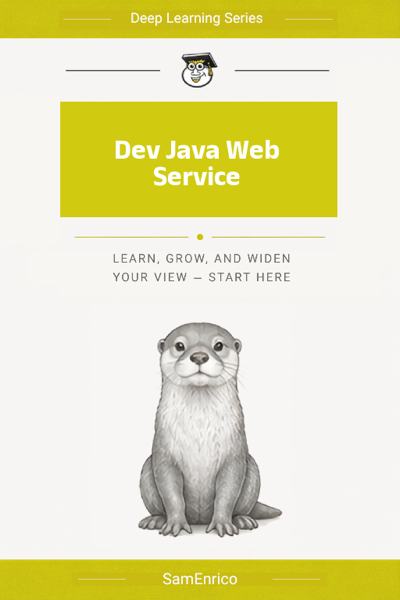
Dev Java Web Service eBook
A Coursebook on Dev Java Web Service
A Coursebook on Dev Java Web Service
Formats
Free sample
Chapter 1: The Billion-Dollar Mistake...–- In 1996, a major airline lost $50 million on a single software project. The goal had been simple: connect their ticket reservation system (running on an IBM mainframe) to their new website (running on Sun Solaris servers). The teams spent eighteen months trying to make two programs talk to each other. They tried custom sockets. They tried Remote Procedure Call (RPC). They tried a homegrown message format. Nothing worked reliably. Every time the mainframe team changed a field type, the website team's parsers broke. Every time the network team upgraded a router, connections dropped and never recovered.–- The project failed so spectacularly that the airline’s CTO later wrote a memo titled "What We Learned," and in that memo, buried on page fourteen, was a sentence that should be engraved above every developer’s desk: "We spent eighteen months learning that distributed systems are fundamentally different from local programs. We wish someone had told us on day one."–- This chapter is that warning. Before you write a single line of a web service, you need to understand the three core problems that every distributed system must solve—and the billion-dollar mistakes that happen when you ignore them. You will learn why RMI (Remote Method Invocation), CORBA (Common Object Request Broker Architecture), and even early SOAP implementations failed in production, not because they were badly coded, but because they violated the fundamental laws of networks.–- By the end of this chapter, you will have written your first web service proxy in Java, watched it fail across a real network, and understood why the industry eventually converged on the REST architecture you will learn in the rest of this book. You will also have a mental checklist of the "Fallacies of Distributed Computing" that you can deploy in any architecture meeting to sound like a senior engineer.The Three Impossible Problems–- Every time two computers talk to each other over a network, three impossible things happen before breakfast. Peter Deutsch, a distinguished engineer at Sun Microsystems, documented these as the "Fallacies of Distributed Computing" in 1994. Most developers have heard the list—eight fallacies in total—but few understand why each one sinks projects.–- Fallacy #1: The network is reliable. Your code almost never fails on localhost. Your integration environment has consistent latency and zero packet loss. Then you deploy to production, and a switch in a data center in Virginia drops 0.1% of packets. Your client retries three times, each retry times out after ten seconds. Your user waits thirty seconds. The product manager asks why. You have no answer.–- Fallacy #2: Latency is zero. Your method call returns in two milliseconds on your laptop. On the production network, with TLS handshakes, serialization, and queuing, the same call takes two hundred milliseconds. You now have a hundred-millisecond budget for an operation that used to take five. Your architecture breaks.–- Fallacy #3: Bandwidth is infinite. You decide to send the entire customer object graph—including orders, addresses, and payment history—in one web service call because "it's easier." Then you have ten thousand concurrent users. Your network card becomes the bottleneck. Users see spinning spinners. The infrastructure team blames your code.–- Fallacy #4: The network is secure. You trust that your internal network is safe. No one is sniffing packets. No one is injecting malicious responses. Then a contractor installs a packet analyzer on a shared switch, or a developer commits credentials to a public Git Hub repository, or an employee plugs a compromised laptop into the office network. You have no encryption. You have no authentication. You have no audit trail.–- Fallacy #5: Topology doesn't change. You hardcode IP addresses into configuration files because "the servers never move." Then the operations team migrates to a new data center. The IP addresses change. Your service points to a dead server. Someone has to manually update twenty config files.–- Fallacy #6: There is one administrator. You assume the network team, the security team, the database team, and the application team all communicate. Then the network team adds a firewall rule that blocks your web service port. No one tells the application team. Your service works in the morning and fails after lunch.–- Fallacy #7: Transport cost is zero. You ignore the CPU cost of serialization, compression, encryption, and protocol parsing. Then your service at 100 requests per second consumes 80% of your CPU just marshalling and unmarshalling messages. Your response time graphs look like a sawtooth wave because garbage collection kicks in every few seconds.–- Fallacy #8: The network is homogeneous. You assume every client and server uses the same character encoding, the same endianness (byte order), the same floating-point representation, and the same version of the same protocol. Then a client on an IBM mainframe (EBCDIC encoding, big-endian byte order) tries to talk to your Java server (UTF-8, big-endian) and sends numbers that look like gibberish.–- These eight fallacies explain every distributed systems disaster you have ever witnessed. The $50 million airline failure happened because they assumed the network was reliable (it wasn't), latency was zero (it wasn't), and transport cost was zero (it wasn't). Their homegrown protocol tried to hide the network, and the network bit back.The First Attempt: Remote Procedure Call (RPC)–- In 1984, Birrell and Nelson at Xerox PARC published a paper titled "Implementing Remote Procedure Calls." The idea was simple and seductive: make remote calls look like local procedure calls. You would write:c Copy Download// Local call - same machine
int result = add(3, 5);
// Remote call - different machine int result = remote_add("server123", 3, 5);–- The syntax was nearly identical. The compiler and runtime libraries would handle marshalling arguments, sending messages over the network, receiving responses, and returning results. This was the original promise of RPC, and it changed how developers thought about distributed programming.–- Java's version was RMI (Remote Method Invocation) , released in 1997 as part of JDK 1.1. Let me show you what RMI looked like, because understanding its failure teaches you everything about why modern web services use HTTP and JSON instead of binary protocols.–- RMI in Action (Simplified)–- First, you defined a remote interface that extended java.rmi.Remote:java Copy Downloadimport java.rmi.Remote; import java.rmi.Remote Exception;
public interface Weather Service extends Remote { // remote method signatures - must declare Remote Exception double get Temperature(String city) throws Remote Exception; }–- Notice the throws Remote Exception. Every remote method had to declare it, because network failures were expected. That was RMI's concession to reality—but it was the only concession.–- Next, you implemented the service:java Copy Downloadimport java.rmi.Remote Exception; import java.rmi.server.Unicast Remote Object; import java.rmi.registry.Locate Registry; import java.rmi.registry.Registry; import java.util.Hash Map; import java.util.Map;
public class Weather Service Impl extends Unicast Remote Object implements Weather Service { private Map temperatures = new Hash Map();
public Weather Service Impl() throws Remote Exception { temperatures.put("London", 12.5); temperatures.put("Paris", 15.0); temperatures.put("New York", 18.2); }
@Override public double get Temperature(String city) throws Remote Exception { // Simulate database lookup or sensor reading if (!temperatures.contains Key(city)) { throw new Remote Exception("City not found: " + city); } return…
This is the end of the free sample. Get the eBook to keep going. Buy now
About this book
Details
- Author
- Childers Celine
- Publisher
- SamEnrico
- Language
- English
- Genre
- Non-Fiction, Informative, Educational
- Released
- 2026-05-08
- Pages (approx.)
- 160
- Available as
- eBook, Audiobook

Read better in the ZLOADR app
Your eBooks on your phone or tablet. Sign in with your SamEnrico account and start reading.
More by Childers Celine
 Notarbartolo Confession AnalysisChilders Celine$11.99
 HIIT for Boxers GuideChilders Celine$11.99
 Vision Friendly Technology GuideChilders Celine$11.99
 Holidays With Addict ParentsChilders Celine$11.99
 Low Nicotine Cigarette TaperChilders Celine$11.99
 The Unseen Hand: How a 19th-Century Lawmaker Shaped Modern DemocracyChilders Celine$11.99
 The Last Broadcast of the Eternal Echo: How AI Predicted the 2008 Financial CollapseChilders Celine$11.99
 Breath Control For Test AnxietyChilders Celine$12.99
 Intellectual Property B2B GuideChilders Celine$12.99
 Understanding Carnevale–krajewska–fischetto SyndromeChilders Celine$17.99
 How to Start a Pots Made of Glass Business (Beginners Guide)Childers Celine$11.99