
Detox And Kidney Function eBook
Explains renal risks and hydration needs during wi
Explains renal risks and hydration needs during withdrawal.
Formats
Free sample
Chapter 1: The Silent Filter--The liver gets all the glory. Walk into any health food store, and you will see shelves lined with “liver cleanses,” “liver detox formulas,” and “liver support tinctures.” Social media influencers tout liver flush recipes involving olive oil, grapefruit juice, and Epsom salts. Patients in withdrawal worry obsessively about their liver enzymes, often demanding liver function tests before they will agree to any treatment plan. Meanwhile, tucked behind the liver’s limelight, two fist-sized organs sit quietly in the retroperitoneal space, filtering your entire blood volume approximately thirty times per day, excreting every single drug metabolite that your liver processed, and maintaining the precise chemical balance that keeps your heart beating and your brain functioning. Those organs are your kidneys, and in the context of substance withdrawal, they are far more vulnerable, far more silent, and far more likely to fail without warning than the celebrated liver.This chapter will fundamentally reframe how you understand detoxification.
You will learn why the kidney, not the liver, is the rate-limiting organ in drug elimination. You will discover the dangerous myths that have led countless withdrawing patients to worsen their condition through misguided “flushing” protocols. And you will be introduced to the single most important distinction in renal medicine: the difference between prerenal acute kidney injury, which is reversible with proper hydration, and intrinsic acute kidney injury, which can destroy nephrons permanently and set you on a path to chronic kidney disease a decade later. By the end of this chapter, you will never look at a glass of water—or a detox kit—the same way again.The Physiology of Renal Excretion: How Your Kidneys Actually Remove Drugs To understand why the kidneys matter so much during withdrawal, you must first understand how they work. The kidney is not a passive filter like a coffee strainer.
It is an active, energy-intensive organ that selectively reabsorbs nutrients while excreting wastes. Each kidney contains approximately one million nephrons—tiny functional units consisting of a glomerulus (a tuft of capillaries) and a tubule (a winding pipe that processes the filtrate).Blood enters the glomerulus under pressure. The glomerular filtration barrier is exquisitely selective: it allows water, sodium, potassium, glucose, and small solutes to pass through, but it holds back blood cells and large proteins like albumin. The fluid that crosses into the tubule is called the glomerular filtrate, and it is essentially blood plasma minus the large proteins. A healthy adult produces about 180 liters of this filtrate every single day.
That is nearly fifty gallons. You do not excrete fifty gallons of urine because the tubules reabsorb 99% of that filtrate back into your bloodstream, leaving only one to two liters of concentrated waste to be excreted as urine.Drug metabolites enter this system in two ways. Water-soluble metabolites are filtered directly at the glomerulus. Lipid-soluble metabolites—which include many drug breakdown products—must first be chemically altered by the liver into water-soluble forms (a process called conjugation) before the kidneys can eliminate them. This is the critical partnership: the liver metabolizes, but the kidney excretes.
If the kidney fails, those metabolites accumulate in your blood regardless of how healthy your liver is. You cannot “detox” if your kidneys are not working.The tubules also actively secrete certain drugs directly from the bloodstream into the urine, bypassing glomerular filtration entirely. This secretion occurs via specialized transport proteins called organic anion transporters and organic cation transporters. These transporters are energy-dependent and can be overwhelmed, inhibited, or downregulated in the setting of inflammation, dehydration, or drug interactions. When these transporters fail, drugs and toxins remain in your circulation.During withdrawal, multiple factors converge to impair both glomerular filtration and tubular secretion.
Vomiting and diarrhea deplete intravascular volume, reducing the pressure that drives filtration. Sweating further contracts blood volume. Inflammatory cytokines released during withdrawal downregulate transport proteins. The result is a perfect storm where the kidneys become less efficient at exactly the moment when the body needs them to work hardest.The Myth of Flushing Toxins: Why More Water Is Not Better Perhaps no idea has caused more renal injury during withdrawal than the belief that drinking massive amounts of water will “flush out” drugs and speed up detoxification. This myth is pervasive, dangerous, and entirely unsupported by physiology.The logic seems intuitive: if drugs are eliminated in urine, producing more urine should eliminate more drugs.
But this assumes that urine flow rate is the limiting factor in drug excretion. It is not. For the vast majority of drugs and their metabolites, the limiting factor is either the glomerular filtration rate (how much blood your kidneys filter per minute) or the activity of the tubular transporters. Increasing urine output beyond normal physiological levels—a state called forced diuresis—does not increase the mass of drug eliminated. It simply dilutes the urine, producing larger volumes with lower concentrations of drug.Worse, forced diuresis can be directly harmful.
Drinking excessive water lowers the sodium concentration in your blood—a condition called hyponatremia. When blood sodium drops too low, water moves from the bloodstream into brain cells, causing them to swell. Early symptoms include headache, nausea, and confusion. As sodium drops further, seizures, coma, and brain herniation can occur. This is not a theoretical risk.
In the 1990s, several young adults died from water intoxication after taking MDMA (ecstasy) and then drinking massive amounts of water to “stay hydrated.” Their kidneys did not fail because of the drug. Their brains failed because of the water.The same principle applies during withdrawal from alcohol, opioids, benzodiazepines, and stimulants. Patients who force themselves to drink gallons of water are not speeding up detoxification. They are diluting their electrolytes, stressing their kidneys, and risking cerebral edema.What about commercial detox kits? These products, sold online and in some supplement stores, typically contain a mix of diuretics (often herbal such as dandelion root, juniper berry, or uva ursi), laxatives, and caffeine.
The diuretics force the kidneys to excrete water, but again, this does not increase the mass of drug eliminated. It simply dehydrates the patient. Laxatives cause fluid loss through the gastrointestinal tract, further contracting blood volume. The net effect is iatrogenic—medically induced—prerenal acute kidney injury.One study published in the Journal of the American Society of Nephrology reviewed cases of AKI linked to herbal detox products and found that over 40% required hospitalization for intravenous fluids. Several progressed to intrinsic AKI requiring dialysis.
The product labels often claimed to “support kidney health.” In reality, they were poisoning the kidneys through volume depletion.Debunking the Lemon Water and Apple Cider Vinegar Myths Because this book will avoid repetition, we will address these myths here and once only. You will not encounter them again. Lemon water and apple cider vinegar are frequently promoted as kidney cleanses. Proponents claim they “alkalinize the blood” and “dissolve kidney stones” or “break down toxins.” These claims are biologically nonsensical.Your body maintains blood p H within a razor-thin range of 7.35 to 7.45 through the coordinated action of your lungs (which excrete carbon dioxide) and your kidneys (which excrete hydrogen ions and regenerate bicarbonate). No food or beverage you consume can significantly alter blood p H outside this range…
This is the end of the free sample. Get the eBook to keep going. Buy now
About this book
Details
- Author
- Dowling Shemika
- Publisher
- SamEnrico
- Language
- English
- Genre
- Non-Fiction, Health & Wellness, Nephrology
- Released
- 2026-06-11
- Pages (approx.)
- 154
- Available as
- eBook, Audiobook

Read better in the ZLOADR app
Your eBooks on your phone or tablet. Sign in with your SamEnrico account and start reading.
More by Dowling Shemika
 Name Recall for Hotel StaffDowling Shemika$11.99
 Verbal Working Memory BoostDowling Shemika$11.99
 Charley Pride Kiss Angel GoodbyeDowling Shemika$11.99
 Zimbabwe Therapy Access PlanDowling Shemika$11.99
 The Support Overload SolutionDowling Shemika$11.99
 Sleep And Emotional MemoryDowling Shemika$11.99
 Anger and Anxious AttachmentDowling Shemika$11.99
 The American Outback: How Australian Rules Football Secretly Won Over the U.S.Dowling Shemika$11.99
 The Corsair King: Jean Bart and the Golden Age of PrivateeringDowling Shemika$11.99
 How to Start a Ammonium Phosphate Business (Beginners Guide)Dowling Shemika$11.99
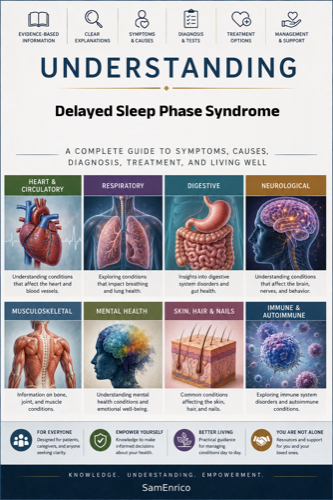 Understanding Delayed Sleep Phase SyndromeDowling Shemika$11.99
 How to Produce ShrubsDowling Shemika$11.99
You may also like
 Restless Leg Syndrome and Kidney DiseaseRyder Fredda$11.99
 Micronutrients For Kidney Health GuideSouthard Teddy$11.99
 RLS And Kidney Disease Management GuideConn Melisa$11.99
 HGH and Kidney AgingSam Cecille$11.99
 Genetic Testing for Kidney DiseaseVillarreal Sydney$11.99
 Meth Rhabdomyolysis GuideCabrera Marvel$11.99
 Renal Failure Detox AdjustmentsHogan Mike$11.99
 Cocaine and Kidney FailureRichardson Rogelio$11.99
 The Dialysis Vaccine GuideBernier Maurine$11.99
 Cannabis Use Disorder and Kidney FunctionMarkley Kamala$11.99
 Naturopathy for Kidney HealthSpriggs Glenn$11.99
 Testosterone and Kidney DiseaseMccorkle Jannette$11.99