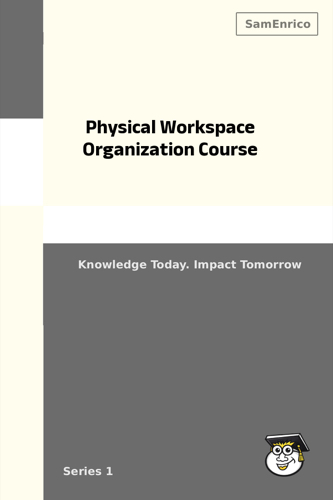
Desk Cleanliness Protocol Audiobook
Removes visual clutter that competes for attention
Removes visual clutter that competes for attention during work.
Formats
Free sample
Chapter 1: The Attention Tax--–- By the time you finish reading this sentence, your brain will have involuntarily glanced at three objects on your desk, registered their shape and color, decided they weren’t a threat, and then forcibly dragged your attention back to these words. That entire sequence took less than two seconds. Now multiply it by 1,400 times per workday. You are not unfocused. You are not lazy.
You are not suffering from some irreversible decline in concentration. Your desk has been pickpocketing your attention, one micro-glance at a time, and you have never noticed until now.This is not a metaphor. It is a measurable neurological phenomenon, and it carries a cost that most knowledge workers never calculate. The average professional loses between two and three hours of focused work each day not to their phone, not to email, not to social media, but to the silent, cumulative effect of visible objects sitting on their desk. A pen here.
A sticky note there. A phone charger. A coffee mug from yesterday. A stack of papers you told yourself you would file last week. A small plant someone gave you that now requires you to check if it needs water.
Each of these items is not merely present. They are competing. And you are paying the price in mental energy you will never get back.This chapter is not about cleaning your desk. It is about understanding why a clean desk is one of the most powerful cognitive tools you have never used. We will explore the neuroscience of visual distraction, introduce the concept of cognitive cost as the book defines it, and reveal why even people who claim to thrive in “organized chaos” are silently bleeding focus.
By the end of this chapter, you will never look at a paperclip on your desk the same way again.The Science of Involuntary Attention Your brain is not a computer. It does not simply process whatever you point it at. Instead, your brain is a survival organ that evolved to constantly scan your environment for threats, opportunities, and changes. This system is called the orienting response, discovered by Russian physiologist Ivan Pavlov in 1927. He found that any novel or unexpected stimulus in the peripheral visual field triggers an automatic physiological reaction: pupils dilate, heart rate slows slightly, and the brain temporarily redirects processing resources toward the new stimulus.
You cannot consciously suppress this response. It is hardwired into your nervous system from hundreds of thousands of years of…
This is the end of the free sample. Get the Audiobook to keep going. Buy now
About this book
Details
- Author
- Reid Theodore
- Publisher
- SamEnrico
- Language
- English
- Genre
- Non-Fiction, Self-Help, Workspace Organization
- Released
- 2026-06-09
- Pages (approx.)
- 154
- Available as
- eBook, Audiobook

Listen in the VoxFlicks app
Audiobooks and audio dramas wherever you go. Sign in with your SamEnrico account and press play.
More by Reid Theodore
 Recurring Dreams and Shadow IntegrationReid Theodore$11.99
 Overload Trance InductionReid Theodore$11.99
 MBSR Eight Week Course GuideReid Theodore$11.99
 Lower Back Pain ChiropracticReid Theodore$11.99
 Hypnosis Cheat SheetReid Theodore$11.99
 Wilson LeagueReid Theodore$11.99
 Motivation Emotional IntelligenceReid Theodore$11.99
 Preventing Engineering BurnoutReid Theodore$11.99
 The Sun King's Grandeur: Louis XIV and the Birth of VersaillesReid Theodore$11.99
 The Last Pharaoh's Secret: Cleopatra's Hidden LegacyReid Theodore$11.99
 Anansi Weaves the World: The Spider’s Song of WisdomReid Theodore$11.99
 Retail Media Network StrategyReid Theodore$11.99