
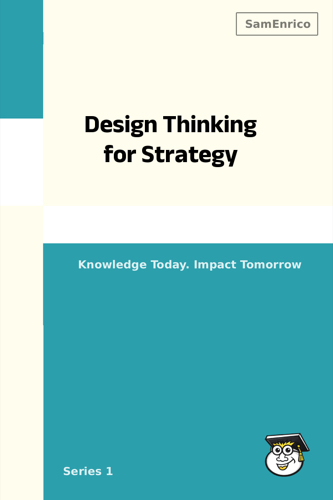
Design Thinking for Strategy eBook
Human centered strategic planning.
Human centered strategic planning.
Formats
Free sample
Chapter 1: The Empathy Vacuum--Every failed strategy begins as a brilliant idea.That is the first and most uncomfortable truth this book asks you to accept. Walk into any corporate boardroom, any government agency, any nonprofit headquarters, and you will find shelves lined with three-ring binders and digital folders filled with strategic plans. Each one represents months of analysis, countless hours of executive debate, and millions of dollars in consulting fees. Each one promised to transform the organization, capture new markets, defeat competitors, or deliver breakthrough results. And each one—or at least most of them—sit exactly where they landed: unopened, unexecuted, and unloved.The problem is not that strategists are unintelligent.
The problem is not that organizations lack data. The problem is not even that competition has intensified or that markets have become unpredictable. All of those things are true, but they are symptoms, not causes. The root cause of strategic failure is far simpler and far more human: strategy has been designed in an empathy vacuum.This chapter introduces the central argument of this entire book. Strategy fails when it is abstract.
Strategy fails when it is designed by people who are disconnected from the humans who must execute it and the humans who must be served by it. Strategy fails when it confuses models for reality, slides for understanding, and forecasts for insight. The antidote is not better analytics or faster planning cycles. The antidote is empathy—systematic, disciplined, uncomfortable empathy for the people on the other end of your decisions.The Strategy Industrial Complex Let us name the enemy clearly. For decades, strategic planning has been dominated by what we might call the abstraction machine.
This machine runs on a particular set of tools: market size projections, competitive positioning matrices, five-year financial forecasts, SWOT analyses, and Porter's Five Forces. None of these tools are inherently bad. They become dangerous when they are mistaken for strategy itself rather than recognized as inputs to strategy.The abstraction machine produces beautiful documents. It fills Power Point slides with elegant arrows and cascading boxes. It generates spreadsheets with numbers that extend to three decimal places, creating an illusion of precision that no human forecast can possibly deliver.
It gives executives the feeling of control, the comfort of certainty, and the satisfaction of a completed plan. What it does not do is touch reality.Consider a typical annual strategic planning process. It begins sometime in the third quarter, when the finance team distributes templates for the coming year. Division heads fill in their projections. Meetings are scheduled, rescheduled, and held in sterile conference rooms with whiteboards and markers that have long since dried out.
Arguments erupt over growth assumptions and resource allocations. Compromises are struck, often late at night, fueled by catered sandwiches and caffeine. Finally, after weeks of negotiation, a plan is approved. It is printed, bound, and distributed. And then—almost immediately—it begins to decay.Why does it decay?
Because the world does not care about your planning calendar. Customers change their minds. Competitors launch unexpected products. Supply chains break. Employees leave.
New technologies emerge. The elegant plan that looked so perfect in December is laughably obsolete by March. But the organization, having invested so much in the plan, often doubles down. It ignores the signals of change. It punishes the messengers who bring bad news.
It treats the plan as sacred and reality as the deviation.This is the empathy vacuum in action. The plan was built on abstractions about customers and employees, not on direct, current, uncomfortable contact with them. The planners did not spend time watching customers struggle. They did not sit with frontline employees to understand why certain processes fail. They did not ask the basic human questions: What is it like to be on the receiving end of our strategy?
What frustrates you? What delights you? What would make your life easier?Defining Human-Centered Strategic Planning Human-Centered Strategic Planning is the systematic practice of building strategy from direct, empathetic engagement with the people the strategy affects. It stands in direct opposition to the abstraction machine. Where traditional planning is rigid, human-centered planning is iterative.
Where traditional planning is forecast-driven, human-centered planning is insight-driven. Where traditional planning is internally focused on shareholder value, human-centered planning is externally focused on human value. Where traditional planning happens once a year, human-centered planning is continuous.This is not a call to abandon rigorous analysis. Financial modeling, market research, and competitive intelligence remain essential. The difference is one of sequence and primacy.
In traditional planning, analysis precedes empathy. You build a model, then you test it against human reactions. In human-centered planning, empathy precedes analysis. You first understand human needs, behaviors, and contexts. Then you build models that serve those realities.The shift from shareholder value to human value is particularly important.
Shareholder value is not evil. It is simply incomplete. When organizations prioritize shareholder returns above all else, they optimize for financial metrics that are lagging indicators of value creation. They cut costs in ways that degrade customer experience. They squeeze employees until engagement collapses.
They make decisions that look great on quarterly earnings calls and terrible in the lives of real people.Human value, by contrast, is a leading indicator. When you design strategy around what actually helps people—customers and employees alike—the financial results follow. Not always immediately, not always smoothly, but inevitably. Companies like Patagonia, REI, and Novo Nordisk have demonstrated this repeatedly. They did not succeed despite caring about human outcomes.
They succeeded because they cared.The Two Faces of Empathy Any discussion of empathy in strategy must address two distinct but equally important constituencies. The first is external empathy for customers, users, patients, citizens, or whoever receives your organization's outputs. The second is internal empathy for employees, managers, and everyone who must execute the strategy. Neglect either face, and your strategy will fail.External empathy asks: What is it like to be a customer? What problems do they face that they cannot articulate?
What workarounds have they invented because your product or service does not quite work for them? What emotions—frustration, anxiety, delight, relief—accompany each interaction with your organization? These questions cannot be answered from a conference room. They require going to where customers live, work, and struggle.Internal empathy asks parallel questions about the people inside your organization. What is it like to be a frontline employee trying to execute a strategy designed by people who have never done your job?
What approvals slow you down? What systems actively work against serving customers well? What would make your work more meaningful and effective? These questions are equally uncomfortable. They require leaders to confront the gap between their assumptions and the reality of daily work.Throughout this book, we will develop methods for both external and internal empathy.
Chapter 3 focuses on ethnographic research with customers. Chapter 4 applies the same methods to employees. Chapter 10 extends internal empathy into process redesign. But the foundational commitment begins now: you cannot design strategy for people you do not understand. And you cannot understand people you do not observe, listen to, and engage with directly.Why Empathy Is Strategic, Not Soft A…
This is the end of the free sample. Get the eBook to keep going. Buy now
About this book
Details
- Author
- Saucedo Odilia
- Publisher
- SamEnrico
- Language
- English
- Genre
- Non-Fiction, Self-Help, Strategy
- Released
- 2026-06-05
- Pages (approx.)
- 142
- Available as
- eBook, Audiobook

Read better in the ZLOADR app
Your eBooks on your phone or tablet. Sign in with your SamEnrico account and start reading.
More by Saucedo Odilia
 Self Hypnosis for Ulcerative Colitis PainSaucedo Odilia$11.99
 Listening Skills for TeamsSaucedo Odilia$11.99
 Body Scan for OverthinkingSaucedo Odilia$11.99
 Self Esteem for Call Center AgentsSaucedo Odilia$11.99
 Jersey Boys OriginsSaucedo Odilia$11.99
 Finding Joy WorkbookSaucedo Odilia$11.99
 The First Lady and the Fatal Affair: The Murder of Betty BroderickSaucedo Odilia$11.99
 The Beast of Brink's: The Zoo Escape That Exposed a Train Robbery ConspiracySaucedo Odilia$11.99
 African Tree Toads: Natural History & Captive Care GuideSaucedo Odilia$11.99
 Essay Writing Scholarship GuideSaucedo Odilia$12.99
 Launching A Youtube Channel For Your Brand ConsistencySaucedo Odilia$12.99
 A Collector's Handbook to the Studebaker Commander RegularSaucedo Odilia$11.99
You may also like
 Hong Kong Handover 1997Dunn Johnnie$11.99
 Zumba For Postnatal Recovery CourseNeal Christian$11.99
 Zumba for BeginnersLadner Nikia$11.99
 YouTube Comment Mining GuideHumes Pandora$12.99
 Worry Box MeditationCarlin Rudy$11.99
 Workplace Stress MeditationNguyen Lynn$11.99
 Workplace Stress and Sleep RepairHawley Ivory$11.99
 Workplace Perfectionism CureDelaney Jeffry$11.99
 Workplace Injustice Anger GuideWallen Isabelle$11.99
 Work Addiction and Burnout LinkGreenwood Ester$11.99
 Women in Yoga and WellnessBeattie Galina$11.99
 Women in Stand Up ComedyChun Evangeline$11.99