
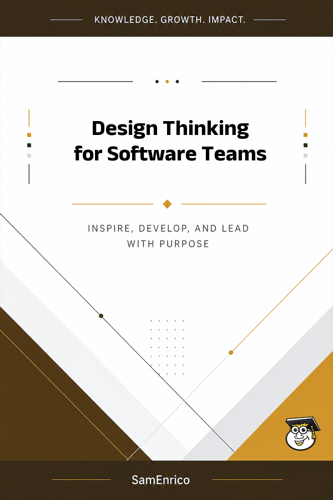
Design Thinking for Software Teams eBook
Build user centered software using agile design th
Build user centered software using agile design thinking integration with this guide.
Formats
Free sample
Chapter 1: The 72% Lie--We have been telling ourselves a comforting fiction. The fiction is that if our code compiles, passes all tests, and deploys without incident, we have done our jobs well. The corollary to this fiction is that when a product fails, the blame must lie elsewhere – with vague requirements, unrealistic timelines, or users who simply do not appreciate good engineering. This chapter exists to shatter that fiction with an uncomfortable truth: technically flawless software fails at an astonishing rate, and the root cause is not bad code but a fragmented relationship between the people who write software and the people who use it.The statistics are damning. For decades, the Standish Group’s Chaos Report has tracked software project outcomes across thousands of organizations.
The headline number has remained stubbornly consistent: approximately 72% of software products fail to deliver their intended value. Not because they crash. Not because they have security vulnerabilities. Not because they are poorly architected. They fail because no one uses them.
Or because users try them once, become frustrated, and never return. Or because the software solves a problem the user does not actually have, while ignoring the problem that keeps them up at night.Let that sink in. Nearly three out of every four features you build – the ones you stayed late to finish, the ones you refactored twice, the ones you were proud to ship – will deliver near-zero value to the people on the other side of the screen. This is not a commentary on your technical ability. It is a commentary on a systemic failure that has nothing to do with how well you write loops or manage state.The Handoff Gap: Where Value Goes to Die If the code is not the problem, what is?
The answer lies in a space that no job description owns, no sprint commits to, and no performance review measures. That space is the gap between problem exploration and solution construction. In industry parlance, it is called the handoff gap.Picture a typical workflow. A product manager gathers requirements from stakeholders. A designer translates those requirements into mockups, often beautiful and pixel-perfect.
These mockups are delivered to developers, sometimes via a ticket in Jira, sometimes via a shared Figma link, often with a brief comment: “Here’s the spec. Let me know when it’s done.” The developers then estimate, break down, code, test, and deploy. Somewhere in this chain – usually at every link – meaning evaporates.The handoff gap manifests in three predictable patterns, each more destructive than the last.The Vague User Story“As a user, I want a fast dashboard.” This is a real user story, pulled from an actual backlog at a mid-sized Saa S company. On its surface, it seems reasonable. The user wants speed.
Who doesn’t? But what does “fast” mean to the user versus the developer? To the developer, fast might mean a server response time under 200 milliseconds. To the user, fast might mean “I don’t have time to check my phone while this loads.” Those are vastly different thresholds. Worse, the developer might optimize database queries while the user is actually waiting for a third-party analytics script that the developer has no control over.
The story said nothing about third-party scripts. The developer delivered a technically fast dashboard that still felt slow to the user. Both sides believe they did their job. Both sides are correct. And the product fails anyway.This is not a failure of effort.
It is a failure of shared understanding. The user story format – “As a user, I want to X so that Y” – was invented to capture context, but it has been hollowed out by repetition into a transactional template. It assumes a rational user who can articulate their needs clearly. Real users are not rational. They are tired, distracted, multitasking, and often unaware of what they truly need until they encounter its absence.The Pixel-Perfect Mockup The second pattern is the designer’s equivalent of the vague user story.
A designer produces a mockup that is visually stunning. Every padding pixel is justified. Every micro-interaction has a smooth animation. The designer presents it to the engineering team with legitimate pride. The developers look at the mockup and see something entirely different.
They see edge cases the mockup does not address – what happens when the user’s name is sixty characters long? They see API limits that make real-time animations impossible – the backend can only update twice per second, not sixty times per second. They see technical debt lurking beneath the beautiful surface – the component library does not support that button style without a two-week refactor.Neither side is wrong. The designer designed for an ideal world where constraints do not exist. The engineer sees the real world where constraints are the only reliable truth.
But instead of collaborating to find a third option, they often default to a battle. The designer says the developer is killing the user experience. The developer says the designer lives in a fantasy land. Meanwhile, the user never sees either version because the feature gets deprioritized due to “complexity.”The Silent Sprint The third pattern is the most insidious because it requires no conflict. The team gathers for sprint planning.
Tickets are assigned. Developers disappear into their work for one or two weeks. They emerge with working software that meets every acceptance criterion. They demonstrate it at sprint review. And the product manager says, “This isn’t what we meant.” Or the designer says, “That’s not how the user would expect that to work.” Or – worst of all – everyone nods, the feature ships, and the analytics show zero uptake.The silent sprint occurs when developers code without ever asking “Why are we building this?” Not because they are lazy or disengaged, but because the process has trained them that asking “why” is not their job.
Their job is to turn requirements into code. Requirements come from product. Design comes from design. The developer’s role begins at the API endpoint and ends at the merge request. This is a catastrophic limitation of the “role-based” mindset, and it is the single biggest obstacle to building software that matters.Beyond the Buzzwords: Agile and Design Thinking as Allies, Not Opponents If you have worked in software for more than a year, you have heard the terms “Agile” and “Design Thinking.” You have likely also heard them positioned as antagonists.
Agile, the story goes, is about speed, iteration, and responding to change. Design Thinking is about empathy, exploration, and understanding problems. One is for builders. One is for thinkers. They seem incompatible.This is a false binary, and it has caused enormous damage.
Agile without Design Thinking becomes a feature factory. Teams sprint from one backlog item to the next, delivering code at a furious pace, measuring success by velocity and story points. They produce output, not outcomes. They ship features that nobody requested, that solve problems nobody has, and that clutter the product until a “cleanup sprint” is needed to delete them. Velocity goes up.
Value goes down.Design Thinking without Agile becomes a perpetual brainstorming session. Teams fall in love with the problem space. They conduct user…
This is the end of the free sample. Get the eBook to keep going. Buy now
About this book
Details
- Author
- Wild Jeraldine
- Publisher
- SamEnrico
- Language
- English
- Genre
- Non-Fiction, Self-Help, Agile UX
- Released
- 2026-06-06
- Pages (approx.)
- 114
- Available as
- eBook, Audiobook

Read better in the ZLOADR app
Your eBooks on your phone or tablet. Sign in with your SamEnrico account and start reading.
More by Wild Jeraldine
 London Empty Shop SchemeWild Jeraldine$11.99
 SAD And Social WithdrawalWild Jeraldine$11.99
 Resilience for FirefightersWild Jeraldine$11.99
 Overcoming Loneliness with Social PrescribingWild Jeraldine$11.99
 The Immigrant Pet Care KingWild Jeraldine$11.99
 GPS Tracker for DementiaWild Jeraldine$11.99
 Collaborative Cultures BlueprintWild Jeraldine$11.99
 The Vanishing Hiker: Alien Encounters or Human Foul Play?Wild Jeraldine$11.99
 The Shadow Warriors of the Skies: The Birth of Wingsuit BASE JumpingWild Jeraldine$11.99
 How to Produce Lawn and Garden SprayersWild Jeraldine$11.99
 Service Providers Guide to EditorsWild Jeraldine$11.99
 Schedule J CompensationWild Jeraldine$12.99
You may also like
 Hong Kong Handover 1997Dunn Johnnie$11.99
 Zumba For Postnatal Recovery CourseNeal Christian$11.99
 Zumba for BeginnersLadner Nikia$11.99
 YouTube Comment Mining GuideHumes Pandora$12.99
 Worry Box MeditationCarlin Rudy$11.99
 Workplace Stress MeditationNguyen Lynn$11.99
 Workplace Stress and Sleep RepairHawley Ivory$11.99
 Workplace Perfectionism CureDelaney Jeffry$11.99
 Workplace Injustice Anger GuideWallen Isabelle$11.99
 Work Addiction and Burnout LinkGreenwood Ester$11.99
 Women in Yoga and WellnessBeattie Galina$11.99
 Women in Stand Up ComedyChun Evangeline$11.99