
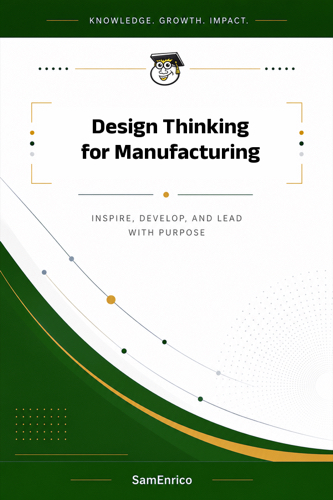
Design Thinking for Manufacturing
Reduce defects by understanding production line wo
Reduce defects by understanding production line worker needs and pain points.
Formats
About this book
Free sample
Chapter 1: The Blueprint Lie--–- On a Tuesday morning in a sprawling automotive plant outside Detroit, a quality manager named Elena stood over a bin containing 147 rejected dashboard assemblies. Each one had the same defect: a misaligned clip that caused a 2mm gap visible to the final inspector. The cost of those 147 rejects, including labor, materials, and rework, was just over $14,000. For the year, similar clip-related defects had cost the plant $1.2 million. The engineering report, delivered to Elena's desk the previous Friday, contained a single phrase in bold type: "Root cause: human error.
Recommend additional training and visual aids."Elena had been in manufacturing for twenty-two years. She had watched the same clip fail the same way for eighteen months. She had seen six different trained operators make the same mistake. She had watched the training videos herself—they were clear, professionally produced, and utterly useless. The operators weren't confused.
They weren't lazy. They were fighting a design that required them to insert a flexible plastic tab into a slot they could not see, at an angle their wrists could not sustain, while maintaining a cycle time that gave them exactly 2.3 seconds per attempt.The problem was not human error. The problem was that no engineer had ever stood in Elena's line and tried to install that clip with their own hands.This chapter dismantles the most expensive and persistent myth in modern manufacturing: the belief that when a worker makes a mistake, the worker is the problem. It will show you why 90% of quality incident reports blame people, while 90% of corrective actions target technical fixes—a mismatch that guarantees recurring defects. You will learn about the "Ivory Tower" problem, where engineers design processes in perfect isolation, and the Empathy Gap that separates the person who designs a task from the person who performs it.
By the end of this chapter, you will understand that human error is almost never the root cause. It is a symptom. And symptoms cannot be cured by blaming the patient.The Arithmetic of Blame Let us begin with a simple question: When a defect occurs…
This is the end of the free sample. Get the eBook to keep going. Buy now
Contents
- Chapter 1
- Chapter 2
- Chapter 3
- Chapter 4
- Chapter 5
- Chapter 6
- Chapter 7
- Chapter 8
- Chapter 9
- Chapter 10
- Chapter 11
- Chapter 12
Details
- Author
- Mcgrew Aracelis
- Publisher
- SamEnrico
- Language
- English
- Genre
- Non-Fiction, Self-Help
- Released
- 2026-06-09
- Pages (approx.)
- 158
- Available as
- eBook, Audiobook

Read better in the ZLOADR app
Your eBooks on your phone or tablet. Sign in with your SamEnrico account and start reading.
More by Mcgrew Aracelis
 World Cafe MethodMcgrew Aracelis$11.99
 End Of Life ReflectionMcgrew Aracelis$11.99
 The Twelve Step Prayer BookMcgrew Aracelis$11.99
 Cleopatra Caesar AllianceMcgrew Aracelis$11.99
 The Power of Words: How Victim Impact Statements Changed Justice in the 1980sMcgrew Aracelis$11.99
 Mom Brain Time HacksMcgrew Aracelis$11.99
 Metabolic Adaptation Long TermMcgrew Aracelis$11.99
 Factory Shift Sleep GuideMcgrew Aracelis$11.99
 The Last Stand of Eric Moussambani: From Pool to Global IconMcgrew Aracelis$11.99
 Student Banking and Finance GuideMcgrew Aracelis$12.99
 Service Providers Guide to Independent LivingMcgrew Aracelis$11.99
 How to Produce an Injection Molding MachineMcgrew Aracelis$11.99
You may also like
 Hong Kong Handover 1997Dunn Johnnie$11.99
 Zumba For Postnatal Recovery CourseNeal Christian$11.99
 Zumba for BeginnersLadner Nikia$11.99
 YouTube Comment Mining GuideHumes Pandora$12.99
 Worry Box MeditationCarlin Rudy$11.99
 Workplace Stress MeditationNguyen Lynn$11.99
 Workplace Stress and Sleep RepairHawley Ivory$11.99
 Workplace Perfectionism CureDelaney Jeffry$11.99
 Workplace Injustice Anger GuideWallen Isabelle$11.99
 Work Addiction and Burnout LinkGreenwood Ester$11.99
 Women in Yoga and WellnessBeattie Galina$11.99
 Women in Stand Up ComedyChun Evangeline$11.99