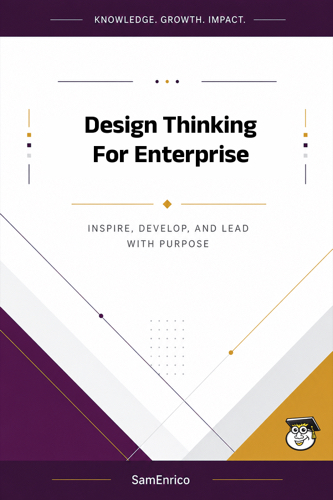
Design Thinking For Enterprise eBook
Scale human centered methods across large organiza
Scale human centered methods across large organizations.
Formats
Free sample
Chapter 1: The Garage Delusion--–- In 2010, a team of five designers and engineers at a now-famous ride-sharing company ran a three-day design sprint. They paper-prototyped a new passenger-matching algorithm, tested it with seventeen real users in a parking lot, and by Friday afternoon had a working hypothesis that would eventually reduce wait times by 40 percent. The story became legend. It was cited in six bestselling books, taught at Stanford, and repeated in boardrooms from San Francisco to Singapore. The implicit promise was intoxicating: give any team five days, a whiteboard, and permission to think differently, and they will produce breakthrough innovation.Then, in 2016, the global financial services division of a Fortune 10 bank tried the exact same method.
They flew twenty-three people from nine different departments into a windowless conference room on the forty-second floor. They spent the first morning arguing over who owned the customer relationship. The second day was consumed by legal review of the recruitment script for user interviews. By the third day, the head of compliance had vetoed the prototype because it used a data field that hadn't been cleared for external testing. On Friday afternoon, the team produced a single Power Point slide that read: "Further study required before proceeding." The sprint cost $187,000 in billable hours.
It produced zero customer insights. The method, identical to the startup's, had failed catastrophically.This book is about the chasm between these two stories—and how to bridge it.The Paradox of Scale, as we will call it throughout these pages, is the uncomfortable truth that the very methods designed to unlock creativity and human-centeredness break when applied to large, complex organizations. Not because the methods are flawed. Not because enterprise employees are less creative or less motivated. But because enterprises operate under a different set of physical laws than startups, and design thinking as currently taught assumes the physics of a garage.The Three Killers of Enterprise Empathy To understand why the startup toolkit fails at scale, we must first name the three forces that systematically destroy empathy inside large organizations.
These are not occasional obstacles or cultural nuisances. They are structural features of enterprise architecture, as immutable as gravity. And every scaling effort that ignores them will eventually crash.Killer One: Hierarchy Hierarchy is not merely a reporting structure. It is a filtration system for information. In a flat startup of five people, an insight from a customer interview travels from ear to ear in under thirty seconds.
The founder hears it directly because the founder was likely in the room. In an enterprise of fifty thousand people, the same insight must survive what we call the Empathy Friction Chain: customer speaks to support agent, agent logs ticket, ticket is aggregated into weekly report, report is reviewed by team lead, team lead presents to manager, manager summarizes for director, director includes in slide deck for VP, VP prioritizes against ninety-seven other items for the SVP, and SVP presents a one-bullet summary to the C-Suite. At each link in this chain, nuance is lost, urgency is downgraded, and the raw human voice of the customer is translated into corporate jargon.The cost is measurable. Research from the Corporate Executive Board found that insights in organizations with more than four reporting layers between customer touchpoint and decision-maker lose 82 percent of their actionable detail before reaching anyone who can approve a change. This is not malice.
It is physics. Each layer adds a filter, and each filter removes the specific, messy, contradictory details that make human-centered design work.Worse, hierarchy introduces incentive misalignment. The support agent who logs the ticket is measured on speed of resolution, not depth of insight. The manager who summarizes the report is rewarded for brevity, not fidelity. The VP who prioritizes the backlog answers to quarterly revenue targets, not long-term customer delight.
By the time the insight reaches a decision-maker, it has been shaped to fit existing power structures rather than to challenge them. The organization's immune system has recognized the foreign body of true customer empathy and has neutralized it.Killer Two: Risk Aversion Startups survive by taking intelligent risks. Enterprises survive by avoiding catastrophic ones. This difference is not cultural—it is fiduciary. Publicly traded companies have legal obligations to shareholders that include protecting assets from foreseeable harm.
Every experiment, every prototype, every user interview carries some risk. In a startup, that risk is measured in days of lost work. In an enterprise, that same risk is measured in potential lawsuits, regulatory fines, and share price movement.Consider the humble customer interview. A startup recruiter posts on social media, talks to twelve strangers in a coffee shop, and learns something valuable. An enterprise must consider: Did the recruitment method create bias?
Was the incentive appropriate and disclosed? Did the interviewer collect personally identifiable information without proper consent forms? Is the conversation subject to data privacy regulations in all seventeen jurisdictions where the company operates? Does the legal department need to review the script? Does compliance need to sign off on the recording method?
Does information security need to approve the storage of any notes?Each question is legitimate. Each question adds friction. And each question, when multiplied across the hundreds of research activities an enterprise should be conducting, creates a paralysis that masquerades as prudence. The result is that enterprises systematically over-invest in analysis (which feels safe) and under-invest in action (which feels risky). They commission market research reports instead of talking to customers.
They run expensive focus groups in controlled facilities instead of observing behavior in the wild. They build detailed requirements documents instead of rough prototypes.The tragedy is that this risk aversion creates its own form of catastrophe. By avoiding the small, manageable risks of customer conversation and rapid prototyping, enterprises accumulate the large, unmanageable risk of building products nobody wants. The financial crisis of 2008 was caused by many factors, but at its core was an industry that had stopped talking to the humans on the other side of the transaction. The risk of a bad loan was modeled to six decimal places.
The risk of a borrower's actual lived experience was not modeled at all.Killer Three: Legacy ITThe third killer is the least discussed and perhaps the most pernicious. Legacy information technology systems—the mainframes, the custom ERPs, the decades-old databases that actually run the world's largest companies—do not just slow down delivery. They fundamentally constrain what is thinkable.A startup designer imagines a new user flow and builds a prototype in Figma within hours. An enterprise designer imagines the same flow and immediately confronts a cascade of constraints: the customer data lives in a system that doesn't expose an API; the transaction logic is hardcoded in COBOL and no one remembers how to change it; the authentication system requires twelve legacy steps that cannot be bypassed; the compliance rules are embedded in the database schema itself.This is not an excuse. It is a reality.
When I worked with a global airline on redesigning their check-in experience, the design team produced a beautiful, intuitive, five-step mobile flow in two weeks. It took eighteen months to implement because every step touched a different legacy system, each owned by…
This is the end of the free sample. Get the eBook to keep going. Buy now
About this book
Details
- Author
- Medlin Ivette
- Publisher
- SamEnrico
- Language
- English
- Genre
- Non-Fiction, Self-Help, Corporate Innovation
- Released
- 2026-06-12
- Pages (approx.)
- 155
- Available as
- eBook, Audiobook

Read better in the ZLOADR app
Your eBooks on your phone or tablet. Sign in with your SamEnrico account and start reading.
More by Medlin Ivette
 Partner Mood Dependency GuideMedlin Ivette$11.99
 Couple Breathing ExerciseMedlin Ivette$11.99
 Dysthymia and AppetiteMedlin Ivette$11.99
 Alcoholism and Empty Nest Syndrome RecoveryMedlin Ivette$11.99
 Senior Housing Regulation GuideMedlin Ivette$11.99
 Real Estate Food AddictionMedlin Ivette$11.99
 Tangaroa Rises: The Ocean’s Wrath in Polynesian MythMedlin Ivette$11.99
 The Last Stand of Dara: Heraclius' Gambit Against the PersiansMedlin Ivette$11.99
 How to Start a Engines (internal Combustion) for Motorcycles Business (Beginners Guide)Medlin Ivette$11.99
 How to Produce Gun GripsMedlin Ivette$11.99
 A Collector's Handbook to the Delaunay-belleville S6Medlin Ivette$11.99
 Federal Procurement Forecast GuideMedlin Ivette$12.99