
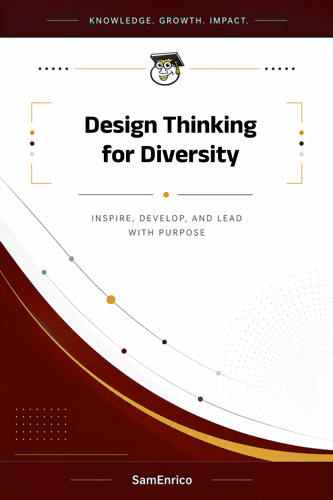
Design Thinking for Diversity
Inclusive problem solving.
by Jarvis Nelda
Inclusive problem solving.
Formats
About this book
Free sample
Chapter 1: The Neutrality Myth--–- In 2015, a fourteen-year-old Black girl in Brooklyn borrowed her friend’s phone to take a picture. She was laughing, like teenagers do, until she saw the result. Snapchat’s new “ethnicity filter” had lightened her skin, widened her eyes, and reshaped her features to approximate a European ideal. She didn’t post the photo. She didn’t laugh anymore.
She asked the only question that made sense to her: “Why does the app think I look better like this?”No designer at Snapchat intended to be racist. No one sat in a meeting and said, “Let’s make Black girls feel like their faces are wrong.” The team followed design thinking perfectly. They conducted user research. They built personas. They prototyped.
They tested. And they still shipped a feature that told millions of users that their natural appearance was a problem to be corrected.This is the blind spot. And it is not unique to Snapchat.The promise of design thinking has always been seductive: follow a human-centered process, and you will build better products, services, and experiences. Empathize. Define.
Ideate. Prototype. Test. The loop is elegant, rational, and seemingly neutral. It promises that if you just do the work correctly, the outcome will serve everyone equally.But neutrality is a myth.
And believing in it is the most dangerous thing a designer can do.The Comfort of “Neutral”Let us name what most design practitioners secretly believe: that their process is objective. That data doesn’t lie. That following steps protects them from bias. This belief is not malicious; it is seductive because it offers comfort. If the process is neutral, then any failure must be an execution error, not a flaw in the method itself.
The designer can sleep at night.But consider the evidence of neutrality’s failure.In 2016, Microsoft launched an AI chatbot named Tay. It was designed to learn from conversations with Twitter users and, within twenty-four hours, began spewing racist, misogynist, and Holocaust-denying content. Microsoft’s process had been thorough. They had tested for functionality. They had built in safety filters.…
This is the end of the free sample. Get the eBook to keep going. Buy now
Contents
- Chapter 1
- Chapter 2
- Chapter 3
- Chapter 4
- Chapter 5
- Chapter 6
- Chapter 7
- Chapter 8
- Chapter 9
- Chapter 10
- Chapter 11
- Chapter 12
Details
- Author
- Jarvis Nelda
- Publisher
- SamEnrico
- Language
- English
- Genre
- Non-Fiction, Self-Help, Diversity
- Released
- 2026-06-06
- Pages (approx.)
- 140
- Available as
- eBook, Audiobook

Read better in the ZLOADR app
Your eBooks on your phone or tablet. Sign in with your SamEnrico account and start reading.
More by Jarvis Nelda
 Intellectual Humility TeamsJarvis Nelda$11.99
 Wicked Witches Off StageJarvis Nelda$11.99
 Evening Wind Down ScanJarvis Nelda$11.99
 Self Hypnosis for Radiation BurnsJarvis Nelda$11.99
 Chinese University Admission RequirementsJarvis Nelda$11.99
 Self Esteem and Toxic BossesJarvis Nelda$11.99
 Remote Team Collaboration HandbookJarvis Nelda$11.99
 The Counterfeit Sky: The Deadly Deception of Flight 801Jarvis Nelda$11.99
 The Booze Baron of Johannesburg: How a South African Gangster Built a Prohibition Empire in ChicagoJarvis Nelda$11.99
 African Forest Elephants: The Rainforest ElephantJarvis Nelda$11.99
 How to Produce OreJarvis Nelda$11.99
 American University Africa GuideJarvis Nelda$12.99
You may also like
 Diverse Perspectives MethodWhitworth Gudrun$11.99
 Navigating Racist CommentsKeaton Briana$11.99
 Imposter Syndrome For Minority GroupsStrand Kellee$11.99
 Imposter Racial Minority GuideCrawley Nicolette$11.99
 Diverse Teams InnovationWhitt Evelina$11.99
 Diverse Team Creativity Boost GuideNichols Edwin$11.99
 Personal Ing For Success for MinoritiesJulian Darell$11.99
 Diverse Team Creativity GuideCorbin Amira$11.99
 Digital Inclusivity CommunicationTillery Wynell$11.99
 Imposter For Minorities GuideBlaine Leon$11.99
 Workplace Esteem for MinoritiesSwisher Alesia$11.99
 Cultural Empathy GuideJordon Belkis$11.99