
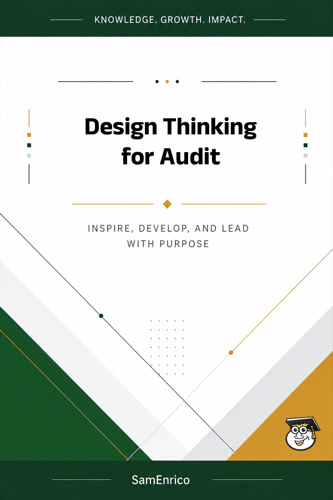
Design Thinking for Audit eBook
Design audit processes that uncover root causes, n
Design audit processes that uncover root causes, not just symptoms.
Formats
Free sample
Chapter 1: The Compliance Trap--–- The warehouse manager’s hands were shaking. Not from fear, but from exhaustion. For three weeks, his team had worked sixteen-hour days to prepare for the annual internal audit. They had reorganized filing cabinets, resubmitted purchase orders from eighteen months ago, and color-coded spreadsheets according to instructions that changed four times. On the morning of the audit, the lead auditor walked through the facility for ninety minutes, asked eleven questions, checked forty-three boxes, and declared: “No material exceptions.
The controls appear to be operating effectively.”Six months later, a single transaction – a routine vendor payment of $47,000 – bypassed every one of those “effective” controls. A clerk, working a double shift after a colleague called in sick, clicked “approve” on an invoice that had already been paid. The system did not flag it because the duplicate invoice number used a hyphen instead of a slash. The manager who was supposed to review high-value payments was on vacation, and no one had been designated as backup. The internal audit had tested the “approval” control by verifying that managers signed off on a random sample of invoices.
All forty-three invoices in the sample had signatures. The control passed.The duplicate payment was not detected until the vendor called, confused, asking why they had received two payments for the same shipment. By then, $47,000 was gone. The company recovered $44,000 after six months of legal back-and-forth. The remaining $3,000 was written off.
The internal audit team added a note to their next year’s plan: “Test for duplicate invoice detection.” The warehouse manager was given a written warning for “failure to supervise.”No one asked why the clerk was working a double shift. No one asked why the system accepted a duplicate invoice number with a hyphen. No one asked why there was no backup approver. No one asked why the audit had tested forty-three invoices – enough for statistical validity – but had never looked at what happened during vacation weeks, double shifts, or 3 AM approvals. The audit had found the symptoms it was designed to find.
It had missed every systemic flaw that made the duplicate payment inevitable.This is the Compliance Trap.The Paradox of Passing Audits That Fail People Let me state the problem as bluntly as possible: organizations routinely pass their audits while failing catastrophically. Financial audits that give clean opinions to banks that collapse six months later. Safety audits that certify factories where workers are injured the following week. IT audits that find “no significant deficiencies” in systems that leak customer data. Quality audits that approve medical device manufacturers whose products later kill patients.How is this possible?
How can an audit say “everything is fine” when the organization is clearly not fine?The answer lies in a fundamental confusion about what audits actually measure. Most audits measure shallow compliance – whether a rule was followed at a single point in time, under ideal conditions, with full attention, in the presence of an auditor. But shallow compliance is a poor predictor of deep assurance – whether a system reliably produces correct outcomes under real-world pressure, with fatigue, interruptions, competing priorities, and the normal chaos of human work.Shallow compliance asks: “Is the signature on this form?” Deep assurance asks: “Would this signature be present if the approving manager had not slept, was interrupted four times, and was rushing to leave for a dentist appointment?”Shallow compliance asks: “Did the clerk follow the procedure?” Deep assurance asks: “Does the procedure make sense when the clerk has processed two hundred invoices in the last three hours?”Shallow compliance asks: “Is the control in place?” Deep assurance asks: “Does the control work when everyone is tired, distracted, and under pressure?”The tragedy is that shallow compliance feels like safety. A full checklist creates the illusion of control. A clean audit report allows executives to say, with apparent confidence, “Our controls are effective.” But that confidence is often misplaced.
The audit did not lie. It simply asked the wrong questions – or rather, it asked the right questions about the wrong things.The Anatomy of a Compliance Trap The Compliance Trap has three structural features that make it almost invisible to those inside it.Feature One: The Audit Optimizes for Detectability, Not Importance Traditional auditing has a hidden bias: it favors what is easy to check over what matters. Signatures are easy to check. Log entries are easy to check. Approval stamps are easy to check.
But these are often the least important controls in a system. The most important controls are often the hardest to verify: judgment, communication, sense-making, exception handling, recovery from error.A signature on a purchase order tells you that someone signed the purchase order. It does not tell you whether they read it, understood it, questioned it, or were even awake when they signed it. But because the signature is detectable, it becomes the focus of the audit. Meanwhile, the nurse’s gut feeling that something is wrong with a patient – a feeling that might prevent a medication error – is not documented, not sampled, not tested, and not audited.
The detectable crowds out the important.Feature Two: The Audit Creates a Performance Paradox When organizations know they will be audited on shallow compliance metrics, they optimize for those metrics. This is rational behavior. If your bonus depends on maintaining a 98% signature rate, you will ensure that signatures happen – even if that means signing without reading. If your department is judged on checklist completion, you will check every box – even if the checklist has nothing to do with actual safety.The result is a system that looks good on paper and fails in practice. The warehouse in our opening story had a 100% approval signature rate in the audit sample.
That was true. It was also irrelevant. The control did not work when it mattered – during a vacation week, on a double shift, with a tired clerk. But because the audit measured the signature and found it present, the organization’s leaders believed they were safe. The audit did not warn them.
The audit reassured them. And then the failure happened.Feature Three: The Audit Punishes Symptoms While Ignoring Causes When a failure occurs after a clean audit, the organization faces a choice. It can ask: “Why did our audit miss this?” That question leads to systemic inquiry – examining audit methods, sampling strategies, and underlying assumptions. Or it can ask: “Who caused this failure?” That question leads to blame – usually directed at the lowest-level employee who touched the transaction last.The Compliance Trap pushes organizations toward blame. It is easier to write up a clerk than to redesign an audit program.
It is faster to issue a written warning than to question why sixteen-hour shifts are normal. It is less threatening to say “human error” than to admit that the system was designed to fail. And so the pattern continues: audit, pass, fail, blame, repeat.The $100 Million Typo (A True Story)Let me tell you a story that illustrates the Compliance Trap in action. I have changed the names and some details, but the essential facts are real.A regional bank had a standard control for wire transfers: any transfer over $50,000 required two approvals…
This is the end of the free sample. Get the eBook to keep going. Buy now
About this book
Details
- Author
- Quintero Vernetta
- Publisher
- SamEnrico
- Language
- English
- Genre
- Non-Fiction, Self-Help
- Released
- 2026-06-09
- Pages (approx.)
- 143
- Available as
- eBook, Audiobook

Read better in the ZLOADR app
Your eBooks on your phone or tablet. Sign in with your SamEnrico account and start reading.
More by Quintero Vernetta
 OA Explained for OvereatersQuintero Vernetta$11.99
 Senior Holiday Alone CopingQuintero Vernetta$11.99
 Flight Attendant Sleep GuideQuintero Vernetta$11.99
 Iterative Improvement LoopQuintero Vernetta$11.99
 Single Parent Scheduling GuideQuintero Vernetta$11.99
 Metabolic Adaptation CourseQuintero Vernetta$11.99
 Cigar and Pipe Tobacco CessationQuintero Vernetta$11.99
 The Silk Road Conspiracy: How a Forgotten Empress Changed the WorldQuintero Vernetta$11.99
 The Siege of Xerxes: The Gates of Babylon Shatter (539 BC)Quintero Vernetta$11.99
 How to Produce Toy AbacusesQuintero Vernetta$11.99
 Service Providers Guide to Hospice CareQuintero Vernetta$11.99
 How to Become a Grain Elevator ClerkQuintero Vernetta$11.99
You may also like
 Hong Kong Handover 1997Dunn Johnnie$11.99
 Zumba For Postnatal Recovery CourseNeal Christian$11.99
 Zumba for BeginnersLadner Nikia$11.99
 YouTube Comment Mining GuideHumes Pandora$12.99
 Worry Box MeditationCarlin Rudy$11.99
 Workplace Stress MeditationNguyen Lynn$11.99
 Workplace Stress and Sleep RepairHawley Ivory$11.99
 Workplace Perfectionism CureDelaney Jeffry$11.99
 Workplace Injustice Anger GuideWallen Isabelle$11.99
 Work Addiction and Burnout LinkGreenwood Ester$11.99
 Women in Yoga and WellnessBeattie Galina$11.99
 Women in Stand Up ComedyChun Evangeline$11.99