
Non-FictionSelf-HelpDesign Thinking
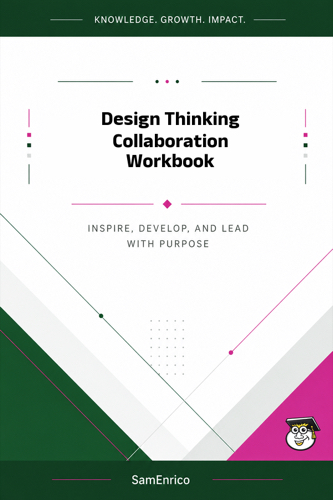
Design Thinking Collaboration Workbook eBook
Applies design thinking phases to group creative s
Applies design thinking phases to group creative sessions for user-centered solutions.
Formats
Free sample
Chapter 1: The Collaboration Myth--–- In 2012, a team of forty-seven engineers, product managers, and designers at a Fortune 500 company spent fourteen months and sixty-two million dollars building a product that exactly zero customers wanted. The post-mortem revealed something shocking: not a single person on the team had been wrong. The engineers had built exactly what they were asked to build. The product managers had perfectly executed the requirements. The designers had created beautiful, intuitive interfaces.
Every individual had done their job flawably. And collectively, they had failed catastrophically.This is the collaboration myth. It is the seductive and dangerous belief that putting smart people in a room and telling them to “work together” produces better results than those same people working alone. It is the assumption that more meetings, more cross-functional alignment, and more “synergy” will automatically yield breakthrough solutions. And it is wrong.The truth is that most teams do not collaborate.
They cooperate. They divide complex problems into smaller pieces, assign each piece to an individual expert, and then stitch those pieces back together at the end. This is not collaboration. It is parallel work wearing a name tag that says “teamwork.” And while cooperation is sometimes the right tool for the job, it will never produce the kind of user-centered, creative, resilient solutions that design thinking promises.This chapter dismantles the myth of the lone genius inventor, introduces the critical distinction between cooperation and collaboration that will reappear throughout this book, and gives you a practical framework for knowing exactly when to collaborate, when to cooperate, and when to work alone. By the end of this chapter, you will have diagnosed your team’s collaboration profile, created a shared charter that prevents the most common team dysfunctions, and signed a collaboration contract that turns vague intentions into specific commitments.The Lone Genius Does Not Exist Let us begin with a story you think you know.Thomas Edison invented the light bulb.
That is what generations of schoolchildren have been taught. The lonely inventor in his laboratory, toiling in isolation until the moment of brilliant discovery. It is a beautiful story. It is also almost entirely false.Edison did not invent the light bulb from scratch. He did not work alone.
And the “invention” itself was less a moment of genius and more a process of systematic iteration building on the work of dozens of predecessors. Twenty-three different inventors had created some form of electric light before Edison ever touched a filament. What Edison actually did was assemble a team of fourteen researchers, machinists, and glassblowers in Menlo Park, New Jersey—what he called his “invention factory.” Together, they tested more than six thousand potential filament materials. A lab assistant, Lewis Latimer, later improved the carbon filament and patented a more durable bulb. Another team member, Francis Upton, handled the mathematics and physics that Edison himself could not solve.The lone genius is a myth.
It is a story we tell because it is simpler than the truth: breakthrough ideas emerge from diverse teams building on each other’s thinking over time.Steve Jobs did not invent the i Phone alone. He stood on the shoulders of teams at Xerox PARC (who invented the graphical user interface and mouse), teams at Bell Labs (who invented the transistor), and his own teams at Apple (who figured out how to make multitouch work at scale). When Jobs returned to Apple in 1997, he did not lock himself in a room and emerge with the i Mac. He gathered a small, cross-functional team of designers, engineers, and marketers—what he called the “core”—and they fought, iterated, and built together.The research is unambiguous. A meta-analysis of seventy-two studies on team innovation published in the Journal of Applied Psychology found that teams with diverse functional backgrounds, moderate levels of cognitive conflict, and structured processes for building on each other’s ideas produced significantly more creative and useful solutions than homogeneous groups of experts working in parallel.
Another study from Carnegie Mellon University tracked sixty-four product development teams over two years and found that the single best predictor of success was not the individual intelligence of team members but the team’s “collective intelligence”—a measure of how well members took turns, read each other’s emotions, and built on partial ideas rather than criticizing them.So why does the lone genius myth persist? Because it is easier to sell. Venture capitalists prefer to fund a charismatic founder than a messy team. Business schools prefer to teach cases about singular visionaries than about the complexities of group dynamics. And most of us prefer to believe that we are the genius waiting to be discovered than that we need other people to do our best work.But if you want to design solutions that actually serve real users, you need to abandon the myth.
You need to learn how to collaborate, not just cooperate.Cooperation vs. Collaboration: The Distinction That Changes Everything This distinction is so important that it will appear throughout this book. Every time you run a design thinking session, you should ask yourself: are we collaborating or cooperating? The answer will determine whether you succeed or fail.Cooperation is splitting work into independent pieces, assigning each piece to an individual, and then reassembling the pieces at the end. Think of an assembly line.
Each person does their part, hands it off, and never touches it again. Cooperation is efficient for routine, predictable, well-understood tasks. It is terrible for creative problem-solving.Collaboration is iteratively building on shared work in real time. Think of a jazz band. No one plays their solo and leaves.
Everyone listens, responds, and adjusts. The final performance is not the sum of individual parts; it is something new that could not have been created by any musician alone.Here is the critical insight that most teams miss: most of what teams call “collaboration” is actually cooperation. The product manager writes requirements and hands them to design. Design creates mockups and hands them to engineering. Engineering builds and hands to QA.
This is a handoff, not a collaboration. It is efficient for execution. It is disastrous for innovation.True collaboration looks different. The product manager, designer, and engineer sit in the same room (physical or virtual) and sketch ideas together. The designer starts a rough wireframe.
The engineer says, “That interaction will be expensive to build, but what if we did this instead?” The product manager says, “That would solve the user’s need faster, but we’d have to deprioritize something else.” They argue. They iterate. They produce something none of them could have produced alone.This book is about creating the conditions for that second kind of work. But before you can collaborate, you need to know when collaboration is actually the right tool.The Collaboration Dosage Framework Not every task requires collaboration. In fact, forcing collaboration on tasks that are better done alone is a waste of time and a fast track to resentment.
The Collaboration Dosage Framework helps you decide.Ask three questions before any team activity:Question 1: Does this task require diverse perspectives to avoid blind spots? If the answer is no—if the task is…
This is the end of the free sample. Get the eBook to keep going. Buy now
About this book
Details
- Author
- Marcus Ardith
- Publisher
- SamEnrico
- Language
- English
- Genre
- Non-Fiction, Self-Help, Design Thinking
- Released
- 2026-06-10
- Pages (approx.)
- 128
- Available as
- eBook, Audiobook

Read better in the ZLOADR app
Your eBooks on your phone or tablet. Sign in with your SamEnrico account and start reading.
More by Marcus Ardith
 Innocence Project Delaware CasesMarcus Ardith$11.99
 Intermittent Fasting GuideMarcus Ardith$11.99
 Israel Green Tax Reform GuideMarcus Ardith$11.99
 The Holiday Sleep Survival GuideMarcus Ardith$11.99
 Freedom’s Echo: The Forgotten Voices of the 1963 March on DetroitMarcus Ardith$11.99
 The Alchemy of Colors: The Lost Palette of the MayaMarcus Ardith$11.99
 Understanding Chromosome 3 Duplication SyndromeMarcus Ardith$17.99
 IT AuditorMarcus Ardith$11.99
 Manually Delivered MVP GuideMarcus Ardith$12.99
 Social Media Business SetupMarcus Ardith$12.99
 How to Become a Cable Installer-repairerMarcus Ardith$11.99
You may also like
 Hong Kong Handover 1997Dunn Johnnie$11.99
 Zumba For Postnatal Recovery CourseNeal Christian$11.99
 Zumba for BeginnersLadner Nikia$11.99
 YouTube Comment Mining GuideHumes Pandora$12.99
 Worry Box MeditationCarlin Rudy$11.99
 Workplace Stress MeditationNguyen Lynn$11.99
 Workplace Stress and Sleep RepairHawley Ivory$11.99
 Workplace Perfectionism CureDelaney Jeffry$11.99
 Workplace Injustice Anger GuideWallen Isabelle$11.99
 Work Addiction and Burnout LinkGreenwood Ester$11.99
 Women in Yoga and WellnessBeattie Galina$11.99
 Women in Stand Up ComedyChun Evangeline$11.99