
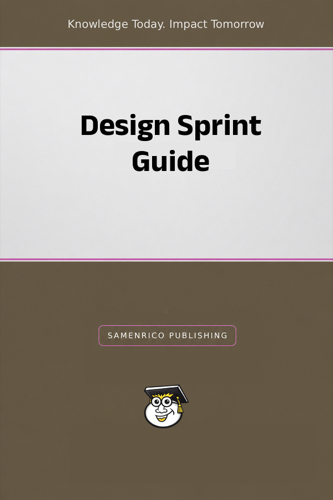
Design Sprint Guide eBook
Five day problem solving framework.
Five day problem solving framework.
Formats
Free sample
Chapter 1: The Monday Morning Lie--–- Every Monday morning, in thousands of offices around the world, a ritual repeats itself. A team gathers around a whiteboard. Someone says, "We really need to fix the onboarding flow" or "The pricing page isn't converting" or "Our customers keep asking for X feature." Everyone nods. Someone volunteers to "look into it." Someone else schedules a follow-up meeting for Thursday. And then the team disperses, returning to their email inboxes, their Slack messages, their Jira tickets, and the quiet, comfortable delusion that progress has been made.Three months later, that same team gathers again.
The onboarding flow is still broken. The pricing page still isn't converting. Feature X is now three months overdue and half-baked. And someone says, "Why didn't we just build a prototype and test it first?"This book is the answer to that question. And it begins with a simple, uncomfortable truth: most teams spend months solving the wrong problem because they are afraid to find out, in five days, that they are wrong.The Anatomy of Business Failure Let me tell you about a company I once worked with.
Let's call them Fin Corp. Fin Corp had a problem: their mobile banking app had a 78% dropout rate during account setup. Customers would download the app, enter their email, see the eight-screen, eleven-field, two-verification-code onboarding flow, and then quietly disappear forever.Fin Corp did what most companies do. They formed a committee. The committee met every Tuesday for four months.
They wrote requirements documents. They commissioned user research that took six weeks to recruit and report. They built wireframes, then high-fidelity mockups, then a functional prototype that took three engineering sprints to build. Then they tested it with users.The users hated it.The committee went back to the drawing board. Another three months passed.
Eventually, fifteen months after the problem was first identified, Fin Corp launched a new onboarding flow. It was better than the old one. It reduced dropout from 78% to 63%. The product manager declared victory. The company spent approximately $2.3 million to achieve a 15% improvement.Here is what Fin Corp could have done instead: a five-day Design Sprint.In five days—one single work week—they could have mapped the problem, sketched eight different solutions, chosen the best two, built a fake prototype that looked real, tested it with five actual customers, and learned, by Friday at 4 PM, exactly what worked and what didn't.
Total cost: one week of five people's time. Maybe $15,000.The difference between $2.3 million and $15,000 is not a rounding error. It is the difference between guessing and knowing. It is the difference between the way most companies work and the way the best companies work.What This Chapter Will Teach You Before we dive into the mechanics of the Design Sprint, I need to make sure you understand what you're getting into. This chapter is the foundation upon which the rest of this book is built.
By the time you finish reading it, you will understand:What a Design Sprint actually is (and what it is not)Why traditional product development is secretly designed to avoid failure—and why that guarantees mediocrity The exact conditions under which you should run a sprint (and, just as importantly, when you should absolutely not)The five non-negotiable roles required to run a sprint, and why missing even one will cause your sprint to fail before it starts If you are the kind of person who skips ahead to the "actionable" chapters, I am asking you to resist that urge. The teams that fail at sprints almost always fail because they skipped the foundation. They grabbed a template, invited some people into a room, and then wondered why Wednesday felt like a knife fight and Friday felt like a funeral.Do not be that team.What a Design Sprint Actually Is The Design Sprint was invented at Google Ventures between 2010 and 2012. Its creator, Jake Knapp, was a design partner at the firm, and his problem was simple: Google Ventures invested in startups that had great ideas but no process for de-risking those ideas before throwing millions of dollars at engineering. Knapp needed a way to compress months of work into days.
He borrowed from design thinking, from agile methodology, from cognitive psychology, and from his own experience running countless failed workshops. The result was a five-day framework that looked like this:Monday: Understand the problem and choose a target.Tuesday: Sketch competing solutions.Wednesday: Decide which solution to prototype.Thursday: Build a realistic fake prototype.Friday: Test it with five real customers.That is the skeleton. But a skeleton is not a body. The Design Sprint is not a checklist or a template. It is a structured argument with reality.
Every activity, every timer, every rule exists to solve a specific psychological or organizational problem.The long-term goal exercise solves the problem of misaligned ambition. The mapping exercise solves the problem of invisible assumptions. The lightning demos solve the problem of "not invented here" syndrome. The silent sketching solves the problem of loudest voice in the room. The anonymous voting solves the problem of hierarchy bias.
The one-day prototype solves the problem of perfectionism. The five-user interview solves the problem of self-deception.A Design Sprint is not a workshop. It is a truth machine. And like any machine, it requires precise inputs to produce reliable outputs.What a Design Sprint Is Not Because this book will likely be read by people who have heard the term "sprint" thrown around in various contexts, let me be crystal clear about what a Design Sprint is not.It is not an Agile sprint. In Agile development, a sprint is a time-boxed period (usually two weeks) during which a team builds a shippable increment of product.
The output of an Agile sprint is working software. The output of a Design Sprint is learning. You can run a Design Sprint to figure out what to build in your next Agile sprint. You cannot replace your Agile sprint with a Design Sprint unless you enjoy explaining to your stakeholders why there is no code after five days.It is not a brainstorming session. Brainstorming, as commonly practiced, is a performance.
Extroverts dominate. Ideas are evaluated in real time, which means novel ideas get shot down before they are fully formed. The Design Sprint replaces brainstorming with silent sketching and structured sharing precisely because brainstorming has been scientifically demonstrated to produce fewer good ideas than individuals working alone. I will say that again: brainstorming produces worse results than solitary work. The sprint acknowledges this and designs around it.It is not a design workshop.
A design workshop might produce a beautiful set of wireframes or a user journey map. A Design Sprint produces a tested prototype and a clear yes/no/pivot decision. The difference is accountability. At the end of a design workshop, you have artifacts. At the end of a Design Sprint, you have truth.It is not a replacement for user research.
The sprint includes user research on Friday, but it is a specific kind of research: usability testing of a specific prototype. If you need to understand your customers' broader needs, motivations, or…
This is the end of the free sample. Get the eBook to keep going. Buy now
About this book
Details
- Author
- Stuart Rueben
- Publisher
- SamEnrico
- Language
- English
- Genre
- Non-Fiction, Self-Help, Sprint
- Released
- 2026-06-06
- Pages (approx.)
- 127
- Available as
- eBook, Audiobook

Read better in the ZLOADR app
Your eBooks on your phone or tablet. Sign in with your SamEnrico account and start reading.
More by Stuart Rueben
 Self Hypnosis for Trigeminal NeuralgiaStuart Rueben$11.99
 Jamsession Creativity GuideStuart Rueben$11.99
 Job Loss in Mid CareerStuart Rueben$11.99
 Parental Anger And PTSDStuart Rueben$11.99
 Self Esteem Skill BuildingStuart Rueben$11.99
 Buttoning Jacket ClosureStuart Rueben$11.99
 Understudy Who Became StarStuart Rueben$11.99
 The Jaguar’s Gambit: How a Zoo Escape Exposed a Latin American Spy RingStuart Rueben$11.99
 The Cape Town Gold Conspiracy: The Turncoat Who Exposed the Diamond SyndicateStuart Rueben$11.99
 How to Become a Mat SewerStuart Rueben$11.99
 How to Produce Coin and Bill CountersStuart Rueben$11.99
 Afghan Hounds: Breed GuideStuart Rueben$11.99
You may also like
 Hong Kong Handover 1997Dunn Johnnie$11.99
 Zumba For Postnatal Recovery CourseNeal Christian$11.99
 Zumba for BeginnersLadner Nikia$11.99
 YouTube Comment Mining GuideHumes Pandora$12.99
 Worry Box MeditationCarlin Rudy$11.99
 Workplace Stress MeditationNguyen Lynn$11.99
 Workplace Stress and Sleep RepairHawley Ivory$11.99
 Workplace Perfectionism CureDelaney Jeffry$11.99
 Workplace Injustice Anger GuideWallen Isabelle$11.99
 Work Addiction and Burnout LinkGreenwood Ester$11.99
 Women in Yoga and WellnessBeattie Galina$11.99
 Women in Stand Up ComedyChun Evangeline$11.99