
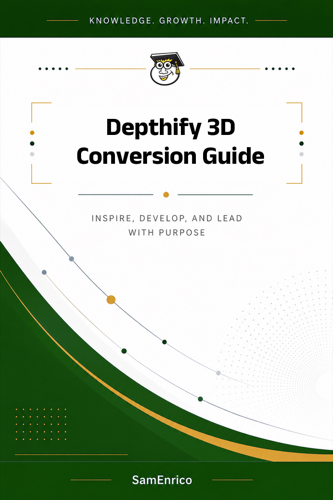
Non-FictionAI Operator3D Production
Depthify 3D Conversion Guide eBook
Turn 2D footage into stereoscopic 3D using AI dept
by Fish Tisa
Turn 2D footage into stereoscopic 3D using AI depth mapping for VR or theatrical release.
Formats
Free sample
Chapter 1: The Invisible Blueprint--–- Close your eyes for a moment. Now open them. What you just experienced—the effortless, instantaneous reconstruction of a three-dimensional world from two flat images on your retinas—is arguably the most sophisticated computational process your brain performs every waking second. You did not ask for it, you did not train for it, and you certainly did not read a manual. Yet there you are, navigating a volumetric world, catching objects thrown at you, flinching when something flies toward your face, all because your visual system is a stereoscopic conversion engine that would make any AI researcher weep with envy.Your mission, should you choose to accept it, is to reverse-engineer this biological marvel using silicon and software.
You are going to teach machines to do what your brain does unconsciously: infer depth from a single flat image. But before you write a single line of code, before you install Py Torch or download a single model weight, you must understand what depth actually is to the human visual system. Because the AI models you will command in Chapter 2—Depth Anything V3, Video-Depth-Anything V2, Marigold, and their successors—are not intelligent. They are pattern matchers of astonishing sophistication. They will output grayscale maps that look like depth, but they have no idea what those maps mean.
That understanding belongs to you. This chapter builds that understanding from the ground up.The 6.5 Centimeters That Changed Everything Place your index finger six inches from your nose. Close your left eye. Now close your right eye and open your left. Observe the jump.
That small horizontal leap your finger appears to make against the background is called binocular disparity, and it is the single most important measurement in the entire field of stereoscopic 3D.Your eyes are approximately 6.5 centimeters apart, measured from the center of each pupil. This interaxial distance—a term you will encounter repeatedly in this book and in professional stereoscopic software—means that each eye sees the world from a slightly different angle. The difference between these two images is disparity. Your brain measures the magnitude of disparity for every point in your field of view and instantly calculates how far away that point must be. Large disparity means close.
Small disparity means far. Zero disparity means the object is exactly at the distance your eyes are currently converged upon.This system is so fast, so automatic, and so deeply embedded in your visual cortex that you never notice it working. But it is also fragile. Feed your brain contradictory disparity information—a pattern that suggests an object is simultaneously close and far—and your visual system will rebel. You will feel eye strain, headache, nausea, or all three.
The entire art and science of stereoscopic 3D conversion can be summarized as this: give the viewer's visual system the disparity information it expects, in the quantities it can tolerate, for the duration of your content. Violate that contract, and your audience will punish you by looking away, closing their eyes, or never watching your 3D content again.The Dirty Secret of Human Depth Perception Here is where most introductory 3D books mislead you. They present binocular disparity as the mechanism of depth perception, as if your brain uses only the difference between your two eyes to construct the three-dimensional world. This is a convenient simplification for teaching stereoscopy, but it is also wrong. Or rather, it is incomplete.Your brain uses at least a dozen distinct depth cues, and binocular disparity is only one of them.
In fact, for distances beyond about ten meters, disparity becomes so small that it is essentially useless. Yet you can still tell that a mountain twenty kilometers away is farther than a tree fifty meters away. How? Because your brain is a Bayesian inference engine that weighs multiple cues, many of which do not require two eyes at all.Consider these monocular depth cues—depth information available from a single image, which is why they are critical for 2D-to-3D conversion:Relative size. An object that appears smaller is assumed to be farther away.
This cue is so powerful that it overrides disparity when the two conflict (a phenomenon called the size-distance illusion).Occlusion. If object A blocks your view of object B, object A is closer. This cue is absolute—it cannot be fooled by any other depth signal—which is why it is the most reliable depth cue in both natural vision and AI depth estimation.Aerial perspective. Distant objects appear hazier, lower in contrast, and shifted toward blue in color temperature because of light scattering in the atmosphere. This is why mountains look purple-blue in the distance.Texture gradient.
The pattern of a textured surface—brickwork, gravel, grass—appears to compress and become denser as it recedes from view.Linear perspective. Parallel lines appear to converge in the distance. Think of railroad tracks meeting at the horizon.Motion parallax. When you move your head, closer objects appear to move faster across your field of view than distant objects. This cue is monocular—you can experience it with one eye closed—and it is extraordinarily powerful.Shading and shadows.
The pattern of light and dark on a surface reveals its three-dimensional shape. A sphere lit from above has a bright top and dark bottom; a flat disc lit from above has uniform brightness.Your brain weighs all of these cues simultaneously, constantly, and without your awareness, to construct the three-dimensional world you experience. This is why you can close one eye and still navigate your environment perfectly well (although your fine depth discrimination suffers, which is why you should not drive with one eye closed).The relevance for 3D conversion is profound. When you convert 2D footage to stereoscopic 3D, you are not creating depth from nothing. You are adding one new cue—binocular disparity—to a visual scene that already contains many other depth cues.
If the disparity you add contradicts the existing cues (for example, if you assign negative parallax to an object that occlusion clearly places in the background), your brain will experience conflict. The result is discomfort at best, and an unwatchable artifact at worst.The War Inside Your Head: Accommodation Versus Convergence Every stereoscopic creator must understand a concept that optometrists call the accommodation-convergence conflict. These four words explain more about 3D discomfort than any other idea in this book. Ignore them, and your audience will experience a war inside their own heads every time they watch your content.Let us define our terms with surgical precision.Accommodation is your eye's focusing mechanism. When you look at something close—say, a book six inches from your face—the lens in each eye changes shape, becoming more spherical (increasing its refractive power) to bring that close object into sharp focus.
When you look at something far away—a mountain on the horizon—the lens flattens (decreasing its refractive power). This focusing happens automatically, triggered by the distance to whatever you are actually looking at. You cannot consciously control it, though you can feel it working if you pay attention.Convergence is your eye's pointing mechanism. When you look at something close, both eyes rotate inward toward…
This is the end of the free sample. Get the eBook to keep going. Buy now
About this book
Details
- Author
- Fish Tisa
- Publisher
- SamEnrico
- Language
- English
- Genre
- Non-Fiction, AI Operator, 3D Production
- Released
- 2026-06-09
- Pages (approx.)
- 135
- Available as
- eBook, Audiobook

Read better in the ZLOADR app
Your eBooks on your phone or tablet. Sign in with your SamEnrico account and start reading.
More by Fish Tisa
 Gratitude Sleep MeditationFish Tisa$11.99
 Self Esteem During PregnancyFish Tisa$11.99
 Dual Diagnosis Depression and AlcoholFish Tisa$11.99
 OKRs for Meditation Teacher TrainingFish Tisa$11.99
 The Iron Order: Frederick the Great and the Birth of Modern PrussiaFish Tisa$11.99
 Understanding Igda SyndromeFish Tisa$17.99
 Revolut Banking License HandbookFish Tisa$12.99
 Indoor LED Lighting GuideFish Tisa$12.99
 Shipping AdministratorFish Tisa$11.99
You may also like
 Hong Kong Handover 1997Dunn Johnnie$11.99
 Zumba For Postnatal Recovery CourseNeal Christian$11.99
 Zumba for BeginnersLadner Nikia$11.99
 YouTube Comment Mining GuideHumes Pandora$12.99
 Worry Box MeditationCarlin Rudy$11.99
 Workplace Stress MeditationNguyen Lynn$11.99
 Workplace Stress and Sleep RepairHawley Ivory$11.99
 Workplace Perfectionism CureDelaney Jeffry$11.99
 Workplace Injustice Anger GuideWallen Isabelle$11.99
 Work Addiction and Burnout LinkGreenwood Ester$11.99
 Women in Yoga and WellnessBeattie Galina$11.99
 Women in Stand Up ComedyChun Evangeline$11.99