
Non-FictionHealth & WellnessNeuroscience
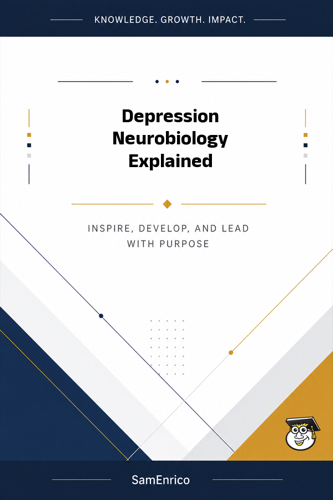
Depression Neurobiology Explained
Explores serotonin, dopamine, and norepinephrine d
by Hoskins Tony
Explores serotonin, dopamine, and norepinephrine dysfunction in major depressive disorder.
Formats
About this book
Free sample
Chapter 1: The Serotonin Myth--–- In 1996, a pharmaceutical advertisement appeared in a popular American magazine showing a sad, hunched figure next to a simplistic diagram of a synapse. The caption read: “For years, Jane thought her depression was her fault. Now she knows it’s a chemical imbalance.” In that single image, a complex scientific hypothesis became a cultural certainty. Within a decade, polls showed that over eighty percent of the general public believed depression was caused by “low serotonin” — a belief so widespread that it transcended patient education and entered the realm of folk wisdom. Doctors repeated it to patients.
Patients repeated it to families. And the billion-dollar antidepressant industry built its marketing strategy around three simple words: chemical imbalance.There was only one problem. The science never truly supported it.This chapter is not an attack on antidepressants. Millions of people have been helped by SSRIs (Selective Serotonin Reuptake Inhibitors), and as we will see in Chapter 11, these medications work — but they work for reasons that have almost nothing to do with correcting a hypothetical serotonin deficiency. This chapter is an autopsy of a myth: how a legitimate scientific hypothesis became a marketing slogan, how that slogan shaped public understanding for three decades, and why dismantling it is the first essential step toward understanding the real neurobiology of depression.We begin where all good investigations begin: with the story of how we got it wrong, and why getting it right matters more than ever.The Birth of a Hypothesis The idea that depression might involve a deficit in brain chemicals emerged in the 1950s and 1960s from two seemingly unrelated observations.
First, researchers noticed that the drug reserpine — used to treat high blood pressure — caused severe depression in a significant minority of patients. When they examined what reserpine did to the brain, they found that it depleted stores of three monoamine neurotransmitters: serotonin, norepinephrine, and dopamine. Second, a tuberculosis medication called iproniazid was observed to produce euphoria and improved mood in patients. Iproniazid, it turned out, inhibited an enzyme called monoamine oxidase (MAO), which breaks down…
This is the end of the free sample. Get the eBook to keep going. Buy now
Contents
- Chapter 1
- Chapter 2
- Chapter 3
- Chapter 4
- Chapter 5
- Chapter 6
- Chapter 7
- Chapter 8
- Chapter 9
- Chapter 10
- Chapter 11
- Chapter 12
Details
- Author
- Hoskins Tony
- Publisher
- SamEnrico
- Language
- English
- Genre
- Non-Fiction, Health & Wellness, Neuroscience
- Released
- 2026-06-11
- Pages (approx.)
- 155
- Available as
- eBook, Audiobook

Read better in the ZLOADR app
Your eBooks on your phone or tablet. Sign in with your SamEnrico account and start reading.
More by Hoskins Tony
 Sentence Mining TechniqueHoskins Tony$11.99
 Innovation for Electrical EngineersHoskins Tony$11.99
 Social Phobia GuideHoskins Tony$11.99
 Sobriety for IntrovertsHoskins Tony$11.99
 Mock Jury Deliberations on ID EvidenceHoskins Tony$11.99
 Fuzzy Zoeller Fan FavoriteHoskins Tony$11.99
 Beta Blockers GuideHoskins Tony$11.99
 The Shanghai Tunnel Escape: The Forensic Breakthrough That Cracked the UnderworldHoskins Tony$11.99
 The Silent Reaper: The Untold Story of Dr. Jack Kevorkian's Final PatientHoskins Tony$11.99
 A Collector's Handbook to the Georges Irat 11cvHoskins Tony$11.99
 Line of Credit Safety NetHoskins Tony$12.99
 Factoring in Nigeria GuideHoskins Tony$12.99
You may also like
 Hong Kong Handover 1997Dunn Johnnie$11.99
 Zumba For Postnatal Recovery CourseNeal Christian$11.99
 Zumba for BeginnersLadner Nikia$11.99
 YouTube Comment Mining GuideHumes Pandora$12.99
 Worry Box MeditationCarlin Rudy$11.99
 Workplace Stress MeditationNguyen Lynn$11.99
 Workplace Stress and Sleep RepairHawley Ivory$11.99
 Workplace Perfectionism CureDelaney Jeffry$11.99
 Workplace Injustice Anger GuideWallen Isabelle$11.99
 Work Addiction and Burnout LinkGreenwood Ester$11.99
 Women in Yoga and WellnessBeattie Galina$11.99
 Women in Stand Up ComedyChun Evangeline$11.99