
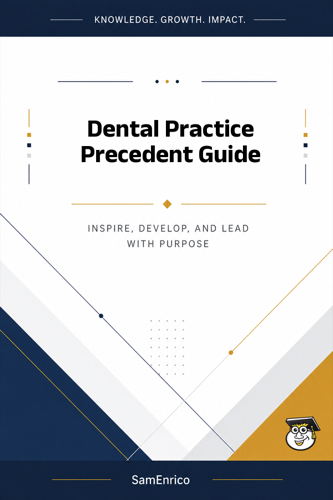
Non-FictionCapital & Valuation RegisterDental
Dental Practice Precedent Guide eBook
Reviews DSO, single office, and specialty dentistr
by Cooke Celina
Reviews DSO, single office, and specialty dentistry acquisition comps.
Formats
Free sample
Chapter 1: The Million-Dollar Gap--The phone call came on a Tuesday afternoon. Dr. Sarah Reynolds, a general dentist in suburban Cleveland who had built her single-office practice over twenty-two years, had just received an offer. Her broker was excited. “Eighty percent of collections, just like we projected,” he said.
“Congratulations. You’re selling for $800,000.”She felt relief, gratitude, and a quiet pride. She had done everything right. She had paid off her equipment loans. She had a loyal patient base.
She had never missed a mortgage payment on the office building she owned next door. The offer was fair, according to every resource she had consulted. The “80 percent rule” was gospel in dental transitions. She signed the letter of intent that same week.Seventy miles away, in a northern Detroit suburb, Dr. James Chen was also receiving an offer for his single-office general dentistry practice.
His collections were almost identical to Sarah’s. His patient demographics were comparable. He had been practicing for nineteen years. His broker, however, was not celebrating eighty percent of collections. He was walking Dr.
Chen through a different set of numbers entirely. “The DSO is offering 5.7 times adjusted EBITDA,” the broker said. “After holdbacks and earn-outs, your net effective proceeds should land around $4.2 million. Congratulations. You’re selling for over five times what your neighbor just accepted.”Two identical practices.
Two different brokers. Two buyers. One gap of more than three million dollars.This is not a hypothetical exercise. It is happening every single day across the United States. Dentists who understand the difference between collections and earnings sell their practices for multiples of what their peers accept.
Dentists who rely on outdated rules of thumb leave millions on the table. And the vast majority do not even know there is a gap to close.This chapter is called The Million-Dollar Gap because that is the minimum difference we have observed between a practice sold on traditional collections-based valuation and the same practice sold on adjusted EBITDA to the right buyer. In many cases, the gap is substantially larger. Dr. Sarah was not a victim of a bad broker.
She was a victim of an information asymmetry that pervades the dental M&A market. Her broker specialized in solo-to-solo transitions. He had never sold to a DSO. He did not know how to calculate normalized EBITDA. He was not malicious.
He was simply operating in a different era.That era is ending.This book exists because the dental practice market has bifurcated. On one side, you have the traditional market. Solo buyers. Seller financing. Eighty percent of collections.
Two to three times seller’s discretionary earnings. Handshake deals with local bankers. On the other side, you have the institutional market. Dental service organizations. Private equity funds.
Regional roll-up platforms. Six to eight times adjusted EBITDA. Earn-outs. Holdbacks. Management services agreements.
Employment contracts with non-compete clauses that can span ten miles and five years.Most dentists do not know which side of the market they belong on. Many do not know that two sides exist at all. This chapter will show you how to determine where your practice fits, what the gap actually looks like in real numbers, and why the difference matters more than any clinical decision you will make in the last decade of your career.The Anatomy of a Precedent Transaction Before we can understand the gap, we must understand what a precedent transaction actually is. The term “precedent” appears throughout this book in three distinct ways, and it is worth clarifying them here because confusion over language has cost sellers millions.First, and most commonly, a precedent transaction is a historical deal that serves as a comparable for your own practice. When a DSO offers you a multiple of EBITDA, they are not pulling that number from thin air.
They are comparing your practice to every other practice they have acquired in the last twenty-four months. They have a database of precedent transactions. They know what an orthodontic practice in a suburban Atlanta zip code sold for in March of 2025. They know what a pediatric practice with nineteen percent Medicaid sold for in Dallas the previous November. You do not have access to that database.
But you do not need full access. You need to understand what they are looking for and how to position your practice to appear in the top quartile of their precedent set.Second, legal precedent appears in this book, primarily in Chapter Seven when we discuss employment agreements and non-compete clauses. Courts in different states have ruled differently on what constitutes an enforceable non-compete for a dentist. A ten-mile radius might be enforceable in Texas. It would almost certainly be struck down in California.
Knowing the legal precedents in your state is not optional. It is the difference between selling your practice and selling your freedom to work afterward.Third, future precedent appears in Chapter Twelve when we look ahead at trends that may reshape dental M&A over the next three to five years. Virtual DSOs, ESG metrics, and the impact of rising interest rates on multiples are all future precedents we can begin to anticipate today.Throughout this book, unless otherwise specified, “precedent” means transaction precedent. It means a real deal that actually closed, with real terms, real multiples, and real net proceeds. It means data.
Not rules of thumb. Not what your broker’s uncle thinks. Data.The 80 Percent Rule – Where It Came From and Why It Is Dying The eighty percent of collections rule has been the standard valuation method for solo dental practice sales for more than forty years. It emerged in an era when most practices were sold by retiring dentists to graduating associates. The buyer was a newly minted DMD or DDS with a small down payment from a bank loan and a large seller-financed note.
The seller wanted a simple, predictable calculation. The bank wanted a formula they could underwrite. Eighty percent of the last three years’ average collections became the default.For its time, the rule made sense. Overhead in a typical solo practice ran between sixty and seventy percent. Eighty percent of collections left a reasonable margin for the buyer after debt service.
The seller received a clean exit. Everyone understood the math.That era is gone for a significant portion of the market.The rule has not disappeared entirely. For small practices with less than approximately one million dollars in EBITDA equivalent, solo-to-solo sales remain common. A practice generating eight hundred thousand dollars in collections with two hundred thousand dollars in EBITDA will likely still sell to an individual dentist using a collections-based formula. The eighty percent rule is not dead.
It is simply no longer the only game in town.The problem arises when a practice has characteristics that would appeal to institutional buyers, but the seller uses a solo buyer’s valuation method. This is where the million-dollar gap originates. A practice with two million dollars in collections and seven hundred thousand dollars in EBITDA might sell to a solo dentist for $1.6 million using an eighty percent of collections formula. The same practice, properly normalized and presented to a regional DSO, might sell for $4.2 million…
This is the end of the free sample. Get the eBook to keep going. Buy now
About this book
Details
- Author
- Cooke Celina
- Publisher
- SamEnrico
- Language
- English
- Genre
- Non-Fiction, Capital & Valuation Register, Dental
- Released
- 2026-06-10
- Pages (approx.)
- 134
- Available as
- eBook, Audiobook

Read better in the ZLOADR app
Your eBooks on your phone or tablet. Sign in with your SamEnrico account and start reading.
More by Cooke Celina
 Creative Marketing for Non CreativesCooke Celina$11.99
 Sobriety and Child CustodyCooke Celina$11.99
 The Cruise Line SurvivorCooke Celina$11.99
 Nomad Exit Tax PlanningCooke Celina$11.99
 Babe Zaharias Athlete LegendCooke Celina$11.99
 Unconscious Transference ExplainedCooke Celina$11.99
 ERP Therapy GuideCooke Celina$11.99
 The Starry Mind of Giordano Bruno: A Martyr of Cosmic ThoughtCooke Celina$11.99
 The Poisoned Chalice of Damascus: A 19th-Century Toxicology MysteryCooke Celina$11.99
 How to Produce Thread and Yarn CuttersCooke Celina$11.99
 A Collector's Handbook to the Frazer Nash BoulogneCooke Celina$11.99
 Payment Term Negotiation GuideCooke Celina$12.99
You may also like
 Hong Kong Handover 1997Dunn Johnnie$11.99
 Zumba For Postnatal Recovery CourseNeal Christian$11.99
 Zumba for BeginnersLadner Nikia$11.99
 YouTube Comment Mining GuideHumes Pandora$12.99
 Worry Box MeditationCarlin Rudy$11.99
 Workplace Stress MeditationNguyen Lynn$11.99
 Workplace Stress and Sleep RepairHawley Ivory$11.99
 Workplace Perfectionism CureDelaney Jeffry$11.99
 Workplace Injustice Anger GuideWallen Isabelle$11.99
 Work Addiction and Burnout LinkGreenwood Ester$11.99
 Women in Yoga and WellnessBeattie Galina$11.99
 Women in Stand Up ComedyChun Evangeline$11.99