
Non-FictionTrue CrimeForensic Science
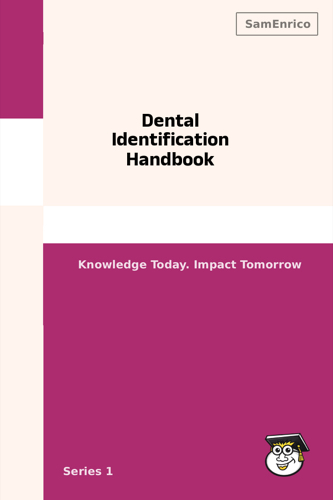
Dental Identification Handbook
Use bite marks and dental records to identify huma
Use bite marks and dental records to identify human remains in forensic cases.
Formats
About this book
Free sample
Chapter 1: The Silent Witness--The dead, it is often said, tell no tales. But this is a profound misunderstanding of the forensic arts. A corpse does not speak, but it testifies relentlessly. Its testimony is written in the lividity of its skin, the fracture patterns of its bones, and most persistently, within the mineral fortress of its mouth. For the forensic odontologist, the oral cavity is not a dark and silent cavity; it is a historical archive, a biological signature, and often, the only key to restoring a name to a nameless body.
This chapter is the first step in learning to read that archive. Before one can match a post-mortem discovery to an ante-mortem record, before one can testify in a court of law, one must first master the landscape. This is the blueprint of the mouth—the anatomy, the anomalies, and the enduring features that make human dentition one of the most powerful identification tools in forensic science.The Foundation: Why Teeth are Nature’s Hard Drives To understand the value of dental identification, one must first appreciate the biological exceptionalism of the tooth. Unlike skin, which decomposes rapidly, or soft tissue, which is subject to rapid autolysis, the tooth is encased in enamel—the hardest substance produced by the human body. Enamel is approximately 96% mineral hydroxyapatite, a crystalline calcium phosphate structure that can withstand temperatures exceeding 1,000 degrees Celsius, prolonged immersion in saltwater, and the acidic byproducts of decomposition.
While a fingerprint may be lost to a burn and DNA may degrade in humid environments, a tooth remains a durable, readable data chip.This durability is the foundational premise of this handbook. Consider the victim of a house fire. The epidermis may be charred beyond recognition; dermal papillae, the basis of fingerprints, are destroyed. Yet, within the oral cavity, the posterior teeth, protected by the buccal fat pad and the masseter muscle, may remain remarkably preserved. Similarly, in a drowning victim recovered after weeks in a river, soft tissue slippage may render facial recognition impossible.
But the teeth, anchored in the alveolar bone, retain their shape, restorations, and unique rotational alignments. The forensic odontologist does…
This is the end of the free sample. Get the eBook to keep going. Buy now
Contents
- Chapter 1
- Chapter 2
- Chapter 3
- Chapter 4
- Chapter 5
- Chapter 6
- Chapter 7
- Chapter 8
- Chapter 9
- Chapter 10
- Chapter 11
- Chapter 12
Details
- Author
- Abreu Genevive
- Publisher
- SamEnrico
- Language
- English
- Genre
- Non-Fiction, True Crime, Forensic Science
- Released
- 2026-06-10
- Pages (approx.)
- 136
- Available as
- eBook, Audiobook

Read better in the ZLOADR app
Your eBooks on your phone or tablet. Sign in with your SamEnrico account and start reading.
More by Abreu Genevive
 Customer Service Shift HandoffAbreu Genevive$11.99
 Saint Francis Brother Sun SongAbreu Genevive$11.99
 Keto and Kidney Stones RiskAbreu Genevive$11.99
 The Protein First Weight StrategyAbreu Genevive$11.99
 Whispers in the Dark: The Forensic Mind of Sherlock HolmesAbreu Genevive$11.99
 Vinyl Cutting Machine OperatorAbreu Genevive$11.99
 Instagram Pivot StoryAbreu Genevive$12.99
 Faceless YouTube Educational ChannelAbreu Genevive$12.99
 Learn to Play the Ilimba DrumAbreu Genevive$11.99
 How to Become a Game AttendantAbreu Genevive$11.99
You may also like
 Hong Kong Handover 1997Dunn Johnnie$11.99
 Zumba For Postnatal Recovery CourseNeal Christian$11.99
 Zumba for BeginnersLadner Nikia$11.99
 YouTube Comment Mining GuideHumes Pandora$12.99
 Worry Box MeditationCarlin Rudy$11.99
 Workplace Stress MeditationNguyen Lynn$11.99
 Workplace Stress and Sleep RepairHawley Ivory$11.99
 Workplace Perfectionism CureDelaney Jeffry$11.99
 Workplace Injustice Anger GuideWallen Isabelle$11.99
 Work Addiction and Burnout LinkGreenwood Ester$11.99
 Women in Yoga and WellnessBeattie Galina$11.99
 Women in Stand Up ComedyChun Evangeline$11.99