
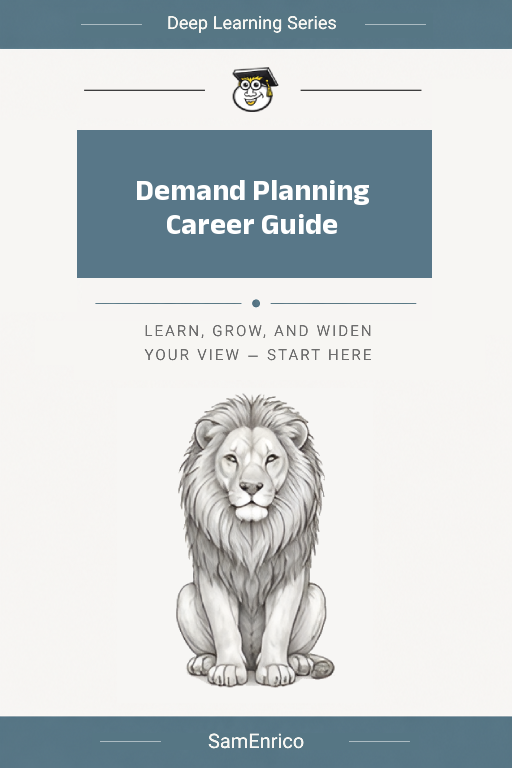
Non-FictionNon Obvious CareerDemand Planning
Demand Planning Career Guide
Master forecasting, inventory optimization, and da
by Adler Wilton
Master forecasting, inventory optimization, and data analysis for supply chain roles.
Formats
About this book
Free sample
Chapter 1: The $100 Million Mistake--–- Anna Chen had been a demand planner for eleven years before she understood what the job actually was. For the first ten, she thought she was a forecaster. She built models, cleaned data, ran error metrics, and sent spreadsheets to the supply chain team every Thursday at 2 PM. She was good at it—her w MAPE was consistently below 25%, which her manager called "solid." Then the pandemic hit, and everything changed. Overnight, her models became useless.
The statistical baselines that had worked for years produced errors of 300%. And yet, Anna didn't get fired. In fact, she got promoted. Not because she predicted the pandemic—no one did—but because she was the only person in the room who could answer the question that kept the CEO awake at night: "What do we do now?"This chapter is about why that question matters more than any forecast. It is about why demand planning is not a clerical function, not a statistical exercise, and not a back-office afterthought.
It is the unseen engine of the supply chain, and if you master it, you will sit at the table where billion-dollar decisions are made.The Financial Physics of Getting It Wrong Let us begin with a number: $1.2 billion. That is how much inventory was sitting on cargo ships off the coast of Los Angeles in October 2021—goods that had been ordered based on demand forecasts that turned out to be wrong. Some companies had too much. Others had too little. Almost all had paid the price.Forecast accuracy is not an academic metric.
It is a direct financial lever with three measurable impacts.First, inventory costs. Every dollar of inventory that sits in a warehouse costs about 20-30% annually in carrying costs—storage, insurance, taxes, obsolescence, and the opportunity cost of capital. A company with 100millionininventoryanda20100 million in inventory and a 20% forecast bias (consistently over-forecasting by 20%) is carrying 100millionininventoryanda2020 million of unnecessary inventory. At 25% carrying cost, that is $5 million per year in pure waste. Conversely, a company that under-forecasts by 20% will face stockouts, expedited freight, and lost revenue.
The math is symmetric and brutal.Second, revenue. A stockout does not just mean a missed sale. It means a customer…
This is the end of the free sample. Get the eBook to keep going. Buy now
Contents
- Chapter 1
- Chapter 2
- Chapter 3
- Chapter 4
- Chapter 5
- Chapter 6
- Chapter 7
- Chapter 8
- Chapter 9
- Chapter 10
- Chapter 11
- Chapter 12
Details
- Author
- Adler Wilton
- Publisher
- SamEnrico
- Language
- English
- Genre
- Non-Fiction, Non Obvious Career, Demand Planning
- Released
- 2026-05-29
- Pages (approx.)
- 149
- Available as
- eBook, Audiobook

Read better in the ZLOADR app
Your eBooks on your phone or tablet. Sign in with your SamEnrico account and start reading.
More by Adler Wilton
 Major Depressive Disorder Relapse Prevention PlanAdler Wilton$11.99
 Sibling Reunification in Foster CareAdler Wilton$11.99
 Incense Smoke Particulate MatterAdler Wilton$11.99
 Metta for Chiropractic AdjustmentAdler Wilton$11.99
 Local Theatre FounderAdler Wilton$11.99
 John Trudell PoetAdler Wilton$11.99
 Slave Ship Captains LogsAdler Wilton$11.99
 Success Without Burnout for MarketersAdler Wilton$11.99
 Hippocrates of Byzantium: The Healer of ConstantinopleAdler Wilton$11.99
 The Painter and the Volcano: How a Chilean Artist Captured the Soul of OsornoAdler Wilton$11.99
 How to Produce Water TimersAdler Wilton$11.99
 How to Produce Lobster and Crab CrackersAdler Wilton$11.99
You may also like
 Hong Kong Handover 1997Dunn Johnnie$11.99
 Zumba For Postnatal Recovery CourseNeal Christian$11.99
 Zumba for BeginnersLadner Nikia$11.99
 YouTube Comment Mining GuideHumes Pandora$12.99
 Worry Box MeditationCarlin Rudy$11.99
 Workplace Stress MeditationNguyen Lynn$11.99
 Workplace Stress and Sleep RepairHawley Ivory$11.99
 Workplace Perfectionism CureDelaney Jeffry$11.99
 Workplace Injustice Anger GuideWallen Isabelle$11.99
 Work Addiction and Burnout LinkGreenwood Ester$11.99
 Women in Yoga and WellnessBeattie Galina$11.99
 Women in Stand Up ComedyChun Evangeline$11.99