
Non-FictionInformativeEducational
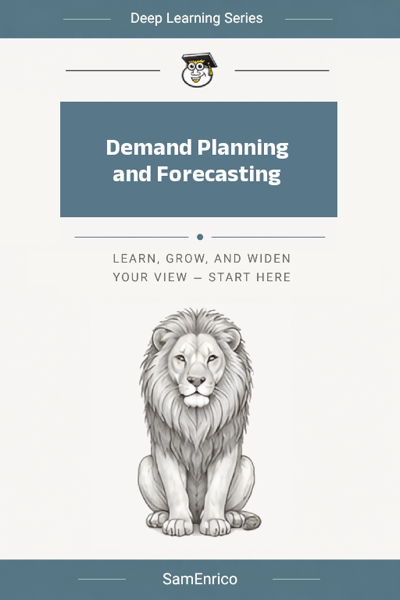
Demand Planning and Forecasting eBook
A Coursebook on Demand Planning and Forecasting
A Coursebook on Demand Planning and Forecasting
Formats
Free sample
Chapter 1: The Forecasting Trap--The meeting was already a disaster, and it wasn't even nine in the morning. Around the conference table sat fifteen people from sales, marketing, operations, finance, and supply chain. Each one held a different version of the forecast. The sales director believed next quarter would be a blowout—his team was closing deals, the pipeline was full, and he needed inventory to support the surge. The operations VP thought sales was delusional.
The factory was already running at capacity, raw material suppliers were quoting extended lead times, and there was no way to meet the numbers sales was promising. The finance director sat in silence, calculating how much cash would be tied up in inventory if they split the difference and got it wrong.The demand planning manager, a competent professional who had inherited this mess three months earlier, watched the debate spiral. The statistical forecast predicted steady growth of five percent. Sales wanted to adjust it up to twenty percent. Operations wanted to adjust it down to flat.
The CEO, frustrated and late for another meeting, finally slammed his hand on the table and demanded a number. Anyone. Any number. The room went silent. The demand planning manager, caught in the headlights, said the only thing she could: "Let's use the statistical forecast and revisit it next month."No one was happy.
Sales felt ignored. Operations felt overruled. Finance had no confidence in any of the numbers. The CEO walked out without a plan. And the demand planning manager went back to her desk wondering why a process that should be about data and logic had become a political battleground.This scene happens somewhere in the global economy every single day.
Perhaps it happens in your organization. Perhaps you have been the demand planning manager in that room, caught between competing agendas, armed with a spreadsheet and a prayer. If so, I have good news and bad news. The bad news is that your experience is not an anomaly. It is the normal state of demand planning in most companies.
The good news is that it does not have to be. The problems that cause these meetings to fail are not mysteries. They are known, documented, and solvable. But solving them requires first understanding why most organizations approach demand planning completely backward.The Three Deadly Assumptions Before we can build a better approach, we need to clear away the wreckage of the old one. Most demand planning failures trace back to three assumptions that seem reasonable but are actually catastrophic.
Let me name them, and then we will dismantle each one.The first deadly assumption is that forecasting is primarily a mathematical problem. This assumption leads organizations to invest heavily in statistical models, machine learning, and AI while neglecting everything else. The thinking goes: if we just had a better algorithm, our forecasts would be accurate. This is seductive because it promises a purely technical solution to what is actually a socio-technical problem. No algorithm can compensate for bad data.
No model can incorporate information that no one bothers to share. No forecast produced in isolation will be trusted by the people who have to use it. The math matters, but it matters far less than most executives believe.The second deadly assumption is that forecast accuracy is the only thing that matters. This assumption leads organizations to obsess over error metrics while ignoring the decisions those forecasts are meant to inform. A forecast can be statistically accurate but still useless for decision-making if it is at the wrong level of aggregation, on the wrong time horizon, or delivered too late to act upon.
Conversely, a forecast with modest accuracy delivered on time at the right level of detail can be immensely valuable. Accuracy is a means, not an end. The end is better decisions.The third deadly assumption is that the future is fundamentally predictable. This assumption leads organizations to treat forecasts as commitments rather than hypotheses. When a forecast misses, people are blamed.
When people are blamed, they sandbag—they forecast conservatively so they will look good when actual demand falls short. Sandbagging is rational behavior in a culture that punishes forecast error. It is also a cancer on demand planning because it systematically biases forecasts and hides true demand from the supply chain.Let me be unambiguous about each of these assumptions and why they must be discarded.First, forecasting is not primarily a mathematical problem. It is primarily a data problem, a process problem, and an organizational problem. The math is the easy part.
Any competent analyst can learn exponential smoothing in an afternoon. The hard part is getting clean data, getting the right people in the room, getting them to share information honestly, and getting them to commit to a single number. Organizations that succeed at demand planning succeed because they have solved the organizational problems, not because they have the most sophisticated algorithms.Second, forecast accuracy is not the only thing that matters. In fact, optimizing solely for accuracy often produces worse business outcomes. Consider a company that sells both high-margin and low-margin products.
An accuracy-focused forecast will distribute error proportionally across both categories. But a business-focused forecast might accept higher error on low-margin items to free up attention and inventory for high-margin items where being wrong is more expensive. The best forecast is not the one with the lowest MAPE. It is the one that leads to the best decisions.Third, the future is not fundamentally predictable. Some things are predictable.
Seasonality. Slow-moving trends. The impact of a planned promotion. But many things are not. Competitor actions.
Macroeconomic shocks. Global pandemics. Sudden shifts in consumer preferences. Pretending these things are predictable does not make them so. It just ensures that your forecast will be wrong in ways you did not anticipate.
The goal of demand planning is not to eliminate uncertainty—that is impossible. The goal is to understand uncertainty, quantify it, and make decisions that are robust to it.Why Most Forecasts Fail Before They Are Made Let me walk you through the typical forecasting process in a mid-sized company. I have seen this process dozens of times. It is almost always the same, and it almost always fails.The process begins with an analyst pulling historical sales data from the enterprise resource planning system. The data is messy—it includes periods of stockouts where zero sales do not represent zero demand, promotional spikes that distort the baseline, returns that are netted against gross sales, and one-time events that will not repeat.
The analyst does not clean the data because no one has taught them how or given them time to do it.The analyst then runs a forecasting model—probably exponential smoothing or a simple moving average—and produces a baseline forecast. This forecast is emailed to a handful of stakeholders: sales, marketing, operations, and finance. Each stakeholder looks at the forecast through their own lens. Sales sees numbers that are too low to support their targets. Marketing sees opportunities to add promotional lifts.
Operations sees numbers that are too high for their capacity. Finance sees numbers that are inconsistent with the budget.Each stakeholder adjusts the forecast…
This is the end of the free sample. Get the eBook to keep going. Buy now
About this book
Details
- Author
- Chapman Ralph
- Publisher
- SamEnrico
- Language
- English
- Genre
- Non-Fiction, Informative, Educational
- Released
- 2026-05-11
- Pages (approx.)
- 137
- Available as
- eBook, Audiobook

Read better in the ZLOADR app
Your eBooks on your phone or tablet. Sign in with your SamEnrico account and start reading.
More by Chapman Ralph
 The Quit Smoking Cancer FearChapman Ralph$11.99
 Listening In Education GuideChapman Ralph$11.99
 Stress Relapse Prevention CouplesChapman Ralph$11.99
 Athlete Focus Distraction GuideChapman Ralph$11.99
 The Social Media ScrollChapman Ralph$11.99
 Voice Recording Dream MethodChapman Ralph$11.99
 Telehealth for Rural AreasChapman Ralph$11.99
 The Photo in the ShoeboxChapman Ralph$11.99
 EQ for College Students GuideChapman Ralph$11.99
 Silicon Exodus: The Great Tech Migration of 2020Chapman Ralph$11.99
 The Hollow Men of Harrowdown HillChapman Ralph$11.99
 Black Socks and Broken Barriers: The Fight for Racial Equality in Italian FootballChapman Ralph$11.99
You may also like
 Hong Kong Handover 1997Dunn Johnnie$11.99
 Zumba For Postnatal Recovery CourseNeal Christian$11.99
 Zumba for BeginnersLadner Nikia$11.99
 YouTube Comment Mining GuideHumes Pandora$12.99
 Worry Box MeditationCarlin Rudy$11.99
 Workplace Stress MeditationNguyen Lynn$11.99
 Workplace Stress and Sleep RepairHawley Ivory$11.99
 Workplace Perfectionism CureDelaney Jeffry$11.99
 Workplace Injustice Anger GuideWallen Isabelle$11.99
 Work Addiction and Burnout LinkGreenwood Ester$11.99
 Women in Yoga and WellnessBeattie Galina$11.99
 Women in Stand Up ComedyChun Evangeline$11.99