
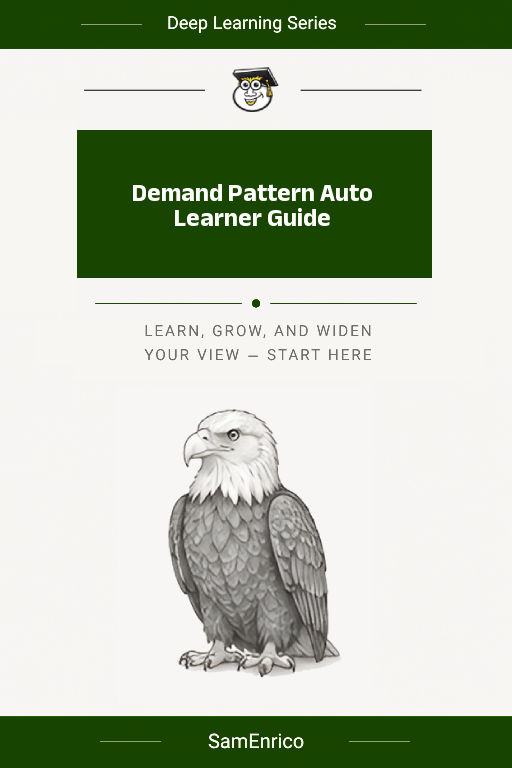
Non-FictionAI OperatorLogistics OptimizationSkills Guide
Demand Pattern Auto Learner Guide Audiobook
Train AI to recognize seasonal trends, promotional
by Barba Fidel
Train AI to recognize seasonal trends, promotional impacts, and market shifts for accurate inventory forecasts. Includes historical data preprocessing, feature extraction, and model retraining prompts.
Formats
Free sample
Chapter 1: The Expensive Spreadsheet--–- On a Tuesday morning in March, a supply chain manager named Elena watched a $2.4 million mistake unfold on her laptop screen. Three months earlier, her team had used a moving average forecast to order winter jackets for the upcoming season. The model, which worked beautifully two years ago, had missed a subtle trend: customers were shifting toward lighter, technical outerwear. The warehouse now held forty thousand heavy parkas that nobody wanted. Meanwhile, the lightweight jackets were backordered for eight weeks.
Elena’s forecast error wasn’t bad luck. It was the inevitable outcome of using static tools on dynamic demand.The problem Elena faced is not unique. Across retail, manufacturing, and distribution, thousands of forecasters wake up to similar surprises every day. They trusted their spreadsheets. They trusted their ERP systems.
They trusted the same exponential smoothing models that have been in use since the 1950s. And those tools failed them—not because the tools are poorly built, but because they were designed for a world that no longer exists. The world of stable seasons, predictable promotions, and slow-moving competitors is gone. In its place is a landscape of viral Tik Tok trends, supply chain disruptions, climate-driven season shifts, and price wars that erupt overnight.This book exists because static forecasting is no longer a viable strategy. The Demand Pattern Auto Learner Guide will teach you how to build systems that adapt automatically—systems that retrain themselves when the market changes, that learn from their own mistakes, and that turn demand forecasting from a quarterly calendar event into a continuous, autonomous process.
But before we build the solution, we must fully understand the problem. This chapter dissects why traditional forecasting methods fail, why the cost of that failure is measured in millions of dollars, and why auto-learning is not a luxury but a necessity.The Three Pillars of Traditional Forecasting To understand why traditional methods break, we first need to understand what they are. Most organizations rely on a small set of classical techniques, often implemented in spreadsheets or embedded in legacy enterprise systems. Each technique has a specific weakness that becomes catastrophic under modern demand patterns.Moving Averages: The Rearview Mirror The moving average is the simplest forecasting method. It takes the average of the last N periods and projects that average forward.
A 12-week moving average, for example, sums the last 12 weeks of sales and divides by 12. That number becomes…
This is the end of the free sample. Get the Audiobook to keep going. Buy now
About this book
Details
- Author
- Barba Fidel
- Publisher
- SamEnrico
- Language
- English
- Genre
- Non-Fiction, AI Operator, Logistics Optimization, Skills Guide
- Released
- 2026-06-01
- Pages (approx.)
- 143
- Available as
- eBook, Audiobook

Listen in the VoxFlicks app
Audiobooks and audio dramas wherever you go. Sign in with your SamEnrico account and press play.
More by Barba Fidel
 Caregiver Career Gap GuideBarba Fidel$11.99
 The Gut Brain Sleep ConnectionBarba Fidel$11.99
 Resentment After Divorce WorkbookBarba Fidel$11.99
 Body Language for DiplomatsBarba Fidel$11.99
 The Gambling Addiction and Depression GuideBarba Fidel$11.99
 Beanie Babies: The Furious Rise and Fall of a Collectible EmpireBarba Fidel$11.99
 Green Technology Policy GuideBarba Fidel$12.99
 Understanding Landy–donnai SyndromeBarba Fidel$17.99
 Boutique SupervisorBarba Fidel$11.99
 How to Start a Stock Car Racing Team BusinessBarba Fidel$11.99
You may also like
 Hong Kong Handover 1997Dunn Johnnie$11.99
 Zumba For Postnatal Recovery CourseNeal Christian$11.99
 Zumba for BeginnersLadner Nikia$11.99
 YouTube Comment Mining GuideHumes Pandora$12.99
 Worry Box MeditationCarlin Rudy$11.99
 Workplace Stress MeditationNguyen Lynn$11.99
 Workplace Stress and Sleep RepairHawley Ivory$11.99
 Workplace Perfectionism CureDelaney Jeffry$11.99
 Workplace Injustice Anger GuideWallen Isabelle$11.99
 Work Addiction and Burnout LinkGreenwood Ester$11.99
 Women in Yoga and WellnessBeattie Galina$11.99
 Women in Stand Up ComedyChun Evangeline$11.99