
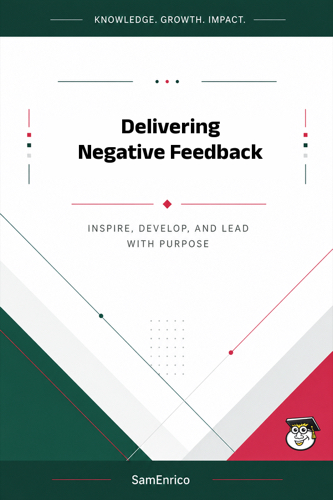
Delivering Negative Feedback eBook
Frames criticism constructively to promote growth
by Vail Kelle
Frames criticism constructively to promote growth rather than defensiveness.
Formats
Free sample
Chapter 1: The Feedback Paradox...–- Every manager remembers the moment. You have known for three weeks that something is wrong. The reports are late. The quality has slipped. The client sent a terse email asking if anyone is paying attention.
You have rehearsed the conversation in the shower, in the car, and while pretending to read the same email for the tenth time. You know what you need to say. You know it will help them in the long run. You know that avoiding it is only making things worse.And yet, you have not said a single word.Instead, you have done what most people do. You have hoped the problem would fix itself.
You have complained about it to your spouse, your own manager, and perhaps a trusted colleague. You have watched the person make the same mistake again, wincing internally each time. You have told yourself that you are being kind by not saying anything. You have told yourself that next week will be a better time. And deep down, you have felt a growing sense of resentment toward the very person you are trying to protect.This is the feedback paradox.
We know, intellectually, that negative feedback is necessary for growth. We know that avoiding it allows small problems to become large ones. We know that people cannot fix what they do not know is broken. We know that every great coach, teacher, and leader in history has been someone willing to tell hard truths. And yet, we avoid giving negative feedback like it is a physical threat to our survival.Because to your brain, it is.The Neuroscience of Why We Avoid Before we can learn how to deliver negative feedback effectively, we must understand why our bodies rebel against the very idea of it.
This is not a matter of cowardice or poor character. It is a matter of biology.Your brain is equipped with an ancient alarm system designed to keep you alive in a world of predators, rival tribes, and physical danger. This alarm system, centered in a small almond-shaped structure called the amygdala, operates below the level of conscious thought. It scans every social interaction for signs of threat. And evolution has taught it that one of the most dangerous things a human can experience is rejection from the tribe.Thousands of years ago, being expelled from your social group meant death.
No one would share food with you. No one would protect you from predators. No one would help you raise your children. Your brain therefore learned to treat social rejection—criticism, exclusion, public shame—with the same urgency as a physical attack.When you contemplate giving negative feedback to someone, your amygdala fires. It sends stress hormones coursing through your body.
Your heart rate increases. Your palms sweat. Your breathing becomes shallow. Your prefrontal cortex—the rational, planning part of your brain—begins to shut down. This is called an amygdala hijack, and it is the reason why otherwise intelligent, compassionate, confident people suddenly find themselves unable to say a simple sentence like, "The report was late."Here is the crucial insight that most feedback books get wrong: Your avoidance of negative feedback is not a weakness.
It is a survival instinct. And the first step to overcoming any survival instinct is to name it, understand it, and stop judging yourself for having it.The goal of this book is not to turn you into someone who enjoys confrontation. The goal is to give you a set of tools so reliable, so scripted, and so psychologically safe that your amygdala gradually learns to stop firing. When you know exactly what to say, exactly when to say it, and exactly how to handle the response, the feedback conversation stops feeling like a threat and starts feeling like a routine part of your work.Intent vs. Impact: The Great Misunderstanding There is a second paradox embedded within the first one.
Even when we manage to overcome our avoidance and deliver the feedback, it often goes badly. The person gets defensive. They argue with the facts. They blame someone else. They cry, or they shut down, or they storm out.
And we walk away thinking, "But I was just trying to help."This is the gap between intent and impact.Your intent, in almost every case, is positive. You want the person to succeed. You want the team to perform better. You want to prevent a small problem from becoming a large one. You are not trying to be cruel, and you certainly do not think of yourself as someone who attacks other people's character.But impact is not intent.
Impact is what the receiver experiences. And what the receiver experiences, more often than not, is an attack.Think about it from their perspective. They arrive at work expecting a normal day. You ask to speak with them privately. Your body language is stiff.
You close the door. You sit across from them at a desk—a position that feels like an interrogation. You say, "We need to talk about your performance." Their amygdala fires instantly. They are no longer in a conversation. They are in a survival situation.Everything you say after that moment will be filtered through their threat response.
If you say, "The report was late," they hear, "You are lazy." If you say, "You interrupted the client," they hear, "You are rude." If you say, "The quality needs to improve," they hear, "You are incompetent."This is not because they are fragile or unreasonable. It is because the human brain is wired to interpret criticism as a threat to identity. And when identity is threatened, the rational mind shuts down and the defensive mind takes over.The solution is not to stop giving feedback. The solution is to understand the three specific triggers that cause feedback to land as an attack—and to structure your message so that it avoids those triggers entirely.The Three Feedback Triggers Drawing on decades of research from the Harvard Negotiation Project, specifically the work of Douglas Stone and Sheila Heen in their book Thanks for the Feedback, we can identify three distinct triggers that cause feedback conversations to go wrong. Each trigger represents a different way that the receiver's brain interprets your message as a threat.Trigger One: The Truth Trigger The truth trigger is activated when the receiver disagrees with the content of your feedback.
They believe that your facts are wrong, your assessment is inaccurate, or your interpretation of events does not match reality.When the truth trigger fires, you will hear statements like:"That's not what happened.""You have your facts wrong.""Let me explain what actually occurred.""Where did you get that information?"Notice that the receiver is not necessarily being defensive in a hostile way. They may genuinely believe that you have made a mistake. They may have evidence that contradicts your version of events. Or they may simply have a different interpretation of the same set of facts.The truth trigger is the most common trigger in feedback conversations, and it is also the most seductive. As the giver, you will be tempted to double down on your facts.…
This is the end of the free sample. Get the eBook to keep going. Buy now
About this book
Details
- Author
- Vail Kelle
- Publisher
- SamEnrico
- Language
- English
- Genre
- Non-Fiction, Self-Help, Feedback Skills
- Released
- 2026-06-08
- Pages (approx.)
- 153
- Available as
- eBook, Audiobook

Read better in the ZLOADR app
Your eBooks on your phone or tablet. Sign in with your SamEnrico account and start reading.
More by Vail Kelle
 The Twelve Step Gratitude ListVail Kelle$11.99
 IBS And Endometriosis GuideVail Kelle$11.99
 Journaling for Smoking RecoveryVail Kelle$11.99
 Disappointment Resilience TrainingVail Kelle$11.99
 Parent of Gifted ChildVail Kelle$11.99
 Methamphetamine Recovery GuideVail Kelle$11.99
 Alcohol Detox Medical GuideVail Kelle$11.99
 The Last Lighthouse Keepers: Guardians of the StormVail Kelle$11.99
 Embers of the Phoenix King: The Forgotten Fires of Ancient EgyptVail Kelle$11.99
 How to Produce Track Starting BlocksVail Kelle$11.99
 How to Produce Interactive KiosksVail Kelle$11.99
 How to Become a Powder LoaderVail Kelle$11.99
You may also like
 The Feedback Delivery HandbookShepherd Lorilee$11.99
 Remote Feedback Giving GuideBlevins Lurlene$11.99
 Feedback Reception ConfidenceStack Kasi$11.99
 Presentation Feedback IntegrationDunbar Maple$11.99
 Giving and Receiving FeedbackMallory Oda$11.99
 Teen Criticism AcceptanceJacobsen Emery$11.99
 Small Talk for Performance ReviewsBarry January$11.99
 Assertive Feedback Delivery GuideCallaway Merrilee$11.99
 The Feedback ConversationMccray Phyliss$11.99
 Remote Feedback Delivery GuideDodge Billy$11.99
 EQ Feedback Reception GuideBethel Monnie$11.99
 The Feedback Delivery MethodKinder Jaimee$11.99