
Non-FictionSelf-HelpLeadership
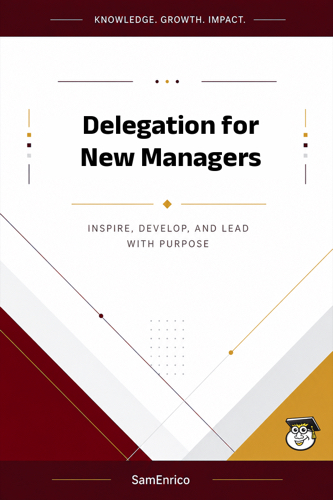
Delegation for New Managers eBook
Transition from doer to leader by letting go of ta
Transition from doer to leader by letting go of tasks.
Formats
Free sample
Chapter 1: The Superhero Trap--–- Every new manager remembers the exact moment they were promoted. Maybe it was a call from HR, a quiet word in the CEO’s office, or an email that arrived at 4:47 PM on a Thursday. The relief was immediate. All those late nights, the projects you rescued from the brink, the spreadsheets you mastered, the clients you kept from walking—someone had noticed. You had been chosen.
Finally, you would have the title, the pay, and the authority that matched your effort.Then came Monday morning.You sat in your new chair—slightly nicer than the old one, but not by much—and looked at your inbox. Three hundred and forty-two unread messages. Your old tasks were still there, because no one had been hired to replace you. Your new tasks were also there: budget reviews, one-on-one meetings, a performance review due Friday for an employee you barely knew, and a request from your boss to “get more strategic.” By 10 AM, you had already done seven things. By noon, you had missed a deadline on a project you used to love.
By 3 PM, your best employee asked for help with a problem that would have taken you ten minutes to solve, but instead you spent an hour explaining it. By 5 PM, you were the last one in the office, just like always. Nothing had changed.You were promoted, but you were still doing the same work. Worse, you were now doing your old work and your new work. And somewhere in the back of your mind, a small, exhausted voice whispered: Maybe I wasn’t ready for this.You were ready.
You just didn’t know how to stop being a hero.The Promotion Paradox Here is the single most destructive belief in all of management: “I was promoted because I was excellent at my job, so I should continue doing that job while also managing others.”This belief is so common, so deeply embedded in corporate culture, that almost no one questions it. The senior engineer becomes the engineering manager but still writes code. The top salesperson becomes the sales director but still makes calls. The lead graphic designer becomes the creative director but still opens Photoshop. And every single one of them burns out within eighteen months.Let us name this belief.
Call it the Superhero Fallacy.The Superhero Fallacy says that doing more work than anyone else is how you prove your value. It says that saying “yes” to every request is noble. It says that if you want something done right, you should do it yourself. It says that asking for help is weakness. It says that your identity is tied to your output—the spreadsheets you built, the code you shipped, the deals you closed.All of that was true when you were an individual contributor.
It is now a lie.As a manager, your job has fundamentally changed. But your instincts have not. Your instincts still tell you to grab the keyboard, to rewrite the email, to fix the problem yourself because it is faster and you know exactly how to do it. Those instincts are the trap. They are the reason 60% of new managers fail or underperform within their first two years, according to research from the Corporate Leadership Council.
They are the reason you feel more exhausted now than when you were an individual contributor, despite having “less work” on paper.The Superhero Fallacy convinces you that letting go of tasks is abandoning your team. In reality, holding onto tasks is abandoning your team. Because while you are formatting a spreadsheet at 7 PM, you are not doing the one thing only you can do: leading.Technical Work vs. Strategic Work To understand why the Superhero Fallacy is so dangerous, you must first understand a distinction that most organizations never teach. The distinction is between technical work and strategic work.Technical work is execution.
It is writing the code, fixing the typo, building the pivot table, answering the customer email, designing the logo, negotiating the contract. Technical work is tangible. It has a beginning, a middle, and an end. When you finish a piece of technical work, you get a small hit of dopamine. You see progress.
You feel productive.Strategic work is invisible. It is designing the system that produces the code. It is coaching the person who fixes the typo. It is removing the obstacles that slow down the pivot table. It is setting the direction so that customer emails are answered consistently, without you.
Strategic work has no clear endpoint. When you do strategic work well, nothing dramatic happens. The team just works. Problems are solved before you even hear about them. And because nothing dramatic happens, no one gives you a medal.
No one sends a thank-you email. Your boss does not notice, because your boss is also trapped in technical work.Here is the brutal math: As a new manager, your job is 80% strategic. But most new managers spend 80% of their time on technical work.Why? Because technical work is comfortable. You know how to do it.
You have been rewarded for doing it your entire career. Strategic work is uncomfortable. It requires patience, trust, and the ability to tolerate ambiguity. When you spend an hour coaching an employee on how to handle a difficult client, you have no idea if it will work. When you spend that same hour handling the client yourself, you know exactly what will happen—the client will be satisfied, and you will feel like a hero.That feeling is the trap.The Opportunity Cost of Doing Let us make this concrete.
Suppose you earn $100,000 per year as a new manager. Your direct report, a skilled individual contributor, earns $60,000. Every hour you spend doing their job—the job you used to do—costs the company $40 in misallocated labor. You are being paid a premium to lead, and you are spending that premium time on work that someone else could do for 40% less.But the real cost is not financial. The real cost is opportunity.Every hour you spend on technical work is an hour you do not spend on strategic work.
And strategic work has leverage. One hour of strategic work—removing a bottleneck that affects five people—saves five hours of collective labor. One hour of coaching a direct report on a skill they will use for the next three years pays dividends long after you have moved on. One hour of planning prevents twenty hours of firefighting.When you do technical work, you help one person (yourself) for one hour. When you do strategic work, you help your entire team for weeks or months.
The leverage difference is not 2x or 5x. It is often 20x or more.Here is a simple exercise to see your own opportunity cost. For one week, keep a log. Every time you do a task, write down:What the task was.How long it took.Whether it was technical (execution) or strategic (design, coaching, removal of obstacles).Whether someone else on your team could have done it at 70% of your quality.At the end of the week, add up the hours spent on technical tasks…
This is the end of the free sample. Get the eBook to keep going. Buy now
About this book
Details
- Author
- Patino Bennie
- Publisher
- SamEnrico
- Language
- English
- Genre
- Non-Fiction, Self-Help, Leadership
- Released
- 2026-06-06
- Pages (approx.)
- 137
- Available as
- eBook, Audiobook

Read better in the ZLOADR app
Your eBooks on your phone or tablet. Sign in with your SamEnrico account and start reading.
More by Patino Bennie
 Nurse Who Never Gave UpPatino Bennie$11.99
 Emotion Exposure HierarchyPatino Bennie$11.99
 Breath Awareness For Chronic PainPatino Bennie$11.99
 Alcohol Recovery Finance PlanPatino Bennie$11.99
 Antwerp Heist PhotographyPatino Bennie$11.99
 Pomodoro For Writers BlockPatino Bennie$11.99
 Graham Hancock OdysseyPatino Bennie$11.99
 The Troll King’s Riddle: A Saga of Excalibur and FrostPatino Bennie$11.99
 The Phantom of the Fur Trade: The Ghosts of the Hudson's Bay CompanyPatino Bennie$11.99
 10 Ways to Use Sweet Sherry (Recipe Book)Patino Bennie$11.99
 Citing Data Sets GuidePatino Bennie$12.99
 Seasonal Student Job GuidePatino Bennie$12.99
You may also like
 Hong Kong Handover 1997Dunn Johnnie$11.99
 Zumba For Postnatal Recovery CourseNeal Christian$11.99
 Zumba for BeginnersLadner Nikia$11.99
 YouTube Comment Mining GuideHumes Pandora$12.99
 Worry Box MeditationCarlin Rudy$11.99
 Workplace Stress MeditationNguyen Lynn$11.99
 Workplace Stress and Sleep RepairHawley Ivory$11.99
 Workplace Perfectionism CureDelaney Jeffry$11.99
 Workplace Injustice Anger GuideWallen Isabelle$11.99
 Work Addiction and Burnout LinkGreenwood Ester$11.99
 Women in Yoga and WellnessBeattie Galina$11.99
 Women in Stand Up ComedyChun Evangeline$11.99