
Non-FictionSelf-HelpConstruction
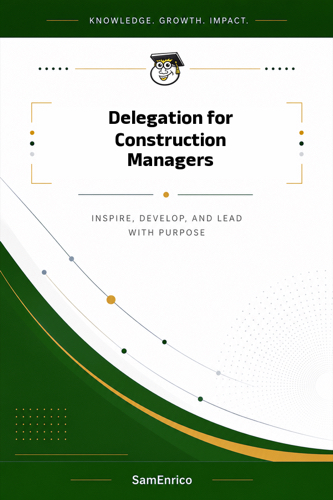
Delegation for Construction Managers eBook
Assigns subcontractors and crews.
Assigns subcontractors and crews.
Formats
Free sample
Chapter 1: The Craftsman's Trap--The day I stopped being a construction manager was the day I finally became one.I was standing in the middle of a $14 million commercial renovation, concrete dust caked into the sweat on my forearms, a tape measure clipped to my belt, and a drywall sub waiting for me to mark layout lines. My phone buzzed. My wife. I ignored it. It buzzed again.
And again. When I finally answered, she wasn't calling to remind me about dinner. She was calling from the emergency room. Our daughter had fallen at gymnastics. Possible fracture.
They were waiting for X-rays.I looked at the drywall sub. He looked at his watch. Then at me. "You gonna mark these lines, or should I guess?"I marked the lines. I stayed.
I missed my daughter's discharge. I missed tucking her in that night. I missed the look on her face when the doctor said it wasn't broken—just a bad sprain—because I wasn't there.And for what? So a drywall sub could start hanging board two hours earlier?That night, sitting in my truck in the driveway, I had a realization that cracked my entire identity as a construction professional: I had built a company that could not survive my absence. Every subcontractor, every crew, every single person on that jobsite was waiting for me.
Me. Not the plans. Not the schedule. Not their own foreman. Me.I was not a construction manager.
I was the bottleneck.The Promotion That Destroys You Let me tell you a secret that the construction industry hides behind every job posting for "Superintendent" and "Project Manager."You were probably an excellent carpenter. Or a brilliant electrician. Or a mason who could lay block faster and straighter than anyone on the crew. Your technical skills got you noticed. Your attention to detail got you promoted.
Your ability to solve problems with your hands made you valuable.And then someone gave you a hard hat with a different color and a title that sounded impressive. "You're running jobs now," they said. "You're a manager."Here is what no one told you: the skills that made you an excellent craftsman will destroy you as a manager.This is the Craftsman's Trap. It has claimed more construction managers than alcoholism, divorce, and bankruptcy combined. I am not being dramatic.
I have sat across from dozens of superintendents who were burning out, failing, or quitting—every single one of them trapped by the same lie. The lie that says your value comes from what you build with your hands, not from what you enable others to build.The Craftsman's Trap operates through three predictable stages.Stage One: The Hero Craftsman. You are the best on your crew. You can do any task faster and better. When something goes wrong, you fix it yourself because it's quicker than explaining it to someone else.
Your boss notices. You get promoted.Stage Two: The Reluctant Manager. You now have a title and a crew, but you still carry your tools. You tell yourself it's just until the new guys learn the ropes. You work sixty-hour weeks—forty hours managing, twenty hours doing.
You are exhausted but proud. "I'm not afraid to get my hands dirty," you tell anyone who asks.Stage Three: The Burning Bottleneck. This is where most construction managers live. Your crew waits for you to make decisions. Your subs wait for you to mark layout.
Your phone never stops buzzing because no one can do anything without you. You are angry, overwhelmed, and secretly ashamed. You know something is wrong, but you cannot name it. You just know you cannot keep living like this.If you recognize yourself in those three stages, this chapter—this entire book—is written for you.The $50,000 Mistake You Are Making Right Now Before we go any further, let me show you the math. Because construction managers understand numbers.
We understand labor hours, material costs, and profit margins. So let me translate your delegation problem into a language you cannot ignore.The cost of poor delegation for a mid-sized construction firm is between $30,000 and $50,000 per year.I did not invent this number. It comes from analysis of labor waste across seventeen commercial GCs who tracked how their superintendents spent time. Here is what they found.A superintendent who touches tools for ten hours a week—just ten hours—is not actually "helping the crew." That superintendent is:Not reviewing submittals (missed errors that become rework)Not walking the site looking for conflicts (missed change orders)Not communicating with the owner (missed relationship-building)Not planning the next week's sequence (missed schedule optimizations)Each of those misses has a dollar amount attached. A missed submittal error costs $500 to $5,000 in rework.
A missed conflict between trades costs $1,000 to $10,000 in demolition and reinstallation. A missed schedule optimization costs $2,000 to $20,000 in extended general conditions.Add it up over fifty weeks. You are not "helping" when you pick up a hammer. You are stealing from your own profit.But the math gets worse. Because the ten hours of tool-touching is just the visible waste.
The invisible waste is larger.When you are the bottleneck, your subs wait. Waiting subs bill you for idle time or—worse—leave the site to work for someone else. Your crew loses momentum. Your best foremen get frustrated and quit. Your owner loses confidence.
And every single one of those costs shows up somewhere on your profit and loss statement, disguised as "overhead" or "miscellaneous" or "cost of doing business."It is not overhead. It is the Craftsman's Trap. And you can climb out of it.Assigning vs. Delegating: The Distinction That Changes Everything Most construction managers think they are delegating. They are not.
They are assigning. And the difference between assigning and delegating is the difference between drowning and swimming.Assigning is task-focused. You tell someone what to do, step by step. "Install these twenty outlets. Use the blue wire for neutral.
Put the box at forty-eight inches on center." You retain all the thinking. You are just outsourcing the labor.Delegating is outcome-focused. You transfer ownership of a result, with clear boundaries. "You own the electrical rough-in for Zone Three. Deliver a complete, code-passing installation by Friday.
Your constraints are: no overtime, coordinate with HVAC for wall access, and send me daily photo updates. How will you do it?"Do you see the difference? Assigning creates followers. Delegating creates owners.When you assign, you are still the brain. The sub is just the hands.
When something goes wrong—and it will—the sub looks to you for the solution. Because you never gave them permission to think.When you delegate, the sub becomes the brain for their scope. They figure out the sequence. They solve the small problems. They escalate only the issues that exceed their authority.
You go from being a firefighter to being an air traffic controller. You still own the overall flight path. But you are not flying every plane.Here is a test to determine whether you are assigning or delegating. Look at your most recent instruction to a sub or crew. Did you tell them how to do the…
This is the end of the free sample. Get the eBook to keep going. Buy now
About this book
Details
- Author
- Chambers Sharon
- Publisher
- SamEnrico
- Language
- English
- Genre
- Non-Fiction, Self-Help, Construction
- Released
- 2026-06-05
- Pages (approx.)
- 146
- Available as
- eBook, Audiobook

Read better in the ZLOADR app
Your eBooks on your phone or tablet. Sign in with your SamEnrico account and start reading.
More by Chambers Sharon
 PTSD Growth Mindset GuideChambers Sharon$11.99
 Collaborative Writing GuideChambers Sharon$11.99
 Assertiveness for Trauma SurvivorsChambers Sharon$11.99
 The OKR Common MistakesChambers Sharon$11.99
 Mindfulness for ADHD BeginnersChambers Sharon$11.99
 Congo Basin Lost WorldChambers Sharon$11.99
 Slow Driver Patience GuideChambers Sharon$11.99
 The Sultan’s Whisper: A Djinn’s Bargain in the Sands of TimeChambers Sharon$11.99
 The Moonlit Pact of Otohime and UrashimaChambers Sharon$11.99
 Small Naked Oat: Naked Oat HarvestingChambers Sharon$11.99
 How to Produce PvcChambers Sharon$11.99
 How to Produce Elliptical TrainersChambers Sharon$11.99
You may also like
 Hong Kong Handover 1997Dunn Johnnie$11.99
 Zumba For Postnatal Recovery CourseNeal Christian$11.99
 Zumba for BeginnersLadner Nikia$11.99
 YouTube Comment Mining GuideHumes Pandora$12.99
 Worry Box MeditationCarlin Rudy$11.99
 Workplace Stress MeditationNguyen Lynn$11.99
 Workplace Stress and Sleep RepairHawley Ivory$11.99
 Workplace Perfectionism CureDelaney Jeffry$11.99
 Workplace Injustice Anger GuideWallen Isabelle$11.99
 Work Addiction and Burnout LinkGreenwood Ester$11.99
 Women in Yoga and WellnessBeattie Galina$11.99
 Women in Stand Up ComedyChun Evangeline$11.99