
Non-FictionSelf-HelpRumination
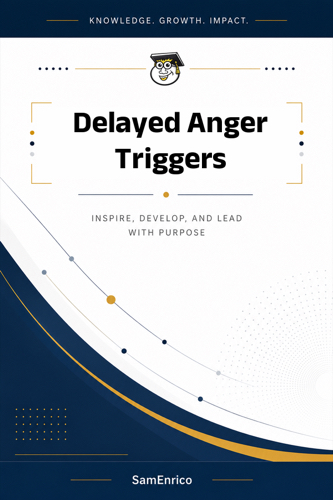
Delayed Anger Triggers eBook
Explores how a trigger can cause anger hours later
by John Mimi
Explores how a trigger can cause anger hours later after rumination.
Formats
Free sample
Chapter 1: The Dangling Conversation...--–- She had not spoken to her sister in eleven months. The silence had started, as these things often do, with nothing at all. A phone call not returned. A text left on read. A birthday overlooked.
Small things, each one. But small things, when you stack them, become a wall. By the time Claire walked into my office, the wall was so high she could not see over it. She was not sad about the estrangement. She was not lonely.
She was angry. A low, steady, humming anger that she carried with her like a second heartbeat.“What happened?” I asked.“I don’t know,” she said. And she meant it.Claire is not unusual. She is the rule. Most people who struggle with delayed anger cannot tell you what started it.
They can describe the explosion in vivid detail—the fight, the slammed door, the text they wish they had not sent. They can describe the trigger—the fork, the sigh, the “okay.” But the original provocation? The thing that actually started the gas leak? It has vanished into the fog of rumination. They have replayed the conflict so many times that they can no longer distinguish the original event from the stories they have told about it.This chapter is about what happens before the ghost argument.
It is about the raw material that ghost arguments are made of. It is about the conversations we never finish, the words we never say, the moments when something shifts inside us and we do not know how to shift it back. Psychologists call this “unfinished business.” I call it the dangling conversation. And until you learn to recognize it, name it, and complete it, you will continue to explode over forks while the real provocation sits in the corner of your mind, untouched and unacknowledged.The Unfinished Symphony The Zeigarnik effect is one of the most replicated findings in psychology. In the 1920s, a Russian psychologist named Bluma Zeigarnik noticed something curious about waiters.
They could remember complex orders with perfect accuracy—as long as the order was still in progress. But the moment the customer paid and left, the waiter’s memory of the order vanished. Zeigarnik tested this phenomenon in the laboratory. She gave people simple tasks—puzzles, math problems, manual tasks. Some tasks she allowed them to complete.
Others she interrupted before they could finish. Later, when she asked them to recall the tasks, they remembered the interrupted tasks nearly twice as well as the completed ones.Your brain treats unfinished tasks like open tabs on a computer. They consume mental energy. They demand attention. They ping you, periodically, with a reminder that something is still pending.
This is adaptive in many contexts. It helps you remember to pick up milk, pay a bill, finish a report. But your brain does not distinguish between a grocery list and a relationship conflict. An unresolved argument is an open tab. A conversation you never finished is an open tab.
A boundary you never set is an open tab. And your brain will keep those tabs open until you close them—or until you convince yourself that they are closed when they are not.Claire had dozens of open tabs. Her sister had made a comment at a family dinner three years earlier—something about Claire’s parenting, something dismissive and sharp. Claire had felt the sting but said nothing. The dinner continued.
The tab opened. A few months later, Claire’s sister forgot to invite her to a gathering. An oversight, probably, but Claire filed it under “evidence.” Another tab. Then the missed birthday. Then the unreturned call.
Tab after tab, each one small enough to ignore, each one adding to the load. By the time Claire stopped speaking to her sister, she could not point to any one thing. There was no single provocation. There was only the accumulated weight of a hundred dangling conversations.The Equity Ledger Here is another thing your brain does. It keeps score.
Not consciously, not deliberately, but relentlessly. Psychologists call this “equity theory.” The basic idea is simple: humans expect fairness. We expect that what we give and what we receive will balance over time. When the balance tips—when we give more than we get, when we are treated worse than we deserve—we experience a state of distress. That distress often shows up as anger.The equity ledger is not a rational accounting.
It is emotional, selective, and deeply biased. You remember the times you were slighted more vividly than the times you were celebrated. You remember the ten dollars you lent more clearly than the ten dollars you borrowed. You keep track of who apologized first, who called last, who made the greater sacrifice. And you do this automatically, without instruction, without effort.
It is simply how the human mind works when it comes to social exchange.The problem is that most equity ledgers are never balanced. The other person does not know they are being scored. They do not know they owe you an apology, because you never told them you were hurt. They do not know they owe you a phone call, because you never said you were waiting. Your ledger is private.
It exists only in your head. And because it exists only in your head, it can never be balanced by anyone other than you.This is the cruel irony of the equity ledger. You are keeping score in a game no one else knows they are playing. You are accumulating debts no one knows they owe. And then one day, when the ledger is full, you explode over a fork.
The fork is not the problem. The fork is the moment when the accumulated imbalance finally exceeds your capacity to contain it. The fork is the bankruptcy of your private accounting system.Claire’s equity ledger was overflowing. Every unreturned call was a debit. Every forgotten birthday was a debit.
Every dismissive comment was a debit. And because she never spoke up, because she never told her sister that these things mattered, there were no credits. The ledger never balanced. It just grew. By the time she stopped speaking to her sister, the ledger was so far in the red that no single conversation could have fixed it.
The dangling conversations had become a wall.The Splinter and the Pearl There is a third element that turns a dangling conversation into a delayed anger explosion. It is not enough to have unfinished business. It is not enough to have an unbalanced ledger. You also need meaning. You need to have attached the small provocation to something larger about who you are and how the world works.Psychologists call this “schematic processing.” Your brain organizes experience into patterns, or schemas.
These schemas are like templates. When something happens, your brain tries to fit it into an existing template. If your template says “people take advantage of me,” then a forgotten phone call is not a mistake. It is evidence. If your template says “I am not respected,” then a dismissive comment is not a thoughtless moment.
It is confirmation. The small event becomes a pearl around which layers of meaning accumulate.This is why two people can…
This is the end of the free sample. Get the eBook to keep going. Buy now
About this book
Details
- Author
- John Mimi
- Publisher
- SamEnrico
- Language
- English
- Genre
- Non-Fiction, Self-Help, Rumination
- Released
- 2026-06-09
- Pages (approx.)
- 126
- Available as
- eBook, Audiobook

Read better in the ZLOADR app
Your eBooks on your phone or tablet. Sign in with your SamEnrico account and start reading.
More by John Mimi
 Academic Email Anxiety WorkbookJohn Mimi$11.99
 The Workaholic's Friend ReconnectionJohn Mimi$11.99
 Multilingual Team Creativity GuideJohn Mimi$11.99
 Green Beret Unconventional WarfareJohn Mimi$11.99
 The Last Oracle of Delphi: Rome's Forgotten ProphecyJohn Mimi$11.99
 The Blockbuster Blunder: How the 2018 Paul George Trade Almost Broke the NBAJohn Mimi$11.99
 Founder Diligence Response PrimerJohn Mimi$12.99
 Chinese Parent CommunicationJohn Mimi$12.99
 Understanding Fuqua–berkovitz SyndromeJohn Mimi$17.99
 Chihuahua BreedingJohn Mimi$11.99Chihuahua BreedingJohn Mimi$11.99
 How to Start a Software Reproducing BusinessJohn Mimi$11.99
You may also like
 Hong Kong Handover 1997Dunn Johnnie$11.99
 Zumba For Postnatal Recovery CourseNeal Christian$11.99
 Zumba for BeginnersLadner Nikia$11.99
 YouTube Comment Mining GuideHumes Pandora$12.99
 Worry Box MeditationCarlin Rudy$11.99
 Workplace Stress MeditationNguyen Lynn$11.99
 Workplace Stress and Sleep RepairHawley Ivory$11.99
 Workplace Perfectionism CureDelaney Jeffry$11.99
 Workplace Injustice Anger GuideWallen Isabelle$11.99
 Work Addiction and Burnout LinkGreenwood Ester$11.99
 Women in Yoga and WellnessBeattie Galina$11.99
 Women in Stand Up ComedyChun Evangeline$11.99