
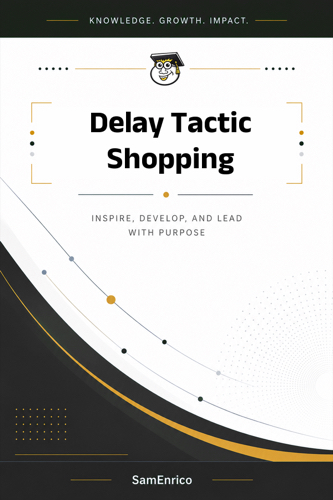
Non-FictionSelf-Help / Impulse Control
Delay Tactic Shopping eBook
Uses 24-hour and 30-day rules to reduce impulse bu
Uses 24-hour and 30-day rules to reduce impulse buys.
Formats
Free sample
Chapter 1: The Leaky Basket--Imagine waking up one morning, walking to your kitchen, and noticing a small hole in your water pipe. Water is dripping out—slowly, silently, steadily. You can’t see the puddle yet because the floor is absorbing it. But over a month, that drip becomes gallons. Over a year, it becomes a flood.
You wouldn’t ignore that pipe. You’d call a plumber immediately.Now consider this: The average American adult makes 12 impulse purchases per month. Not planned purchases. Not groceries or gas or rent. Spontaneous, unplanned, often regretted purchases.
The average total? Three hundred fourteen dollars per month. That’s $3,768 per year. Over a decade, that’s nearly $40,000—money that could have been a down payment on a house, a year of college tuition, or two years of early retirement.But here’s the problem: You don’t feel the leak. Unlike a dripping pipe, impulse spending doesn’t announce itself.
It hides in plain sight. It’s the $4 latte you didn’t plan. The $27 Amazon order at 11 PM because you were bored. The $80 sweater that looked good in the store lighting but now hangs in your closet with the tags still on. Each purchase is small enough to justify in the moment.
“It’s only twenty dollars.” “I deserve this.” “It’s on sale.” But those small justifications add up to a hole in your financial life—a hole you didn’t even know was there.This chapter is about seeing the leak for the first time. It is not yet about fixing it. It is about diagnosis. Because before you can change a behavior, you have to understand why it happens. And impulse spending, despite what you might believe, is not a moral failure.
It is not a sign of weakness, laziness, or lack of discipline. It is a neurological response to a carefully engineered environment. You are not broken. The system is designed to make you spend.Let me prove it to you.The Most Expensive Word in Retail Walk into any grocery store. What do you notice at the checkout line?
Candy, gum, magazines, small electronics, batteries, energy drinks. These items are not there by accident. They are called “impulse buy zones,” and retailers pay premium shelf space for them. The logic is simple: You are already standing there, wallet in hand, waiting to complete a transaction. Your brain is in “buying mode.” Adding one small item feels effortless.Now take that logic and multiply it by a thousand.
Online retailers have perfected the impulse buy zone to a science that would impress a neurosurgeon.Consider the phrase “Only 2 left in stock.” When you see those words, what do you feel? A slight tightness in your chest? A flicker of urgency? That is not a coincidence. That is a trigger designed to activate your brain’s scarcity response.
Evolutionary psychologists call this “loss aversion”—the human tendency to feel the pain of losing something more intensely than the pleasure of gaining something. When you see “Only 2 left,” your brain does not compute it as a neutral fact. It computes it as a potential loss. And loss aversion drives action.Or consider the countdown timer: “Sale ends in 3 hours, 14 minutes, 22 seconds.” This is the digital equivalent of a starting pistol. The ticking clock creates a sense of urgency that bypasses your logical brain.
Neuroscientists have found that time-limited offers activate the amygdala—the part of the brain responsible for fight-or-flight responses. Your body literally treats a sale ending as a mild threat. And when you are in threat mode, you don’t think. You act.Or consider free shipping thresholds. “You are $12 away from free shipping.” This is perhaps the most insidious trap of all.
You came to buy a $20 item. Now you are being offered a reward—free shipping—if you spend just a little more. The $12 item you add to your cart is rarely something you needed. It’s something you bought to avoid paying $6.99 for shipping. You spent $12 to save $7.
That is not rational. But it feels rational in the moment because your brain has been hijacked by what behavioral economists call “the anchoring effect.” The $12 purchase feels small compared to the $20 you already committed to spending.These are not bugs in the retail system. They are features. They are intentionally designed, rigorously tested, and constantly optimized to do one thing: get you to click “Buy Now” before you have time to think.The Neurochemistry of a Click To understand why these tactics work, you need to understand a small molecule called dopamine. Dopamine is often described as the “pleasure chemical,” but that is not quite accurate.
Dopamine is the anticipation chemical. It spikes not when you receive a reward, but right before you believe you are about to receive a reward.Let me give you an example. Imagine you are waiting for a package to arrive. You track it obsessively. You watch the delivery truck on the map.
You feel a flutter of excitement when the status changes to “Out for Delivery.” Then the doorbell rings. You open the box. And then… nothing. The excitement fades. The object is in your hands, but the feeling you were chasing is gone.
That is because dopamine did its job. It gave you the thrill of anticipation. Acquisition, by comparison, is almost boring.Retailers understand this better than psychologists. Every aspect of online shopping is designed to maximize the dopamine spike before the purchase. The “Add to Cart” button is bright and satisfying.
The animation of the item dropping into the cart is visually pleasing. The checkout process is streamlined to one click. The confirmation screen celebrates you. All of this is not about making the purchase easier. It is about making the anticipation more exciting.The problem is that dopamine is a finite resource.
Every spike is followed by a trough. And the trough feels bad. So what do you do? You seek another spike. You buy something else.
This is the dopamine loop: Trigger → Craving → Action → Reward → Trough → Repeat. It is the same loop that drives gambling addiction, social media scrolling, and substance use. Shopping, for many people, is not about acquiring objects. It is about chasing a feeling.And here is the cruel irony: The more you chase that feeling through spending, the harder it becomes to feel it. Over time, your dopamine receptors downregulate—they become less sensitive.
This means you need bigger, more frequent purchases to get the same hit. The $4 latte stops working. Now you need the $40 candle. Then the $400 handbag. This is called tolerance, and it is not limited to drugs and alcohol.
It happens with shopping, too.The Myth of Willpower Most people believe that impulse spending is a willpower problem. If you just tried harder, if you were more disciplined, if you had more self-control, you wouldn’t buy things you don’t need. This belief is not just wrong. It is harmful. Because it leads to shame.
And shame leads to more spending.Let me explain. Willpower is not a character trait. It is a finite cognitive resource that depletes with use. Psychologists call this “ego depletion.” In a famous study, researchers…
This is the end of the free sample. Get the eBook to keep going. Buy now
About this book
Details
- Author
- Knudson Dione
- Publisher
- SamEnrico
- Language
- English
- Genre
- Non-Fiction, Self-Help / Impulse Control
- Released
- 2026-06-07
- Pages (approx.)
- 135
- Available as
- eBook, Audiobook

Read better in the ZLOADR app
Your eBooks on your phone or tablet. Sign in with your SamEnrico account and start reading.
More by Knudson Dione
 Preventing Binge Relapse After Weight LossKnudson Dione$11.99
 Foot in Door PersuasionKnudson Dione$11.99
 Ayurvedic Hair Care GuideKnudson Dione$11.99
 Caregiving For Parent With ALSKnudson Dione$11.99
 The Private Estate WorkerKnudson Dione$11.99
 Panic In Older AdultsKnudson Dione$11.99
 Winter Survival PsychologyKnudson Dione$11.99
 The Lost Tapes of Billie Holiday: Unheard Stories from the Blue Note SessionsKnudson Dione$11.99
 Operation Thunderbolt: The Impossible Hostage Rescue of EntebbeKnudson Dione$11.99
 How to Produce Home Fragrance AccessoriesKnudson Dione$11.99
 How to Produce Television Parts and AccessoriesKnudson Dione$11.99
 A Collector's Handbook to the Ford Escort GtKnudson Dione$11.99
You may also like
 Hong Kong Handover 1997Dunn Johnnie$11.99
 Zumba For Postnatal Recovery CourseNeal Christian$11.99
 Zumba for BeginnersLadner Nikia$11.99
 YouTube Comment Mining GuideHumes Pandora$12.99
 Worry Box MeditationCarlin Rudy$11.99
 Workplace Stress MeditationNguyen Lynn$11.99
 Workplace Stress and Sleep RepairHawley Ivory$11.99
 Workplace Perfectionism CureDelaney Jeffry$11.99
 Workplace Injustice Anger GuideWallen Isabelle$11.99
 Work Addiction and Burnout LinkGreenwood Ester$11.99
 Women in Yoga and WellnessBeattie Galina$11.99
 Women in Stand Up ComedyChun Evangeline$11.99