
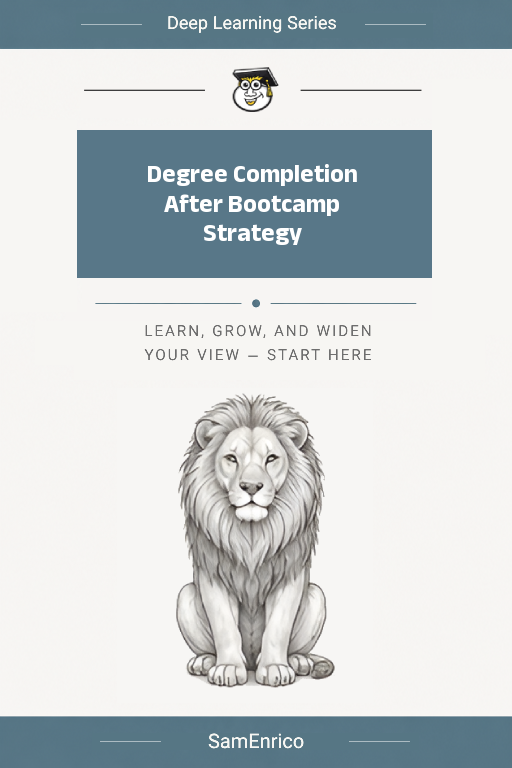
Non-FictionStudent's ShortcutCredit Transfer
Degree Completion After Bootcamp Strategy eBook
Plan a hybrid path where you attend bootcamp then
Plan a hybrid path where you attend bootcamp then transfer credits to finish an accelerated bachelors degree.
Formats
Free sample
Chapter 1: The Paper Ceiling--– In 2019, Maria graduated from a highly selective coding bootcamp. She had spent twelve weeks writing code for fourteen hours a day, surviving on instant coffee and the quiet desperation of someone who had bet her last 18,000onacareerpivot.Withinninetydays,shelandedajuniordeveloperroleatamid−sizedtechcompanyin Austin,Texas.Shewasgoodatherjob—betterthangood.Byhersecondyear,shewasunofficiallyleadingateamoffive.Shedebuggedtheirpullrequests,mentoredthenewhires,anddesignedthearchitectureforafeaturethatwouldeventuallygenerate18,000 on a career pivot. Within ninety days, she landed a junior developer role at a mid-sized tech company in Austin, Texas. She was good at her job—better than good. By her second year, she was unofficially leading a team of five.
She debugged their pull requests, mentored the new hires, and designed the architecture for a feature that would eventually generate 18,000onacareerpivot.Withinninetydays,shelandedajuniordeveloperroleatamid−sizedtechcompanyin Austin,Texas.Shewasgoodatherjob—betterthangood.Byhersecondyear,shewasunofficiallyleadingateamoffive.Shedebuggedtheirpullrequests,mentoredthenewhires,anddesignedthearchitectureforafeaturethatwouldeventuallygenerate2 million in annual revenue.When a promotion to engineering manager opened up, Maria applied. Her manager, a man named Todd who had a bachelor's degree in communications from a state school and who had not written a line of production code in seven years, encouraged her to apply. "You're ready," he said. A week later, HR rejected her application. The reason, delivered via a sterile automated email: "This position requires a bachelor's degree from an accredited institution.
Your application does not meet the minimum qualifications."Maria printed that email. She taped it to her refrigerator. She cried in her car during her lunch break. Not because she was sad—she was furious. She had the skills.
She had the results. She had the receipts. What she did not have was a piece of paper that a human resources algorithm considered valid. Todd, who could not code his way out of a paper bag, had that piece of paper. So he got the promotion.
Maria got an email.This book is for every Maria who has ever been told that their skills are not enough because they lack a credential. This book is for the bootcamp graduate who codes circles around their degreed colleagues but cannot get past the automated resume filter. This book is for the welder who has kept a factory running for fifteen years but cannot become the plant manager because someone in corporate decided that a bachelor's degree is the price of entry to the corner office. This book is for the salon owner who built a business from nothing but cannot secure a small business loan because the bank's underwriting algorithm assigns a higher credit score to a twenty-two-year-old with a fresh English degree and no revenue than to a thirty-year-old with a profitable business and no diploma.This book is for you.And here is the first truth you need to accept: you are not a failure. You are not lazy.
You did not make a mistake by choosing a bootcamp over a traditional university. You were an early adopter of a smarter system that was not yet complete. The bootcamp gave you the skills. This book will show you how to get the credential that unlocks the career those skills deserve.The $140,000 Question Let us start with a number: 140,000.Thatistheaveragetotalcostofafour−yearbachelor′sdegreeataprivateuniversitywhenyoufactorintuition,fees,room,board,books,andthesinglemostexpensivelineitemthatalmosteveryoneignores—opportunitycost.Opportunitycostisthemoneyyoucouldhaveearnedifyouhadbeenworkinginsteadofsittinginalecturehall.Forfouryears,assumingamodest140,000. That is the average total cost of a four-year bachelor's degree at a private university when you factor in tuition, fees, room, board, books, and the single most expensive line item that almost everyone ignores—opportunity cost.
Opportunity cost is the money you could have earned if you had been working instead of sitting in a lecture hall. For four years, assuming a modest 140,000.Thatistheaveragetotalcostofafour−yearbachelor′sdegreeataprivateuniversitywhenyoufactorintuition,fees,room,board,books,andthesinglemostexpensivelineitemthatalmosteveryoneignores—opportunitycost.Opportunitycostisthemoneyyoucouldhaveearnedifyouhadbeenworkinginsteadofsittinginalecturehall.Forfouryears,assumingamodest40,000 annual salary, that is 160,000inforegonewages.Combinedwithtuitionandfees,thetruecostofatraditionaldegreeoftenexceeds160,000 in foregone wages. Combined with tuition and fees, the true cost of a traditional degree often exceeds 160,000inforegonewages.Combinedwithtuitionandfees,thetruecostofatraditionaldegreeoftenexceeds200,000 for students who do not come from wealth.Now let us look at what you actually get for that money. A bachelor's degree is not a single thing. It is a bundle of six distinct products, wrapped together and sold as a package.
Understanding this bundle is the first step to unbundling it and reassembling it in a way that works for you.Product One: General Education. This is the first two years of most degrees: composition, history, math, science, social science. The stated purpose is to create a well-rounded citizen. The unstated purpose is to extract two years of tuition before allowing students to touch their major.Product Two: Major Coursework. This is the part that actually relates to your career.
For a computer science degree, this is data structures, algorithms, operating systems, software engineering. For a business degree, this is accounting, finance, marketing, management.Product Three: Employer Signaling. This is the most expensive and least discussed component. A degree signals to employers that you can show up on time, follow instructions, and complete moderately difficult tasks over a sustained period. It is a filtering mechanism, not an indicator of job readiness.
Studies have consistently shown weak correlation between college grades and job performance after the first two years of employment.Product Four: Networking. This is the alumni database, the career fair, the fraternity or sorority connections, the professor who knows an executive at a target company. For some students, this is worth the price of admission. For most, it is a marketing promise that never materializes.Product Five: Life Skills. Living away from home, managing a budget, navigating roommate conflicts, learning to cook something other than ramen—these are valuable.
They are also available for free or low cost outside the university system.Product Six: The Credential. This is the piece of paper. The laminated diploma that hangs on the wall. The line on your resume that HR algorithms are programmed to find. This product is nearly worthless in terms of actual knowledge—you could learn everything in a computer science curriculum for free using online resources—but it is the only product in the bundle that employers have collectively decided they cannot live without.A bootcamp unbundled this package.
It took product two (major coursework, stripped to its most employable essentials) and product three (employer signaling, but for skills rather than endurance) and sold them for $15,000 over twelve weeks. It left behind products one, four, five, and six. Products one and five you do not need—you already have life skills, and general education credits can be acquired cheaply or through prior learning assessment. Product four you can build yourself through professional networking. Product six—the credential—is the missing piece.Your bootcamp gave you the engine.
This book will help you build the chassis, the wheels, and the steering wheel. And then you will drive past everyone who told you that you could not.The Paper Ceiling The term "paper ceiling" was coined by the nonprofit organization Opportunity@Work to describe the artificial barrier created by degree requirements for jobs that do not actually need a degree to perform. The paper ceiling is the invisible force field that prevents skilled workers without degrees from accessing jobs they are fully qualified to do.The numbers are staggering. According to a 2022 analysis by the Burning Glass Institute, 62 percent of mid-level technology roles require a bachelor's degree even though only 24 percent…
This is the end of the free sample. Get the eBook to keep going. Buy now
About this book
Details
- Author
- Michaud Erlinda
- Publisher
- SamEnrico
- Language
- English
- Genre
- Non-Fiction, Student's Shortcut, Credit Transfer
- Released
- 2026-05-30
- Pages (approx.)
- 146
- Available as
- eBook, Audiobook

Read better in the ZLOADR app
Your eBooks on your phone or tablet. Sign in with your SamEnrico account and start reading.
More by Michaud Erlinda
 Postpartum Depression Exercise PrescriptionMichaud Erlinda$11.99
 Living Abroad Cost CalculatorMichaud Erlinda$11.99
 IBS Overlap Migraine GuideMichaud Erlinda$11.99
 Anger in First Responder LoveMichaud Erlinda$11.99
 Distraction Proof Sales ProspectingMichaud Erlinda$11.99
 Pelvic Floor for IBSMichaud Erlinda$11.99
 The Accountability ConversationMichaud Erlinda$11.99
 The Golden Child Dilemma WorkbookMichaud Erlinda$11.99
 Body Image For Csection ScarsMichaud Erlinda$11.99
 Ride the Iron Horse: The Untold Tale of the Pony Express’s Last StandMichaud Erlinda$11.99
 Gold, Swords, and Loyalty: The War That Bankrupted the SamuraiMichaud Erlinda$11.99
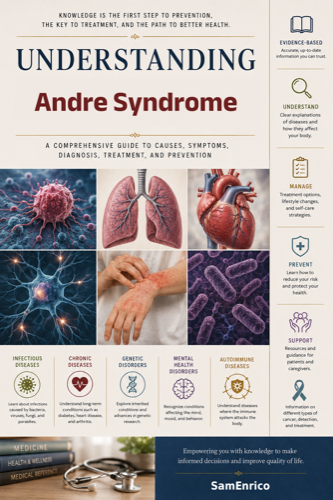 Understanding Andre SyndromeMichaud Erlinda$17.99
You may also like
 Hong Kong Handover 1997Dunn Johnnie$11.99
 Zumba For Postnatal Recovery CourseNeal Christian$11.99
 Zumba for BeginnersLadner Nikia$11.99
 YouTube Comment Mining GuideHumes Pandora$12.99
 Worry Box MeditationCarlin Rudy$11.99
 Workplace Stress MeditationNguyen Lynn$11.99
 Workplace Stress and Sleep RepairHawley Ivory$11.99
 Workplace Perfectionism CureDelaney Jeffry$11.99
 Workplace Injustice Anger GuideWallen Isabelle$11.99
 Work Addiction and Burnout LinkGreenwood Ester$11.99
 Women in Yoga and WellnessBeattie Galina$11.99
 Women in Stand Up ComedyChun Evangeline$11.99