
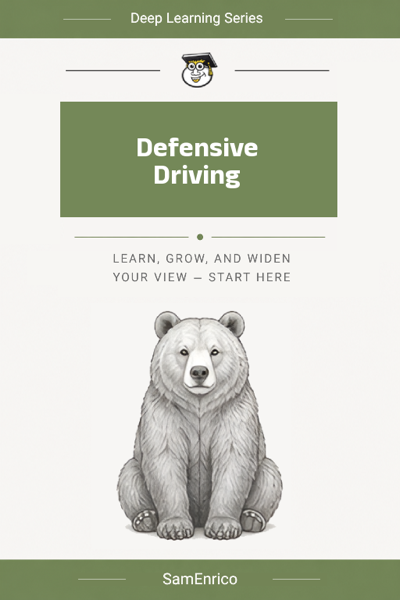
Defensive Driving eBook
A Coursebook on Defensive Driving
A Coursebook on Defensive Driving
Formats
Free sample
Chapter 1: The Illusion of Accident--–- The word "accident" has killed more people than alcohol, speed, and distracted driving combined. Not because the word itself is dangerous, but because what it represents—a belief that collisions are random, unavoidable, and beyond our control—has lulled millions of drivers into a passive, reactive posture behind the wheel. This chapter dismantles that illusion and replaces it with a new foundational philosophy: defensive driving is not about being scared of the road; it is about becoming aware of your own power to prevent crashes before they happen.Every time you hear someone say, "It was an accident," what they are really saying is, "There was nothing I could have done." That single sentence represents the most dangerous mindset a driver can possess. The truth, supported by decades of crash data and forensic analysis, is that the vast majority of collisions are entirely predictable and entirely preventable. They are not accidents in the sense of random, uncontrollable events—like a meteor striking your car or a sudden sinkhole opening beneath your tires.
They are crashes, and crashes have causes. More importantly, crashes have preventers.The goal of this book is to transform you from a reactive driver—someone who responds to danger only after it appears—into a proactive driver, someone who identifies and eliminates danger before it ever reaches your windshield. This transformation begins with a single shift in mindset: you must accept that you are not a passenger in your own driving fate. You are the pilot, the planner, and the primary safety system of your vehicle. The next time you hear someone blame an "accident," you will know the truth.
And that truth is the first step toward becoming a truly defensive driver.The Fatal Flaw in the Word "Accident"The English language is imprecise, and nowhere is that imprecision more dangerous than in how we describe vehicle collisions. The word "accident" derives from the Latin accidere, meaning "to happen" or "to fall out." It implies an event that occurs by chance, without apparent cause, and outside the realm of human responsibility. When a vase falls off a shelf during an earthquake, that is an accident. When a tree branch breaks and lands on a parked car during a storm, that is arguably an accident. But when a driver runs a red light because they were looking at their phone, that is not an accident.
When a driver follows too closely and rear-ends the car in front, that is not an accident. When a driver turns left across the path of an oncoming motorcycle and claims, "I didn't see him," that is not an accident.The National Safety Council (NSC) has been campaigning for decades to eliminate the word "accident" from official crash reporting, replacing it with the term "preventable crash." The reason is not linguistic pedantry—it is psychological. Words shape thoughts, and thoughts shape actions. When a crash is labeled an "accident," the driver subconsciously accepts that the event was beyond their control. When the same event is labeled a "preventable crash," the driver is forced to ask the question: What could I have done differently?Consider two identical scenarios.
Driver A runs a stop sign and collides with another vehicle. An investigator asks, "What happened?" Driver A says, "It was an accident." That driver will likely repeat the same behavior next week. Driver B runs the same stop sign and collides with another vehicle. An investigator asks, "What happened?" Driver B says, "I failed to stop at the sign because I was distracted by my GPS." That driver has already begun the process of change. The word "accident" absolves; the word "crash" investigates.Throughout this book, you will notice that we never refer to collisions as "accidents." We call them crashes, collisions, or preventable incidents.
This is not a stylistic choice—it is a philosophical position. Every time you read that word, you are being reminded that you have power. You are not a victim of fate. You are a decision-maker behind a two-ton machine.The Locus of Control: What You Actually Control Psychologists use a concept called locus of control to describe the degree to which individuals believe they have control over the events in their lives. People with an internal locus of control believe that their own actions, decisions, and efforts determine outcomes.
People with an external locus of control believe that outcomes are determined by outside forces—luck, fate, other people, or circumstances beyond their influence.Behind the wheel, locus of control is the single most important psychological factor separating safe drivers from dangerous ones. Drivers with an external locus of control say things like: "There was nothing I could do," "The other driver came out of nowhere," "The road was too slippery," "The sun was in my eyes," "The car ahead stopped too suddenly." Notice the pattern: every explanation places the cause outside the driver. Drivers with an internal locus of control say things like: "I was following too closely for the conditions," "I should have anticipated that someone might merge," "I was driving too fast for the wet road," "I should have adjusted my sun visor and slowed down," "I did not leave enough stopping distance."The difference is not merely rhetorical. Decades of research into driver behavior have demonstrated that drivers with an internal locus of control have significantly lower crash rates, take fewer risks, and are more likely to engage in defensive driving behaviors such as scanning ahead, maintaining following distance, and anticipating hazards. Conversely, drivers with an external locus of control are overrepresented in crash statistics, particularly in at-fault collisions.Let us be absolutely clear about what you actually control when you are behind the wheel.
You control:Your speed. Not the speed of traffic, not the speed limit, but the actual speed at which your vehicle travels. You can choose to slow down at any moment.Your following distance. You decide how much space to leave between your vehicle and the one ahead. No one can force you to tailgate.Your lane position.
You choose where to place your vehicle within your lane, and you choose when to change lanes.Your attention. You decide where your eyes go, what you think about, and whether you pick up your phone.Your vehicle's condition. You decide whether to check your tire pressure, replace worn wiper blades, and ensure your lights work.Your trip timing. You decide when to leave, whether to rush, and whether to build in extra time for unexpected delays.Your route. You decide which roads to take, and you can choose safer routes even if they take longer.Your emotional state.
You decide whether to engage with an aggressive driver or let them pass. You decide whether to drive when angry, exhausted, or emotionally distressed.What do you not control? You do not control the weather, the road conditions, the behavior of other drivers, the presence of deer or debris, or the mechanical state of other vehicles. Notice something important: the list of things you do not control is shorter than the list of things you do control. And every item on the "do not control" list can be…
This is the end of the free sample. Get the eBook to keep going. Buy now
About this book
Details
- Author
- Booker Deandre
- Publisher
- SamEnrico
- Language
- English
- Genre
- Non-Fiction, Informative, Educational
- Released
- 2026-06-02
- Pages (approx.)
- 154
- Available as
- eBook, Audiobook

Read better in the ZLOADR app
Your eBooks on your phone or tablet. Sign in with your SamEnrico account and start reading.
More by Booker Deandre
 Self Esteem Empty Nest GuideBooker Deandre$11.99
 Commute Energy ManagementBooker Deandre$11.99
 Last Mile Delivery Exception Management GuideBooker Deandre$11.99
 Stigma Reduction Campaign GuideBooker Deandre$11.99
 The Great Bitcoin Heist: How a Shadow War Sabotaged a Crypto EmpireBooker Deandre$11.99
 Nefertem's Golden Whisper: The Lotus Sorcerer of the NileBooker Deandre$11.99
 How to Start a Bridgelayer (tracked Military) Business (Beginners Guide)Booker Deandre$11.99
 Understanding Herrmann–opitz Arthrogryposis SyndromeBooker Deandre$17.99
 Five-Year Artificial Intelligence OutlookBooker Deandre$12.99
 Thundafund Africa Crowdfunding ManualBooker Deandre$12.99