
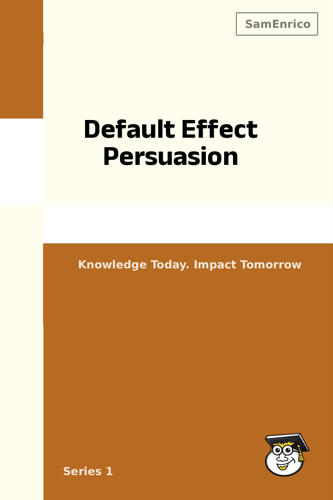
Default Effect Persuasion eBook
Leverage inertia by setting beneficial pre checked
Leverage inertia by setting beneficial pre checked choices.
Formats
Free sample
Chapter 1: The Invisible Architecture...--You have already made a decision today without realizing it. Perhaps you scrolled past a pre-selected shipping option, accepted a default privacy setting, or stayed with the recommended contribution to your retirement account. You did not choose these outcomes so much as you failed to reject them. That failure is not a character flaw. It is a feature of how your brain is wired.This book is about the most powerful, least understood force in modern persuasion: the default effect.
It is the reason a single pre-checked box can determine whether you become an organ donor, save for retirement, or accidentally subscribe to a service you did not want. It is why some companies grow effortlessly while others struggle to convert attention into action. And it is the tool that ethical choice architects use to help people make better decisions without taking away their freedom.But first, we must understand the puzzle that launched a thousand behavioral science studies.The Organ Donor Paradox Consider two neighboring European countries with shared histories, similar cultures, and comparable healthcare systems. In Germany, approximately 12 percent of citizens consent to organ donation. In Austria, approximately 99 percent consent.
The difference is not religion, education, or altruism. It is a single checkbox.Germany uses an opt-in system. To become an organ donor, you must actively check a box, sign a form, or carry a card. Austria uses an opt-out system. Every citizen is presumed to be a donor unless they actively decline.
The default—what happens if you do nothing—is entirely different. And human beings, it turns out, do nothing most of the time.This chapter opens with this famous paradox not because it is typical—as we will see in Chapter 3, it is actually an outlier—but because it reveals the hidden architecture that shapes our lives. The organ donor case is extreme. A 87-point swing from a simple change in default is unusual. Most defaults produce smaller but still meaningful effects.
Yet the lesson is universal: when the path of least resistance leads to a particular outcome, most people will follow it.What Is the Default Effect?The default effect is the tendency for individuals to stick with pre-selected options rather than actively choosing alternatives. It is not laziness, though laziness plays a role. It is not stupidity, though cognitive limitations contribute. It is a rational response to an overwhelming environment.Consider the average number of decisions a modern human makes each day. Estimates range from 35,000 to 50,000, depending on how you count micro-decisions.
Each one requires attention, evaluation, and energy. The brain consumes approximately 20 percent of your body's calories despite being only 2 percent of your mass. Deliberate decision-making is metabolically expensive. Sticking with a default is mental offloading.This is not a bug. It is an evolutionary feature.
Your ancestors did not have the luxury of analyzing every option. The ones who survived were those who could make quick judgments and move on. The default effect is the modern expression of that ancient wiring.But the default effect is more than conservation of energy. It is also a social signal. When an authority—a government, an employer, a trusted brand—pre-selects an option, we unconsciously infer that the option is recommended.
Why else would they have chosen it? This is especially powerful when we lack expertise. If you know nothing about retirement investing, and your employer pre-selects a 5 percent contribution rate into a target-date fund, you assume that is the appropriate choice for someone like you.The default effect also exploits loss aversion. Once a default is assigned—even arbitrarily—we treat it as something we already own. Opting out feels like a loss.
And losses hurt approximately twice as much as equivalent gains feel good. The question changes from "What do I gain by opting out?" to "What do I lose by leaving the default?" That framing shift is invisible but powerful.Finally, the default effect enables information avoidance. If the default seems good enough, we stop searching. We do not compare features, read fine print, or calculate trade-offs. The default becomes a cognitive off-ramp, relieving the anxiety of complex decisions.
This is why defaults are so effective in domains like health insurance, where comparing 40 plans would take hours. The default says: this one is fine. Stop here.The Pre-Checked Box The physical manifestation of the default effect is the pre-checked box. It is small, often inconspicuous, and almost always overlooked. Yet it may be the most powerful persuasive tool ever designed.A pre-checked box requires zero work.
Unchecking it requires at least one click, a moment of attention, and a willingness to deviate from the presented path. That tiny friction—measured in milliseconds and calories—is enough to keep most people in the default. Studies across dozens of domains show that adding just two seconds of friction reduces opt-out rates by 15 to 25 percent.Consider the humble email newsletter sign-up. When the box is unchecked (opt-in), conversion rates typically range from 5 to 15 percent. When the box is pre-checked (opt-out), rates jump to 50 to 80 percent.
The only difference is a single checkmark. The user has not become more interested in your content. They have simply failed to uncheck a box.This is not manipulation. It is architecture. Every interface has a default.
Every form has a path of least resistance. The question is not whether you will use a default but whether you will design it deliberately or leave it to chance. A blank form with no pre-selected options is itself a default—the default of no choice, which is often the worst choice for the user.Why "No Default" Is a Default One of the most common objections to default effect persuasion is the claim that you can avoid it by offering "no default." This is impossible. Abstention is a choice, and the outcome of abstention is a default.Imagine a retirement plan with an opt-in form. The form has no pre-selected options.
The user must actively choose a contribution rate and investment fund. If they do nothing—if they set the form aside, get distracted, or simply forget—what happens? Nothing. They are not enrolled. The default is non-participation.
That default was chosen by someone: the plan designer who decided that inaction should mean exclusion.Now imagine the same form with pre-selected options. The user must actively opt out. If they do nothing, they are enrolled. The default is participation. Both forms have defaults.
The only difference is which outcome is assigned to inaction.This insight is profound and often missed. You cannot avoid setting a default. You can only decide which default to set. The universe does not offer a neutral position. Every choice architecture has a bias.
The only question is whether that bias serves your users or exploits them.The Ethical Line Because defaults are unavoidable, the ethical question is not whether to use them but how. This book distinguishes between three categories of default design.First, beneficial defaults serve the user's long-term interests. They are the choices that users would thank you for later, even if they would not have actively chosen them in the moment. Automatic enrollment in retirement savings is a beneficial default. Most…
This is the end of the free sample. Get the eBook to keep going. Buy now
About this book
Details
- Author
- Franks Nichol
- Publisher
- SamEnrico
- Language
- English
- Genre
- Non-Fiction, Self-Help, Defaults
- Released
- 2026-06-06
- Pages (approx.)
- 129
- Available as
- eBook, Audiobook

Read better in the ZLOADR app
Your eBooks on your phone or tablet. Sign in with your SamEnrico account and start reading.
More by Franks Nichol
 Ayurvedic Stress ManagementFranks Nichol$11.99
 Bipolar Spending ManiaFranks Nichol$11.99
 Affirmations for Nurses GuideFranks Nichol$11.99
 The High Risk Situation MapFranks Nichol$11.99
 International Franchise Conference PlanningFranks Nichol$12.99
 Statins Explained GuideFranks Nichol$11.99
 Expedition Cooking GuideFranks Nichol$11.99
 Panic And VestibularFranks Nichol$11.99
 The All-Black Revolution: New Zealand's Fashion and Scientific TriumphFranks Nichol$11.99
 Kali’s Midnight Dance: The Goddess Who Devours TimeFranks Nichol$11.99
 How to Produce Home Game Console AccessoriesFranks Nichol$11.99
 A Collector's Handbook to the Ford Escort Rs MexicoFranks Nichol$11.99