
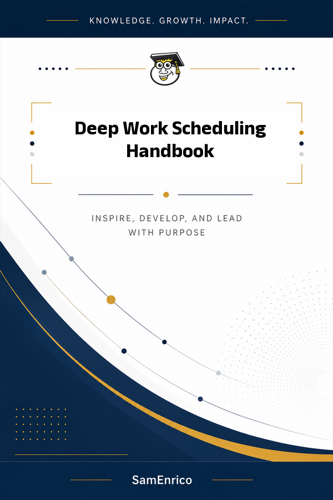
Deep Work Scheduling Handbook eBook
Protect uninterrupted blocks for cognitively deman
by Ruby Ngoc
Protect uninterrupted blocks for cognitively demanding tasks using strategic calendar placement.
Formats
Free sample
Chapter 1: The Busyness Trap--–- Maria checked her calendar at 7:32 AM on a Tuesday. It was already full. Four meetings, three “quick calls,” a lunch she didn’t want, and thirty-seven unread emails that had arrived since she left work at 6:15 PM the night before. She felt a familiar knot in her stomach—the one that said today will be exhausting, and by 5:00 PM, I will have accomplished nothing that actually matters.Maria is a senior marketing director at a mid-sized tech company. She is smart, ambitious, and exhausted.
Her calendar is a mosaic of color-coded blocks: blue for internal meetings, green for client calls, yellow for “focus time” that never actually happens because someone always schedules over it. At the end of every week, she looks back at the wreckage and asks the same question: Where did the time go?She is not lazy. She is not disorganized. She is trapped.Maria’s story is not unique. It is the story of millions of knowledge workers who have mistaken busyness for productivity.
They fill their days with reactive tasks—email, Slack, logistics, administrative debris—and call it work. Then they wonder why the truly important projects, the ones that require sustained concentration and creative output, never get done. The quarterly strategy document sits untouched. The innovative proposal remains a half-finished draft. The skill they need to learn keeps getting pushed to “next week.”This chapter dismantles the most dangerous myth in modern work: the belief that a full calendar equals a productive day.
We will expose the difference between shallow busyness and deep productivity. We will reveal why your brain automatically chooses easy, reactive tasks over hard, proactive ones—a phenomenon called the Principle of Least Resistance. And we will prove that your to-do list is not your friend; it is a trap designed to prioritize urgency over importance. By the end of this chapter, you will complete a simple five-minute audit that will show you, in black and white, exactly how many hours of deep work are available once you clear away the noise. For most readers, the number is shocking.
For some, it is devastating. But for everyone, it is the beginning of freedom.The Difference Between Motion and Action Before we can fix your calendar, we need to diagnose the problem. And the problem begins with a fundamental confusion that afflicts almost every knowledge worker: the inability to distinguish between motion and action.Motion is what feels like work but does not produce progress. Answering an email feels productive because you get to delete something. Moving a file from one folder to another feels productive because you see immediate results.
Attending a meeting feels productive because you are present and engaged. But motion is a lie. Motion keeps you busy without moving you closer to your most important goals. Motion is the treadwheel of the modern office.Action, by contrast, is work that produces meaningful output. Writing a proposal is action.
Solving a complex analytical problem is action. Designing a new system, coding a feature, synthesizing research into insights—these are actions. Action is cognitively demanding. Action requires focus. Action is uncomfortable because it involves staring at ambiguity and wrestling with it until clarity emerges.Here is the painful truth that most productivity books dance around: Motion is easy.
Action is hard. Your brain is wired to conserve energy. When faced with a choice between answering a simple email (motion) and drafting a difficult strategy document (action), your brain will choose the email every single time. Not because you are weak. Because you are human.This distinction is not academic.
It is the foundation of everything that follows in this book. If you cannot tell the difference between motion and action, you will spend your life busy and unfulfilled, wondering why everyone else seems to get the important work done while you drown in the trivial.Consider a typical workday. You arrive at your desk. You open your email. You respond to five messages.
You feel a small dopamine hit with each reply. Then you move to Slack. You answer a few questions. You feel helpful. Then you check your calendar and see a meeting in fifteen minutes.
You spend that time preparing—pulling up documents, reviewing notes, feeling responsible. The meeting happens. You speak. You listen. You contribute.
The meeting ends. You return to your inbox, which has filled up again in the meantime. You repeat the cycle. At 5:00 PM, you look back at the day and realize you never opened the document that matters most. You feel a vague sense of failure, but you cannot pinpoint why.
After all, you were busy all day. You worked hard. You earned your paycheck.You earned your paycheck. But you did not do your best work.This is the Busyness Trap. It is a trap because it feels productive while delivering nothing of value.
It is a trap because your colleagues are in it with you, so the collective delusion reinforces itself. It is a trap because your calendar, that seemingly innocent tool for organizing your time, has become the primary weapon the trap uses against you.The Principle of Least Resistance There is a concept in physics called the principle of least action: nature tends to follow the path of least resistance. Water flows downhill. Electricity follows the path of least resistance to ground. Human behavior is no different.
When given multiple paths to a goal, we instinctively choose the easiest one—even when that path leads away from what truly matters.In the context of knowledge work, the Principle of Least Resistance explains why your inbox has become the center of your professional life. Responding to email is easy. The task is clear (read message, type reply, click send), the feedback is immediate (the email leaves your inbox), and the cognitive load is low (you are reacting, not creating). Drafting a strategic plan, by contrast, is hard. The task is ambiguous (where do you even start?), the feedback is delayed (you won't know if it's good for days or weeks), and the cognitive load is high (you must hold multiple variables in your mind simultaneously).Your brain is not lazy in the moral sense.
It is efficient in the biological sense. The brain consumes about 20% of your body's energy despite being only 2% of your mass. Evolution has tuned it to conserve that energy whenever possible. When given a choice between an easy cognitive task and a hard one, the brain will nudge you toward the easy one. This is not a character flaw.
It is a survival mechanism.The problem is that the modern workplace has weaponized this mechanism. Every notification, every badge, every chime is designed to trigger a small dopamine release, training your brain to prefer the shallow, reactive, low-resistance path. Email clients show you unread counts because those counts exploit your brain's completion drive. Slack badges use red because red demands attention. Meeting invitations arrive with default one-hour durations because it is easier to accept than to question.
The entire infrastructure of knowledge work has been optimized for the path of least resistance.And you have been swimming in that current for years.The…
This is the end of the free sample. Get the eBook to keep going. Buy now
About this book
Details
- Author
- Ruby Ngoc
- Publisher
- SamEnrico
- Language
- English
- Genre
- Non-Fiction, Self-Help, Deep Work
- Released
- 2026-06-11
- Pages (approx.)
- 154
- Available as
- eBook, Audiobook

Read better in the ZLOADR app
Your eBooks on your phone or tablet. Sign in with your SamEnrico account and start reading.
More by Ruby Ngoc
 Single Parent Anger Management GuideRuby Ngoc$11.99
 Diversity Hiring Scaling GuideRuby Ngoc$11.99
 Whispers in the Ice: The Frozen Muse of the ArcticRuby Ngoc$11.99
 The Midnight Coup: The 1974 Impeachment That Almost Toppled a PresidentRuby Ngoc$11.99
 Understanding Hyperimmunoglobulin E Recurrent Infection SyndromeRuby Ngoc$17.99
 Field Office Deployment ManualRuby Ngoc$12.99
 Insurer Telehealth Outlook 2026Ruby Ngoc$12.99
 How to Start a Paste Made of Aluminium Business (Beginners Guide)Ruby Ngoc$11.99
 BlacksmithRuby Ngoc$11.99
You may also like
 Hong Kong Handover 1997Dunn Johnnie$11.99
 Zumba For Postnatal Recovery CourseNeal Christian$11.99
 Zumba for BeginnersLadner Nikia$11.99
 YouTube Comment Mining GuideHumes Pandora$12.99
 Worry Box MeditationCarlin Rudy$11.99
 Workplace Stress MeditationNguyen Lynn$11.99
 Workplace Stress and Sleep RepairHawley Ivory$11.99
 Workplace Perfectionism CureDelaney Jeffry$11.99
 Workplace Injustice Anger GuideWallen Isabelle$11.99
 Work Addiction and Burnout LinkGreenwood Ester$11.99
 Women in Yoga and WellnessBeattie Galina$11.99
 Women in Stand Up ComedyChun Evangeline$11.99