
Deep Work Scheduling Guide eBook
Block 90-minute focus sessions for strategic think
by Wang Hayley
Protects focused blocks for important tasks.
Formats
Free sample
Chapter 1: Diagnosing Your Baseline--–- It is Tuesday morning at 9:47 AM, and you have already checked your phone fourteen times.You do not remember picking it up the first three times. Or the fifth. By the seventh, you noticed your thumb hovering over the Instagram icon, but you tapped it anyway. By the twelfth, you told yourself you were “just checking email,” but then you spent eleven minutes reading a thread about a project that does not involve you. Now, at 9:47, you are trying to write a proposal.
The cursor has been blinking in the same spot for twenty-two minutes. Your brain feels like a browser with forty-seven tabs open. You are busy. You are exhausted. And you have produced nothing.This is not a failure of willpower.
It is a failure of alignment.You have been trying to work against your own biology. You have been scheduling your hardest tasks at 2:00 PM when your brain is begging for a nap. You have been forcing yourself to “power through” when your ultradian rhythm is in its trough. And you have been blaming yourself for lacking discipline when the real problem is that you have been fighting your own nervous system.This chapter ends that fight.You are going to discover exactly when your brain performs best. You are going to identify your Power Window—the 90-minute block each day when your energy peaks and your distraction bottoms out.
And you are going to learn why scheduling a single deep work block at the wrong time is worse than scheduling none at all.But first, you need to understand the hidden rhythm that runs your day.The Rhythm You Never Noticed Your body runs on cycles. You know this instinctively. You sleep in cycles of approximately 90 minutes—this is why waking up in the middle of a sleep cycle leaves you groggy while waking at the end leaves you refreshed. What most people do not know is that the same 90-minute rhythm governs your waking hours.It is called the ultradian rhythm. Discovered by sleep researcher Nathaniel Kleitman in the 1950s, this cycle regulates your alertness, energy, and cognitive performance throughout the day.
For approximately 90 minutes, your brain operates at high capacity. Your focus sharpens. Your working memory expands. Your ability to make connections between seemingly unrelated ideas increases. Then, for 15 to 20 minutes, your brain craves a break.
Your attention fragments. Your energy dips. Your mind wanders.This is not a design flaw. It is a feature.The ultradian rhythm evolved to allow humans to oscillate between intense focus (hunting, gathering, building, creating) and recovery (eating, resting, socializing, scanning the horizon for threats). You are not supposed to maintain peak cognitive performance for eight consecutive hours.
That is like expecting a sprinter to run a marathon at full speed.And yet, most knowledge workers try to do exactly that.They wake up, drink coffee, and immediately start checking email. They attend back-to-back meetings from 9:00 AM to noon. They eat lunch at their desks while responding to Slack messages. They spend the afternoon in a fog of shallow work, then wonder why they feel exhausted and unproductive. They schedule their most important work at 3:00 PM, when their brain is in its deepest trough, then blame themselves for lacking focus.The problem is not you.
The problem is your schedule.The Social Clock Versus Your Biological Clock Here is a question that will change how you think about your workday: If you had complete freedom to choose your working hours, when would you do your hardest thinking?Most people hesitate before answering. They have never considered the question. They have been waking up at 7:00 AM because their school started at 8:00 AM, and their job starts at 9:00 AM, and society has decided that mornings are for work and evenings are for rest. This is the social clock. It is arbitrary.
It has nothing to do with your biology.Your biological clock—your chronotype—is determined by genetics. It influences when your body releases melatonin (the sleep hormone) and cortisol (the alertness hormone). It determines whether you are a natural early riser, a night owl, or something in between.The social clock punishes night owls. It rewards morning larks. And it ignores the vast middle.Consider this: A 2019 study published in the journal Sleep found that night owls forced to wake early for work experienced chronic social jetlag—a condition where your biological clock and your social clock are permanently misaligned.
The consequences included higher rates of depression, lower job performance, and increased risk of metabolic disease. These people were not lazy. They were not undisciplined. They were simply working against their biology.The same principle applies to the 90-minute windows within your day, not just to your sleep schedule. You have a natural peak period—a time when your energy is highest and your distraction lowest.
If you schedule your deep work block at that time, you will feel like a genius. If you schedule it four hours later, you will feel like a fraud.The difference is not intelligence. The difference is timing.Your Seven-Day Diagnostic Before you can schedule your deep work blocks, you need data. You need to know exactly when your Power Window occurs. Guessing is not good enough.
Remembering is not accurate enough. You need a log.For the next seven days, you are going to track two things: your energy and your distraction. This is not optional. Every successful deep work practice begins with measurement. Peter Drucker, the father of modern management, wrote in The Effective Executive, “Effective executives do not start with their tasks.
They start with their time.” You cannot improve what you do not measure.Here is exactly how to run your seven-day diagnostic.Step One: Set Your Alarm Set a repeating alarm on your phone for every 60 minutes during your waking hours. Yes, every hour. Yes, it will be annoying. That is the point. The annoyance will keep you honest.When the alarm goes off, stop what you are doing.
Do not finish your sentence. Do not answer the email. Stop. Take three seconds to rate your energy and distraction on the log you have printed from the Appendix (Template A).Step Two: Rate Your Energy (1–10 Scale)Energy is your physical and mental fuel. On a scale of 1 to 10, ask yourself: How awake do I feel?
How clear is my thinking? How much would I like to lie down right now?1–3: You are exhausted. You could fall asleep standing up. Your thoughts are sludge. You are making mistakes on simple tasks.
Do not schedule deep work here.4–6: You are functional but not sharp. You can handle email, scheduling, and routine tasks. You cannot solve complex problems.7–8: You are alert and engaged. Your mind feels quick. You can sustain focus.
This is your deep work zone.9–10: You are hyper-focused. Time feels different. You lose yourself in tasks. This is flow territory—rare and powerful.Step Three: Rate Your Distraction (1–10 Scale)Distraction is the noise in your environment and your mind. On a scale of 1 to 10, ask yourself: How easy is it to focus right now?
How many times have I checked my phone in the last hour?1–3: You are in a distraction-free zone. No notifications.…
This is the end of the free sample. Get the eBook to keep going. Buy now
About this book
Details
- Author
- Wang Hayley
- Publisher
- SamEnrico
- Language
- English
- Genre
- Non-Fiction, Professional's Cheat Sheet, Deep Work, Self-Help, Focus
- Released
- 2026-06-01
- Pages (approx.)
- 149
- Available as
- eBook, Audiobook

Read better in the ZLOADR app
Your eBooks on your phone or tablet. Sign in with your SamEnrico account and start reading.
More by Wang Hayley
 BRCA Gene Mutation GuideWang Hayley$11.99
 The Pain Mindfulness GuideWang Hayley$11.99
 Meeting Facilitation ScriptsWang Hayley$11.99
 Pinterest VA Idea Pin ExplosionWang Hayley$11.99
 Data Leak Email Auto Reply TemplatesWang Hayley$11.99
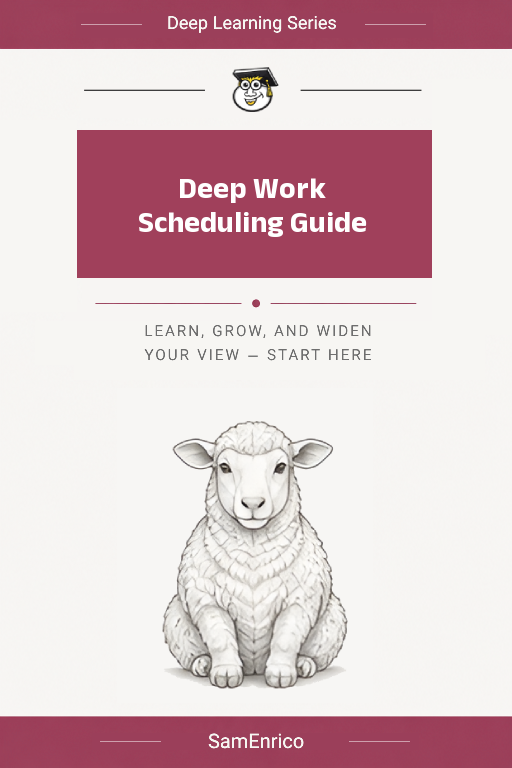 Deep Work Scheduling GuideWang Hayley$12.99
 The Harlem Renaissance: A Revolution in Ink and SoundWang Hayley$11.99
 The Frozen Compass: Ethics and Empire in the Arctic's First Scientific ExpeditionsWang Hayley$11.99
 Understanding Coeliac DiseaseWang Hayley$17.99
 Tappi YC Application TipsWang Hayley$12.99
 Blending OperatorWang Hayley$11.99
 How to Start a Hobby in Lincoln Douglas DebateWang Hayley$11.99