
Non-FictionBusiness BriefBurnout Recovery
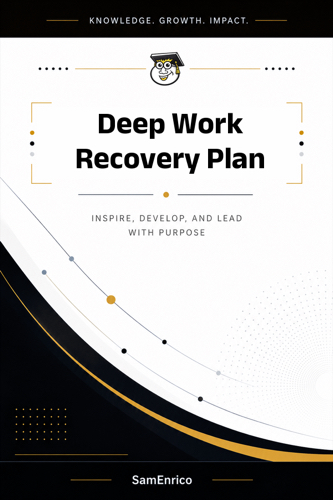
Deep Work Recovery Plan eBook
Teaches rebuilding focus ability after burnout or
Teaches rebuilding focus ability after burnout or long break.
Formats
Free sample
Chapter 1: The Broken Battery...--–- You have been lied to. The lie sounds like encouragement. It sounds like grit. It sounds like every motivational poster ever hung in a corporate hallway: “Push through.” “Hustle harder.” “Your comfort zone is where dreams go to die.” For months—maybe years—you believed this lie. You pushed.
You hustled. You left your comfort zone and took up permanent residence in the war zone of exhaustion. And now, when you sit down to work, something has changed. The page blurs. The cursor blinks at you like a dare you cannot answer.
You read the same sentence four times and still don’t know what it says. You close the laptop. You open your phone. Three hours disappear into the warm, numb glow of a screen that asks nothing of you. Then the shame arrives: Why can’t I just focus?
Everyone else is fine. What is wrong with me?The answer, which will reshape everything you believe about productivity, is this: Nothing is wrong with you. You are not lazy. You are not undisciplined. You are not broken beyond repair.
You are burned out. And burnout is not a motivation problem—it is a neurological injury. This entire book is built on that single distinction. You cannot push through an injury. You cannot hustle your way out of exhaustion.
You cannot willpower your way past a depleted nervous system. What you can do—what this book will teach you to do—is recover. Slowly, strategically, and without shame.The Great Confusion: Laziness vs. Burnout Let us begin with the distinction that changes everything. Laziness is a choice.
It feels like “I don’t want to do this, and I am fine with that.” Laziness is comfortable. It is the decision to watch television instead of working on a project, accompanied by zero guilt and zero physical distress. Burnout is not a choice. It feels like “I want to do this—I genuinely want to focus—but my body and brain will not cooperate.” Burnout is uncomfortable. It is the experience of sitting at your desk, desperate to work, while your brain supplies nothing but static.Most high-achievers have been trained to treat all resistance as laziness.
This is catastrophic because the treatments for laziness (more discipline, longer hours, stricter schedules) are the accelerants for burnout. When you treat burnout as laziness, you push harder. Pushing harder drains your already depleted battery. A drained battery triggers more shame. More shame triggers more pushing.
The cycle accelerates until you crash.Here is your first self-assessment. Read these two columns. Which one sounds like you?Laziness (a choice):You feel neutral or indifferent about the task You could do the task but choose not to No physical symptoms accompany the avoidance You feel fine doing something else The task gets done when the deadline creates pressure Burnout (a neurological condition):You feel distressed that you cannot do the task You genuinely try to start and fail repeatedly Physical symptoms accompany the attempt: fatigue, headache, shallow breathing, rapid heartbeat You feel guilty and ashamed while doing something else The deadline passes and the task remains undone, which deepens the shame If you recognize yourself in the second column, you are not lazy. You are injured. And injuries require different medicine.The Wall of Awful Every time you attempt a task that has caused you stress or failure in the past, your brain constructs a wall.
This concept comes from ADHD literature, but it applies powerfully to burnout. The Wall of Awful is made of every past disappointment, every shame spiral, every time you tried and failed. With each failure, you add another brick. With each brick, the wall grows taller.For a person without burnout, the wall might be a few feet high. Annoying, but climbable.
For a person in the depths of burnout, the wall is thirty feet high and topped with barbed wire. The wall is made of: the memory of last week when you stared at a blank screen for two hours, the shame of missing that deadline three months ago, the voice of your boss saying “we need this done,” the silent judgment of your colleagues who seem to manage just fine, your own internal critic chanting “see, you can’t even do this simple thing.”When you sit down to work, you are not just facing the task. You are facing the Wall of Awful. And burnout has made the wall so high that your brain has learned: don’t even try. That learning is not weakness.
It is a survival mechanism. Your brain is trying to protect you from the pain of climbing a wall you have never successfully climbed. The solution is not to climb harder. The solution is to dismantle the wall brick by brick. That is what this book does.Attention Residue and Cognitive Molasses Cal Newport’s concept of attention residue is essential here, but we must extend it for the burned-out brain.
Attention residue is what happens when you switch from Task A to Task B. Research shows that for up to twenty minutes after switching, a portion of your attention remains stuck on Task A. Your brain is still processing, still worrying, still half-engaged with what you left behind. For a healthy brain, attention residue is an annoyance—a few minutes of inefficiency. For a burned-out brain, attention residue becomes cognitive molasses.
It doesn’t just slow you down. It stops you entirely.Here is why. Burnout depletes your working memory capacity. Your brain has fewer cognitive resources available at baseline. When you switch tasks, the residue from the previous task consumes a larger percentage of your already limited resources.
The result: you try to start a new task, but your brain is still mentally processing the email you just read, the conversation you just had, the notification you just saw. There is no room left for the new task. So you stare at the screen. Nothing happens. You feel stuck.
You scroll your phone. The cycle continues.This is not a discipline problem. This is a capacity problem. You cannot will yourself to have more cognitive resources than you currently possess. You can, however, stop bleeding the resources you have.
This book will teach you to structure your day so that you switch tasks as rarely as possible. One task at a time. One email check per day. One priority per Focus Sprint. The less you switch, the less residue accumulates, and the more you can actually do.Willpower Is Not a Switch—It Is a Battery Perhaps the most damaging myth in productivity culture is the idea that willpower is a switch.
You flip it on. You get to work. You flip it off at the end of the day. This myth suggests that if you cannot focus, you simply haven’t flipped the switch hard enough. Try harder.
Push more. Grind.The truth, supported by decades of research including Roy Baumeister’s foundational work on ego depletion, is that willpower is a battery. It has a finite capacity. Every decision you make, every temptation you resist, every time you force yourself to do something…
This is the end of the free sample. Get the eBook to keep going. Buy now
About this book
Details
- Author
- Severson Darline
- Publisher
- SamEnrico
- Language
- English
- Genre
- Non-Fiction, Business Brief, Burnout Recovery
- Released
- 2026-06-05
- Pages (approx.)
- 142
- Available as
- eBook, Audiobook

Read better in the ZLOADR app
Your eBooks on your phone or tablet. Sign in with your SamEnrico account and start reading.
More by Severson Darline
 Morning Hypnosis ListeningSeverson Darline$11.99
 Accident Scene Reconstruction ManualSeverson Darline$11.99
 Grad Student Time BlockingSeverson Darline$11.99
 Founder Loan AccountingSeverson Darline$11.99
 Retail Talent Flow PatternsSeverson Darline$11.99
 Imposter For EntrepreneursSeverson Darline$11.99
 Administrative Task BlockingSeverson Darline$11.99
 The Magical Realism of Guillermo del Toro: A Director’s Vision Comes to LifeSeverson Darline$11.99
 The Drummer’s Resurrection: How a Broken Hand Sparked a Musical Revolution in 18th-Century AfricaSeverson Darline$11.99
 How to Produce Dowel Pins and RodsSeverson Darline$11.99
 Exploring Russian Art: Icons, Constructivism & SuprematismSeverson Darline$11.99
 Carob: Harvesting PodsSeverson Darline$11.99
You may also like
 Hong Kong Handover 1997Dunn Johnnie$11.99
 Zumba For Postnatal Recovery CourseNeal Christian$11.99
 Zumba for BeginnersLadner Nikia$11.99
 YouTube Comment Mining GuideHumes Pandora$12.99
 Worry Box MeditationCarlin Rudy$11.99
 Workplace Stress MeditationNguyen Lynn$11.99
 Workplace Stress and Sleep RepairHawley Ivory$11.99
 Workplace Perfectionism CureDelaney Jeffry$11.99
 Workplace Injustice Anger GuideWallen Isabelle$11.99
 Work Addiction and Burnout LinkGreenwood Ester$11.99
 Women in Yoga and WellnessBeattie Galina$11.99
 Women in Stand Up ComedyChun Evangeline$11.99