
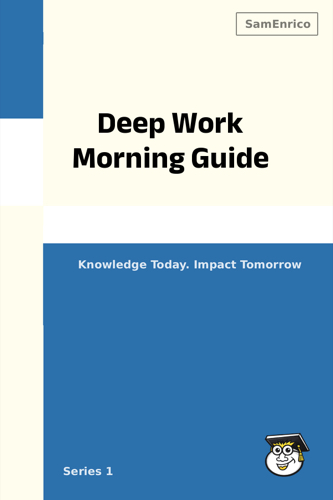
Deep Work Morning Guide eBook
Complete your most important task before 9 AM with
Complete your most important task before 9 AM with this practical focus workbook.
Formats
Free sample
Chapter 1: The 9 AM Lie--–- By the time you finish reading this sentence, you have already lost something you will never get back. Not time—you know about that. Something worse. You have lost a small piece of your cognitive surplus, the biological tailwind that nature gives you every single morning, and you have traded it for absolutely nothing of value.This is not a metaphor. It is a measurable, repeatable, and costly neurological fact.
The first three hours after you wake up represent the single most valuable window of your entire day. Within that window, your brain produces more focus, more willpower, and more creative problem-solving ability than it will produce in the next ten hours combined. And yet, most people arrive at 9 AM having already squandered the majority of that window on activities that could have been done at 4 PM with zero loss of quality.The result is a quiet epidemic of misplaced effort. Millions of professionals sit down at their desks every morning, open their laptops, and immediately begin reacting to emails, notifications, and messages that arrived while they slept. By the time they finally turn to their most important work—the work that actually moves their career, their business, or their life forward—their cognitive tank is already half empty.
They spend the rest of the day trying to do important work with the brain of someone who has already worked a full shift.This chapter exists to expose what I call the 9 AM Lie. The lie is simple, seductive, and everywhere: You can check your email "just for a second" and then get to your real work. The lie tells you that the first hour of your day is optional, that you can ease into things, that you deserve to see what happened overnight before you buckle down.The lie is wrong. And the data proving it wrong is so overwhelming that once you see it, you will never be able to unsee it.The Cognitive Surplus You Are Wasting Let us begin with the science, because the science is the only thing that will protect you when your willpower fails—and your willpower will fail, because willpower is not designed to fight biology.The human brain operates on a roughly 24-hour cycle called the circadian rhythm. Within that cycle, your cognitive performance is not flat.
It is a curve. It rises, peaks, and falls with predictable regularity. For approximately 85 percent of the population—everyone except true night owls, whom we will address in Chapter 2—cognitive performance peaks between 90 and 180 minutes after waking. This is your "cognitive surplus" window. During this window, your working memory capacity is roughly 30 percent higher than baseline.
Your ability to sustain attention without distraction is nearly double what it will be at 3 PM. Your creative problem-solving ability—measured by tasks requiring novel connections between seemingly unrelated concepts—is enhanced by approximately 40 percent.These numbers come from decades of research in chronobiology and cognitive psychology. They have been replicated in laboratory settings, in field studies with knowledge workers, and in longitudinal studies tracking professional output over years. They are not opinions. They are facts.Here is what most people do with this biological gift: nothing.
Or worse, they actively destroy it.A 2018 study of over 1,000 professionals found that the average worker checks email within the first seven minutes of starting their workday. The same study found that after checking email, it takes an average of 23 minutes and 15 seconds to return to a state of deep focus. But that "return" is never complete. The concept of attention residue, first identified by researcher Sophie Leroy, demonstrates that when you switch from Task A to Task B, a portion of your attention remains stuck on Task A. You cannot fully engage with your important work because your brain is still processing that slightly annoying email from your colleague or that notification about a project update.So when you check email at 8:05 AM, you are not just "taking a look." You are injecting attention residue into your most valuable cognitive window.
You are asking your brain to do two things at once: process the shallow work of email while attempting to engage in the deep work of creation, strategy, or problem-solving. Your brain cannot do this. It will try, and it will fail, and you will spend the rest of the morning feeling fuzzy, distracted, and vaguely frustrated.The 9 AM Deadline—the central promise of this book—is not an arbitrary target. It is a recognition of biological reality. Your cognitive surplus window typically ends somewhere between 9 AM and 11 AM, depending on your wake time and chronotype.
If you have not completed your single most important task by the end of that window, you will likely spend the rest of the day trying to do that task with a brain that is no longer optimized for it. You will take twice as long, produce lower quality, and feel more exhausted.This is not a productivity hack. It is a form of cognitive accounting. You have a limited number of high-quality cognitive hours each day. The science suggests that most people have between two and four such hours.
Everything else is maintenance. If you give those hours to shallow work, you are making a choice—usually an unconscious one—to do your most important work with a depleted brain.The Real Cost of "Just One Quick Check"Let me be more concrete. Imagine that your MIT—your Most Important Task for tomorrow—requires four hours of focused work to complete. If you do that work during your cognitive surplus window, it will likely take you the full four hours. The quality will be high.
You will make connections you would otherwise miss. You will finish feeling tired but satisfied.Now imagine you check email first. Just for fifteen minutes. You reply to a few messages, flag a few for later, and then turn to your MIT. How long will it take now?
Based on the research on attention residue, you will lose approximately 23 minutes of focus immediately after checking email. But that is only the direct cost. The indirect costs are larger. Because you started later, you are now pushing your deep work into the declining part of your cognitive curve. By hour three of your MIT, your brain is no longer at peak performance.
You are now doing the hardest part of the work—the part that requires the most creativity and problem-solving—with a brain that is already tired.The result is that your four-hour task now takes five hours. Or six. Or you do not finish it at all, and it spills into tomorrow, creating a rolling debt of unfinished work that follows you like a shadow.This is not an edge case. This is the daily reality for millions of professionals. They wake up, check their phones before they even get out of bed, and then wonder why they feel behind by 10 AM.
They are not behind because they have too much to do. They are behind because they spent their best hours on their worst tasks.One study of software engineers found that the developers who avoided email and Slack for the…
This is the end of the free sample. Get the eBook to keep going. Buy now
About this book
Details
- Author
- Sander Christin
- Publisher
- SamEnrico
- Language
- English
- Genre
- Non-Fiction, Self-Help, Deep Work
- Released
- 2026-06-06
- Pages (approx.)
- 137
- Available as
- eBook, Audiobook

Read better in the ZLOADR app
Your eBooks on your phone or tablet. Sign in with your SamEnrico account and start reading.
More by Sander Christin
 Third Party Logistics OutlookSander Christin$11.99
 Thistle Plant Based ComparisonSander Christin$11.99
 The Arthritis and Comorbidity GuideSander Christin$11.99
 The Battle Royale Gaming DisorderSander Christin$11.99
 Silent Shadows: The Double Life of Mata Hari’s InformantSander Christin$11.99
 Spinner (demonstration)Sander Christin$11.99
 B2B Sales Egypt Market GuideSander Christin$12.99
 Credit Union Business Loan RatesSander Christin$12.99
 Understanding SiderosisSander Christin$17.99
 How to Start a Dressing Gown Cord and Girdle Business (Beginners Guide)Sander Christin$11.99
You may also like
 Hong Kong Handover 1997Dunn Johnnie$11.99
 Zumba For Postnatal Recovery CourseNeal Christian$11.99
 Zumba for BeginnersLadner Nikia$11.99
 YouTube Comment Mining GuideHumes Pandora$12.99
 Worry Box MeditationCarlin Rudy$11.99
 Workplace Stress MeditationNguyen Lynn$11.99
 Workplace Stress and Sleep RepairHawley Ivory$11.99
 Workplace Perfectionism CureDelaney Jeffry$11.99
 Workplace Injustice Anger GuideWallen Isabelle$11.99
 Work Addiction and Burnout LinkGreenwood Ester$11.99
 Women in Yoga and WellnessBeattie Galina$11.99
 Women in Stand Up ComedyChun Evangeline$11.99