
Non-FictionBusiness BriefHabit Science
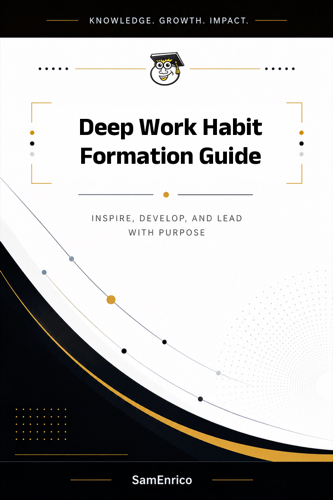
Deep Work Habit Formation Guide eBook
Build sustainable daily routines that train your b
Build sustainable daily routines that train your brain for intense concentration and creative output.
Formats
Free sample
Chapter 1: The Focus Budget--–- Every morning, you wake up with exactly one hundred cognitive coins. By noon, most people have already spent sixty of them on email, notifications, meeting transitions, and the gravitational pull of their phone. By the time they sit down to do work that actually matters, they are cognitively broke. They have nothing left to invest in deep thinking, creative output, or complex problem-solving. And then they blame themselves for lacking discipline.This chapter dismantles the myth that your failure to focus is a character flaw.
It is not. It is a budgeting problem. You have been spending your cognitive wealth on trivialities while believing that willpower alone could cover the deficit. The good news is that budgets can be redesigned. But first, you need to understand what you are actually spending and why the old advice—"just try harder"—has failed you.Let us begin with a story.
Sarah is a marketing director at a mid-sized tech company. She arrives at her desk at 8:45 AM, coffee in hand, feeling clear-headed and motivated. Before she opens her laptop, she checks her phone: three Slack messages, two emails, one Instagram notification. She replies to the Slack messages, scans the emails (doesn't reply, just reads), and clicks the Instagram notification out of habit. Total time: four minutes.
She then opens her laptop. A calendar reminder pops up for a 9:30 AM meeting. She spends the next fifteen minutes "preparing" by switching between three tabs: the meeting agenda, an unrelated report, and her email inbox. The meeting runs from 9:30 to 10:15. She returns to her desk, feeling slightly behind.
She opens her email again—eight new messages now. She replies to three, flags two for later, and deletes the rest. It is now 10:45 AM. She has not yet touched the quarterly strategy document that requires her full concentration. She opens it at 10:50 AM.
By 11:15 AM, she has written two sentences, checked her phone three times, and replied to two more Slack messages. At 11:30 AM, another meeting. By the end of the day, Sarah has worked nine hours, produced very little of value, and feels exhausted. She tells herself she lacks focus. She is wrong.
She lacks a Focus Budget.The Focus Budget is the central metaphor of this book, and it rests on a simple, neurologically grounded truth: the human brain has a finite amount of cognitive energy available for focused work each day. This energy is not infinite. It cannot be hacked, supplemented, or willed into expansion within a single day. It can only be allocated. Every decision you make—whether to check your phone, reply to an email, attend a meeting, or switch browser tabs—spends a portion of this budget.
Shallow tasks spend small amounts, often inefficiently. Deep tasks spend larger amounts but produce exponentially greater returns. The art of deep work is not the art of trying harder. It is the art of budgeting your cognitive coins so that you have enough left when it matters most.The Neuroscience of Why You Feel Broke by 11 AMTo understand the Focus Budget, you must understand the biology beneath it. The prefrontal cortex—the part of your brain responsible for concentration, decision-making, impulse control, and complex problem-solving—runs on glucose.
It is the most metabolically expensive region of the brain, consuming energy at roughly two to three times the rate of regions involved in automatic or resting states. When you engage in sustained focused work, your prefrontal cortex burns through glucose like a car accelerating up a steep hill. When you switch tasks frequently—even for a moment—you force your prefrontal cortex to continually reorient, reload context, and suppress competing impulses. Each switch spends glucose without producing meaningful output. This is not a metaphor.
It is measurable brain chemistry.Chronic task-switching has been shown in multiple f MRI studies to deplete glucose levels in the prefrontal cortex significantly faster than sustained focus on a single task. One study from the University of California, Irvine, found that it takes an average of twenty-three minutes to fully return to a task after an interruption. During those twenty-three minutes, your cognitive performance remains impaired. Your Focus Budget is bleeding out while you are not even aware of the wound.This explains why Sarah felt exhausted after nine hours of shallow work. She did not work hard.
She worked inefficiently. Her prefrontal cortex spent the same amount of glucose that a deep worker would spend in four hours, but it was spread across dozens of trivial tasks that produced little value. She was cognitively broke by 11 AM not because she lacked willpower but because she spent her budget unwisely.The second neurological reality is plasticity. Your brain rewires itself based on your repeated behaviors. When you spend your Focus Budget on shallow work—email, notifications, task-switching, social media—you strengthen the neural pathways associated with distraction and weaken the pathways associated with sustained attention.
This is the opposite of what you want. Every time you check your phone during a deep work session, you are not just spending a coin. You are building a highway for distraction. Over time, that highway becomes the default route. Deep thinking becomes harder not because you are getting older or lazier but because you have literally rewired your brain to prefer the shallow path.The good news is that plasticity works in both directions.
When you repeatedly protect your Focus Budget and spend it on deep work, you strengthen the neural pathways for concentration. The first few weeks are difficult because you are traveling against the grain of your existing wiring. But the brain adapts. This is the neurological foundation of the willpower hybrid model that underpins this entire book: willpower fatigues within a single session (you cannot force your way through cognitive depletion), but across weeks and months, you can increase your baseline capacity (your brain builds stronger focus pathways). Think of it like physical endurance.
You cannot run a marathon on your first day of training, and you cannot force yourself to run faster once your legs have given out. But with consistent training, your baseline endurance rises. The Focus Budget is not fixed for life. It is trainable over time, even if it is depletable in the moment.The Great Lie: Pseudo-Productivity Before you can fix your budget, you must recognize the primary way you are currently spending it without realizing it. This book calls it pseudo-productivity: visible activity that feels like work but produces little genuine output.
Pseudo-productivity is the drug that the modern workplace has addicted you to. It includes answering Slack messages, rearranging files, attending status update meetings, clearing your inbox, organizing your desktop, reading industry news, and any other activity that makes you look busy without requiring deep cognitive effort.Pseudo-productivity is seductive because it provides immediate feedback. When you clear an email, you see the inbox count drop. When you answer a Slack message, you get a dopamine hit of resolution. When you attend a meeting, you feel socially engaged.
These small rewards are neurologically cheap to produce but neurologically expensive to sustain because they keep your prefrontal cortex in a constant state of low-grade switching. You feel busy…
This is the end of the free sample. Get the eBook to keep going. Buy now
About this book
Details
- Author
- Blakely Roselle
- Publisher
- SamEnrico
- Language
- English
- Genre
- Non-Fiction, Business Brief, Habit Science
- Released
- 2026-06-09
- Pages (approx.)
- 131
- Available as
- eBook, Audiobook

Read better in the ZLOADR app
Your eBooks on your phone or tablet. Sign in with your SamEnrico account and start reading.
More by Blakely Roselle
 Mnemonics for Medical ExamsBlakely Roselle$11.99
 Kigali E learning Platform GuideBlakely Roselle$11.99
 Etsy Digital Planner Pricing StrategyBlakely Roselle$11.99
 Memory Loss Sleep DisordersBlakely Roselle$11.99
 The Vanishing of Flight 370: Decoding the Data That Was Never FoundBlakely Roselle$11.99
 The Silk Road of the Mind: Ibn Battuta's Anthropological OdysseyBlakely Roselle$11.99
 How to Start a Audio Visual Engineering Business (Beginners Guide)Blakely Roselle$11.99
 Global Recognition ProgramsBlakely Roselle$12.99
 Cooperative Innovation FundBlakely Roselle$12.99
 Ideation Session LeaderBlakely Roselle$11.99
 Understanding ChimerismBlakely Roselle$17.99
You may also like
 Hong Kong Handover 1997Dunn Johnnie$11.99
 Zumba For Postnatal Recovery CourseNeal Christian$11.99
 Zumba for BeginnersLadner Nikia$11.99
 YouTube Comment Mining GuideHumes Pandora$12.99
 Worry Box MeditationCarlin Rudy$11.99
 Workplace Stress MeditationNguyen Lynn$11.99
 Workplace Stress and Sleep RepairHawley Ivory$11.99
 Workplace Perfectionism CureDelaney Jeffry$11.99
 Workplace Injustice Anger GuideWallen Isabelle$11.99
 Work Addiction and Burnout LinkGreenwood Ester$11.99
 Women in Yoga and WellnessBeattie Galina$11.99
 Women in Stand Up ComedyChun Evangeline$11.99