
Non-FictionBusiness BriefWriting
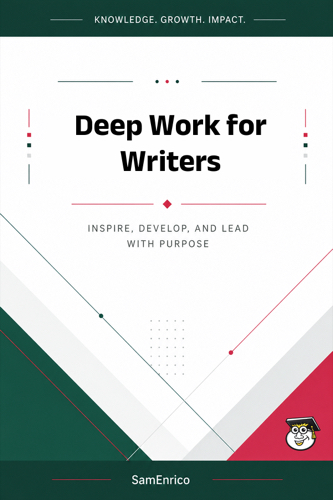
Deep Work for Writers eBook
Write in distraction free software like Scrivener
by Staley Hedy
Write in distraction free software like Scrivener or FocusWriter.
Formats
Free sample
Chapter 1: The Fragmented Mind...--–- The cursor blinks on a blank white screen. Your fingers hover over the keyboard. You have ninety minutes blocked off for writing, a rare and precious gift stolen from a week of meetings, errands, and obligations. This is it. This is the moment when the novel progresses, when the essay takes shape, when the words finally come.Your phone buzzes.You glance at it.
A news alert. Nothing important. You look back at the screen.Three sentences in, you remember you meant to order cat food. You open a new tab, click Amazon, complete the purchase. While you're there, you check the delivery status of a package from three days ago.
You close the tab. Where were you? Something about a man walking through a door. No, that was last week's scene. You scroll up, reread, reorient.Your email icon shows a red badge: seventeen unread messages.
You tell yourself you won't open it, but the badge pulls at your peripheral vision like a loose thread. You open it. Nothing urgent. You close it.Forty-seven minutes have passed. You have written one hundred and twelve words.
They are not good words. They are tentative, clunky, shaved of all confidence. You close the laptop and tell yourself you'll try again tomorrow.This is not a story about laziness. This is not a story about lack of talent. This is a story about fragmentation, and it is the story of nearly every writer alive today.The Great Fragmentation The modern writer lives in a state of perpetual cognitive whiplash.
We switch between applications, between tasks, between mental contexts so rapidly and so often that we no longer notice the switching at all. It has become background noise, like the hum of a refrigerator or the distant rush of traffic on a highway. We have adapted to distraction, which is not the same thing as overcoming it.This chapter is about making that noise audible again. Before you can write deeply, you must understand how deeply you are currently broken. And to understand that, you need a vocabulary for what is happening inside your skull every time you glance at your phone, check your email, or open a new browser tab while supposedly writing.Let me introduce you to a concept that will appear throughout this book: Attention Residue.The term comes from the research of Sophie Leroy, a business professor at the University of Washington.
In a now-famous study, Leroy asked participants to perform complex tasks under varying conditions. Some were allowed to complete one task before moving to the next. Others were interrupted and forced to switch before finishing. The results were striking: even when participants switched to a new task and focused on it exclusively, their performance suffered. Something lingered from the previous task—a residue of attention that occupied mental bandwidth without contributing to the work at hand.Leroy called this phenomenon attention residue.
It is the cognitive equivalent of a sticky film left behind on a counter after you wipe it with a dirty cloth. You think you have cleaned the surface, but the residue remains, invisible but active, contaminating everything that comes after.Here is what attention residue means for writers. You are drafting a scene in which two old friends have a tense conversation about a shared secret. The dialogue is delicate. Every word choice matters.
You are deep in the emotional architecture of the scene when your phone buzzes with a text from your partner asking what you want for dinner.You glance at the text. You do not even respond. You just read it, register the question, and put the phone down. The whole interruption takes three seconds.But those three seconds cost you far more than three seconds of time. When you return to the scene, a portion of your brain—perhaps five percent, perhaps fifteen percent—remains stuck on the question of dinner.
What do you want? Do you have groceries? Should you have responded? The residue lingers. And while that residue occupies your mental background, your prose suffers.
The dialogue becomes slightly more predictable. The subtext flattens. The sentences lose their rhythm.You will not notice this degradation in the moment. You will only notice, hours or days later, that the scene feels "off." You will revise it, cut it, rewrite it. And you will never know that the true enemy was a three-second glance at a text message.The Hidden Cost of Context Switching Attention residue is the mechanism.
But what drives it is something even more insidious: context switching.Every time you shift from one type of task to another, your brain must perform a series of invisible operations. It must disengage from the previous task's cognitive framework, suppress the associated memories and problem-solving strategies, activate the new task's framework, and orient itself to the new goals and constraints.This process is not instantaneous. It takes anywhere from a few seconds to several minutes, depending on the complexity of the tasks involved. And here is the cruel fact: the switch back is just as costly as the switch away. When you glance at your phone and then return to writing, you pay the switching cost twice—once to leave writing, once to return.Researchers in human-computer interaction have measured these costs with precision.
Gloria Mark, a professor at the University of California, Irvine, has spent decades studying attention in the workplace. Her findings are devastating for writers. Mark discovered that the average knowledge worker switches tasks every three minutes and five seconds. Once interrupted, it takes an average of twenty-three minutes to return to the original task with full focus.Twenty-three minutes. For a three-second interruption.Let me repeat that because it is the single most important number in this book.
A three-second glance at your phone costs you twenty-three minutes of cognitive recovery time. If you interrupt yourself six times during a two-hour writing session—a conservative estimate for most writers—you have effectively lost more than half of your session to recovery. You are not writing for two hours. You are writing for forty-seven minutes, interrupted, and spending seventy-three minutes spinning your cognitive wheels.This is the hidden math of fragmentation. It explains why you can sit at your desk for three hours and produce only three hundred words.
It explains why those three hundred words feel like they were written by a sleep-deprived substitute teacher rather than by you. It explains why you close your laptop at the end of the day feeling exhausted but unaccomplished—because you have done the work of context switching, which is metabolically expensive, without doing the work of writing, which is creatively rewarding.The Prose Degradation Curve We need a name for what happens to prose under conditions of fragmentation. Let me propose one: the Prose Degradation Curve.When you write in a state of continuous focus—what I will call Deep Writing throughout this book—your sentences build upon one another. The rhythm of your prose establishes itself. The voice of your narrator becomes consistent.
The logic of your argument coheres because your brain has been allowed to maintain a single, stable cognitive context for…
This is the end of the free sample. Get the eBook to keep going. Buy now
About this book
Details
- Author
- Staley Hedy
- Publisher
- SamEnrico
- Language
- English
- Genre
- Non-Fiction, Business Brief, Writing
- Released
- 2026-06-07
- Pages (approx.)
- 139
- Available as
- eBook, Audiobook

Read better in the ZLOADR app
Your eBooks on your phone or tablet. Sign in with your SamEnrico account and start reading.
More by Staley Hedy
 Scripting for Anger ManagementStaley Hedy$11.99
 Patti Smith Just Kids MemoirStaley Hedy$11.99
 Love Language MismatchStaley Hedy$11.99
 Meeting Silent Mute DefaultStaley Hedy$11.99
 Congressional Floor Speeches DecodedStaley Hedy$11.99
 Job Loss and Marriage GuideStaley Hedy$11.99
 Deep Work Tracker AppStaley Hedy$11.99
 The London Heist: The Armored Car Killer Who Stalked the NHSStaley Hedy$11.99
 The Iron Bridges of Coalbrookdale: How England Forged the Industrial AgeStaley Hedy$11.99
 Exploring Japanese Art: Ukiyo-e, Ink & LacquerStaley Hedy$11.99
 Aubergine: Eggplant HarvestingStaley Hedy$11.99
 How to Produce Poker Chip Carriers and TraysStaley Hedy$11.99
You may also like
 Hong Kong Handover 1997Dunn Johnnie$11.99
 Zumba For Postnatal Recovery CourseNeal Christian$11.99
 Zumba for BeginnersLadner Nikia$11.99
 YouTube Comment Mining GuideHumes Pandora$12.99
 Worry Box MeditationCarlin Rudy$11.99
 Workplace Stress MeditationNguyen Lynn$11.99
 Workplace Stress and Sleep RepairHawley Ivory$11.99
 Workplace Perfectionism CureDelaney Jeffry$11.99
 Workplace Injustice Anger GuideWallen Isabelle$11.99
 Work Addiction and Burnout LinkGreenwood Ester$11.99
 Women in Yoga and WellnessBeattie Galina$11.99
 Women in Stand Up ComedyChun Evangeline$11.99