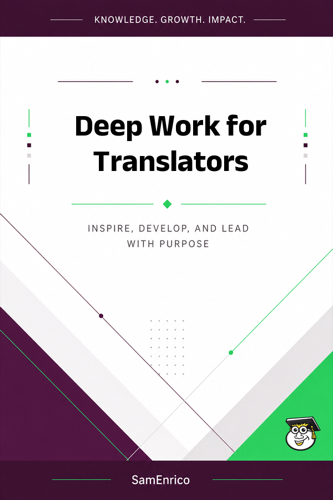
Deep Work for Translators eBook
Protect linguistic flow during document translatio
by Pak Sona
Protect linguistic flow during document translation from email and reference checks.
Formats
Free sample
Chapter 1: The Fifteen-Minute Lie--–- It begins, as it always does, with a single click. You are deep inside a sentence—a long, winding German construction that has carefully placed its verb at the very end, like a punchline waiting to land. You have been holding the subject in your working memory for twelve words now. The gender of the noun, the case of the adjective, the relationship between the main clause and the subordinate clause—all of it is balanced precariously in the fragile architecture of your short-term memory. Then your email icon lights up.
A new message. Just a glance, you tell yourself. Just a quick check. It will take two seconds.That two-second glance will cost you fifteen minutes. And this chapter will prove it.The Most Expensive Click in Translation Let me ask you a question that most translators never stop to consider: How long does it really take to recover from a single interruption?
Ask any working translator, and they will say something like "a few seconds" or "almost no time at all." Ask a project manager, and they will tell you that checking email while translating is just efficient multitasking. Both are wrong. The research on attention residue, pioneered by Cal Newport and built upon decades of cognitive science, tells a different story. When you switch from Task A to Task B, a portion of your cognitive resources remain stuck on Task A. You do not fully leave the first task behind.
You carry it with you like a shadow, and that shadow dims your performance on everything that follows.For most knowledge workers, this is an inconvenience. For translators, it is catastrophic.Why? Because translation is not typing. It is not word substitution. It is not even rewriting.
Translation is the continuous, real-time reconstruction of meaning across two linguistic systems while holding the voice, tone, register, and intent of an author in your head. You are not just converting words; you are inhabiting a mind. And that inhabitation is extraordinarily fragile.Consider the German sentence that haunts every translator who has ever dared to check their email mid-clause:Der Vertrag, den der Anwalt, der die Klage vorbereitet hatte, ohne die Zustimmung des Mandanten unterzeichnet hatte, war ungültig.By the time you reach the verb war, you have navigated three nested clauses. You have held the subject Der Vertrag in memory across twenty-three words. You have tracked the relationship between der Anwalt and der Mandant.
You have built a mental model of who did what to whom. Now imagine checking your email after reading Der Vertrag, den der Anwalt but before reaching unterzeichnet hatte. When you return, the subject's gender is gone. The case of the relative pronoun is a blur. You have to start over.
But you do not start over fresh. You start over with the residue of an email subject line competing for space in your working memory.That is the Fifteen-Minute Lie. You told yourself the interruption would take two seconds. It actually takes fifteen minutes—the time required to fully re-establish what this chapter calls the Flow Buffer.Defining the Flow Buffer The Flow Buffer is the period of uninterrupted cognitive immersion required to achieve full linguistic processing depth. For most translators, it ranges between ten and fifteen minutes.
During this time, you are not yet translating at your peak. You are warming up. You are re-establishing the syntactic and semantic frameworks that allow you to hold complex clauses in memory, track antecedents across long distances, and reproduce an author's voice rather than simply their words.Here is what happens inside the Flow Buffer, broken down by the clock:Minutes 0–3: Orientation. You re-read the last sentence you translated before the interruption. You notice that you have lost the thread.
The words are familiar, but the music is gone. You cannot yet hear the author's voice.Minutes 3–7: Reconstruction. You go back two or three sentences further. You begin to rebuild the logical chain. You notice that you had made a stylistic choice—perhaps using the passive voice in English to mirror the German original—and you had forgotten why.
You second-guess yourself. You waste time wondering if your earlier decision was correct.Minutes 7–10: Stabilization. The voice begins to return. You stop questioning your earlier choices. You start to feel the rhythm of the text again.
You are not yet at full speed, but you are no longer lost.Minutes 10–15: Re-entry. You are back. The translation flows. You have forgotten that you ever checked your email. But you have lost fifteen minutes of productive time, and you have spent cognitive energy on reconstruction that should have been spent on creation.The cruel irony is that the Flow Buffer exists whether you acknowledge it or not.
Every interruption forces you to pay its cost. The only question is whether you will continue to pretend that cost does not exist.Why Email Is Worse Than Any Other Interruption Not all interruptions are created equal. A colleague tapping you on the shoulder, a phone call, a Slack notification—these are all damaging. But email is uniquely destructive to linguistic flow for three specific reasons.First, email arrives with a promise of urgency that is almost always false. When the notification appears, your brain releases a small burst of dopamine.
You anticipate something important: a client question, a new project, a clarification. But the vast majority of emails during a translation project are not urgent. They are status checks, glossary bombs, or the dreaded "Just following up." The notification hijacks your attention for a reward that does not exist.Second, email requires a different cognitive mode than translation. Translation is synthetic and associative. You are building meaning from fragments, holding possibilities open, tolerating ambiguity while you wait for a sentence to resolve itself.
Email is analytic and reductive. You read, you categorize, you decide, you archive or reply. The mental posture required for each is almost opposite. Switching between them is not just a matter of context; it is a matter of cognitive posture.Third, email creates open loops that continue to drain attention even after you close the window. You read a client's message asking for a terminology preference.
You do not have an answer yet. You tell yourself you will think about it later. But your brain does not stop thinking about it. That unresolved question—Should I use agreement or contract? Did they mean the legal sense or the commercial sense?—becomes an open loop that consumes background processing power for hours.This third factor is the most insidious.
You do not need to be actively reading email to be damaged by it. You only need to have opened it once.The German Subordinate Clause Demonstration Let me make this concrete with an experiment you can try yourself. I want you to translate the following sentence. Do not look up any words. Do not check anything.
Just translate it as best you can from memory:Die von der Kommission vorgeschlagenen Maßnahmen, die nach umfangreichen Konsultationen mit den Mitgliedstaaten und nach gründlicher Prüfung der wirtschaftlichen Auswirkungen auf die betroffenen Sektoren erheblich geändert worden waren, wurden schließlich vom Parlament abgelehnt.Take as long as you…
This is the end of the free sample. Get the eBook to keep going. Buy now
About this book
Details
- Author
- Pak Sona
- Publisher
- SamEnrico
- Language
- English
- Genre
- Non-Fiction, Business Brief, Translation
- Released
- 2026-06-12
- Pages (approx.)
- 143
- Available as
- eBook, Audiobook

Read better in the ZLOADR app
Your eBooks on your phone or tablet. Sign in with your SamEnrico account and start reading.
More by Pak Sona
 Three Year Strategic Plan GuidePak Sona$11.99
 Delegation Matrix MethodPak Sona$11.99
 Men's Erectile Dysfunction Heart WarningPak Sona$11.99
 The Shadow Vice Presidency: How Walter Mondale Redefined the RolePak Sona$11.99
 The Silk Road’s Shadow: Opium, Empires, and the Birth of Global Power PlaysPak Sona$11.99
 Understanding Chromosome 10, Uniparental Disomy OfPak Sona$17.99
 Solar EngineerPak Sona$11.99
 How to Start a Hobby in TaekwondoPak Sona$11.99
 Gaming Retention PlaybookPak Sona$12.99
 Vendor Financial Health CheckPak Sona$12.99